
"In Mexico, 76% of new university students are women."
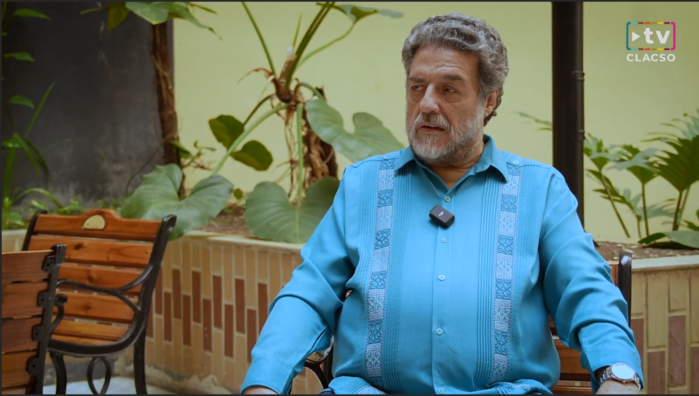
In the context of the XIV International Congress of Higher Education "University 2024" in Havana, Cuba, and the Forum "Higher Education and Social Transformation", organized by CLACSO on February 6, he spoke with CLACSO.tv Luciano Concheiro BórquezUndersecretary of Higher Education of Mexico
– What are the major current challenges for higher education in Latin America and the Caribbean in the face of a very strong power struggle?
– In Mexico, we share the need for inclusion, which perhaps isn't the problem in Argentina. Today, more than 50% of young people in our country are still outside of higher education. Even with all the progress we've made in integrating recent high school graduates.
Neoliberalism advanced through a process of commodification that took on perverse forms throughout our Latin America, as José Martí described it. Essentially, this manifested in the commodification of education, placing the issue of educational quality at the center, and revising curricula and programs to standardize them.
We have other core problems that have required strong confrontation. For example, there is a process of exclusion related to gender, but also in matters concerning Indigenous and Afro-descendant communities. We have regressed in terms of the possibility of including cultural diversity, a perspective that would allow for a comprehensive view.
For Mexico, one of its defining characteristics revolves around the disconnect between higher education and society, with its problems and needs. Even the connection with industry and agriculture was lost; these sectors ceased to be of interest. Life centered around awards and incentives ended up replacing the significant development of higher education's potential. In 1918, Córdoba, Argentina, showed us that autonomy and the struggle for a university were linked to connection and social commitment. These principles had been completely lost in Mexico.
– Within this very particular context, there was much discussion about open science and the importance of science in the logic of transformation. What is the importance for Mexico of considering issues related not only to open access but also to evaluation methods?
– Let's get back to the heart of the matter: for us in Mexico, it meant changing the Constitution, specifically Article Three, to enshrine the idea of the human right to education, but also to science. The central issue was how science and technology were functioning.
As someone who works in government, science, technology, and education, I think what's astonishing is simply the disconnect between the research titles and social problems. So, to address this, an "H" for Humanities was added to the National Council of Humanities, Science, and Technology. This "H" not only emphasized the importance of this perspective but also the significance of the humanistic connection, the ethics of scientific and technological development, and its direction.
The entire postgraduate evaluation system was completely overhauled. In this regard, the National Council delegated the entire postgraduate evaluation system to higher education institutions in order to reconnect research with teaching and outreach. For us, this is essential, because if it were implemented with the power that CONICET or CONACYT might wield, it would separate the two spheres: the one that links generative research with formative research. This research conference seeks to address the problems that afflict our societies.
– This topic seems central. It gives the impression that in some circles around the world, a science is being discussed that doesn't transform the communities it studies…
– Exactly. We found ourselves with the major soft drink companies conducting research in a country where investment by large corporations in research is almost nonexistent, where all the money is public and used for large transnational corporations in Mexico. In other words, we were transferring money (with public resources) to this process of transnationalization.
– In that context, we talk about evaluation on the one hand, research that is appropriate to the societies in which they are found, but what about the publication process? Because publication also has a complex logic of commodification that has led to a privatization of that subsequent knowledge.
– Absolutely. And it's linked to meritocracy. The problem was building a group of researchers who were going to be rewarded through publications. What was the point? None. There's an excess (it's confirmed) of publications on everything. Repetitive ones, that is, academic fiction ended up playing a very important role, publishing for the sake of publishing. You publish an academic paper abroad that has no impact in the country, but since it was published in "x" or "y" journal in the United States, that's enough. That gave you recognition, and it didn't matter if anyone read it in Mexico or if it had any effect. So, we went and established a series of research lines agreed upon at the national level in discussion with the Higher Education institutions themselves, but above all in connection with the major national problems. And the relationship we have in terms of science and technology was modified.
– We are talking about much more than that in terms of laws, regulations, and agreements, but it is a cultural transformation, as it has a different depth.
– Absolutely. We can measure it in various ways. Speaking with CLACSO, I appreciate that they address the issue of gender. In Mexico, first there was a constitutional amendment, then we moved on to the first General Law of Higher Education to outline not only what should be, but also what should be done. So, building around elements related to a worldview led to a significant increase in the number of students—700 new students so far during this administration. But the key statistic of this cultural shift is that 76% are women. It was a game-changer for the country. Now there isn't a single state that doesn't have more women, both students and faculty. So, this shift, coupled with a powerful campaign against violence, in addition to directly confronting harassment and all the conditions that lead to a life of insecurity, has led us to a real cultural change. When we arrived at the most important association of universities, there were only three women. We're talking about hundreds and hundreds of gray men (in suits, of course). We now have 43% of all our higher education institutions led by female rectors and directors general. It's a major cultural transformation.
– In that sense, there are domino effects stemming from some very central measures. I'm thinking about the subsequent caregiving responsibilities so that these women can study, and there are a number of issues that need to be considered when implementing a significant measure, right?
– That's right. Besides asking ourselves if it's enough to provide good entry conditions, we also give scholarships to women, who have had to be more numerous than men.
But we went further. We began with a policy of interculturality, which is another of our major cultural traits and shifts. This policy revolves not around accepting and viewing difference from a perspective of otherness, but rather from a perspective of alterity and shared understanding. Interculturality is for everyone, or it is not intercultural at all.
The other thing is multiculturalism, which is the new discourse of the central ideological construction of the right wing worldwide. This vision has been advancing in Europe in proto-fascist terms regarding culture and other cultures, saying: “I accept you,” but in your neighborhood, in North Africa, or somewhere else. So, there's a shift there.
– We were speaking with René Ramírez, a former Ecuadorian government official in higher education, who referred to a new study regarding the number of students who study at public universities in Latin America, but who, when it comes time to vote, opt for right-wing proposals that would make these universities tuition-based, closed, and restricted to certain sectors. How do you explain this situation?
– In Mexico, fortunately, this isn't happening to us. But there is a group within the teaching profession. This aspirational caste has created an image that you'll eventually achieve those better conditions. But when you manage to increase the number of students from the lowest income bracket by 36% in five years, we don't see those results (of right-wing votes).
Today, we're talking about a process of territorializing politics that accompanies a process of territorializing the university. The disconnect between territories and territory understood as the construction of power, self-management, and social participation has allowed us to operate in a different way. I'm very pleased that this process, which didn't intend to impose itself, has managed to open up significant avenues. Faced with a conservative state, we opened an intercultural university for equality, also envisioning a university focused on gender. When you enter the institution, the design is beautiful; it has a childcare area for children within the university, but there's also another area for elderly parents, because women, in this matter of caregiving, often end up caring for the elderly at home.
This university is located in the state of Aguascalientes, which has a female governor. We've spoken with her extensively. Initially, she told us, "I want a university for women," but in a state like Aguascalientes, we had the honesty to tell her that people might mistakenly believe our proposal was simply to teach women how to cook better, wash clothes, and iron, given all the prejudices surrounding it. So, as we progressed in our dialogue about interculturality and equality, the governor loved the idea, and we ended up developing a completely different approach.
Just like the Afro-university. In Mexico, we have a university called the Afro-university on the Costa Chica of Oaxaca. This whole issue shook the region because Black identity is one of the most invisible. We are transforming what rejects us into an element of identity and a way to confront racism.
– Based on what we're seeing on the future political map, everything points to a possibility of continuity of political ideas. How do we project future logic, considering that if these policies don't continue, it's very difficult for them to gain deep cultural roots?
– In principle, I would say that we need to think about education and health, to think about a state policy. Government policies in education that are exhausted within a single term of government, frankly, have no long-term vision whatsoever.
In contrast, having a law derived from Article Three of the Mexican Constitution has a much stronger foundation, since repealing it requires a two-thirds vote. We must give considerable weight to a truly alternative project, since much of its strength lies in addressing government policy, but in terms of education, we are inevitably talking about state policy.
If you would like to receive more information about CLACSO's training programs:
[widget id=”custom_html-57″]
to our email lists.

