
"What's at stake in Argentina's upcoming elections is democracy or the lack thereof."
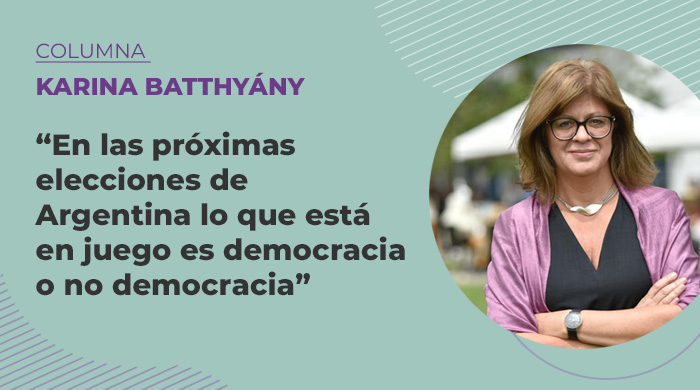
Transcript of Karina Batthyány's column
in InfoCLACSO – November 15, 2023
The seminar held in Madrid, Spain, focused on two key themes: inequality and democracy in Latin America and Europe. Its main objective was to critically analyze the relationship between inequality and democracy in both regions, examining the various dimensions of inequality and how these issues intersect and intersect in the current reality.
Of course, we discussed the relationship between inequality and economic development, but also the role of welfare systems in reducing inequalities, the impact of globalization and information technologies on inequality, as well as racial, ethnic, territorial, gender, and intergenerational dimensions. All of this was analyzed from an intersectional perspective.
With our colleagues from Latin America, we shared a description of the current reality of inequality in our region, but then focused on what can be done, what measures or alternatives are emerging to try to overcome this structural inequality. Moreover, in recent years, after a slight improvement, the situation has only worsened due to the pandemic.
To work on this idea of reducing inequality, it is necessary to consider long-term measures that address the structural causes of inequality. It has become clear that superficial fixes will not solve this problem. Therefore, we have been analyzing how to promote economic growth (which must be inclusive), how to strengthen social protection systems, how to guarantee access to education, health, and other basic human rights, how to promote equal opportunities, and how to work on new rights, particularly the right to care.
We also need to work on tax reforms that truly address inclusive economic growth and development, allowing us to increase tax revenue and, above all, redistribute income from these tax systems more equitably. Furthermore, we must prioritize the discussion on investment, for example, in health, which is absolutely fundamental for the development of those of us who live in these regions. And we must promote gender equality, also from an ethnic and racial perspective, and develop the necessary infrastructure to reduce inequalities within regions and across countries, for example, between urban and rural areas.
In the face of this idea of inequality as a historical and structural characteristic of our Latin American societies, it is necessary to show how it is not simply an element that has already been integrated into reflection, but that it is directly affecting the exercise of people's rights, that is, all political, social, economic and cultural rights.
And this also relates to the notions of citizenship and democracy; that is, trying to consolidate democratic systems on the basis of deeply inequitable and unequal social systems seems to be a contradiction.
In turn, the need to work not only on the analysis of the economic dimensions, but also on the cultural and political order where the fissures or "cracks" (as they are said in Argentina) have appeared from a cultural and political point of view was strongly raised.
And finally, we discussed the importance of placing this relationship between inequality and democracy at the center, understanding that the two need each other and that we cannot take inequality as just another characteristic of our societies, but rather we must consider it as a possible threat to democracy.
In turn, democracy must be analyzed as a tool for consolidation and overcoming inequalities. The need for social movements to play an active role and be strengthened was strongly emphasized; that is, the exercise of citizen oversight that allows progress on these issues. What issues? Ultimately, the reduction of economic and social inequality, the strengthening of democratic institutions, and the fight against mechanisms that are undermining democracy and exacerbating inequalities.
In Latin America we have excellent examples of the role of social movements in addressing inequalities, environmental movements, human rights movements, memory and democracy, and of course feminist movements.
I must mention that we discussed the importance of new social contracts and pacts—that is, the new foundations upon which we organize ourselves socially—where gender equality emerged as a central theme. One of the critical issues currently hindering this equality is the matter of caregiving, this idea that women should be almost exclusively responsible for it, and the need to reformulate and understand that caregiving is a right for everyone, and that it is not only women who have to take on this responsibility.
– In that context, I was thinking how interesting the dialogue between Latin America and the Caribbean with Europe is, moving away from colonial logic…
The dialogue between Latin America and the Caribbean with Europe is about moving beyond those old paradigms and striving to work, collaborate, and cooperate between the two regions. Because, moreover, both regions need each other right now. Often, we believe that some problems are exclusively Latin American or exclusively European. But when we begin to analyze these issues more closely, we find that they are actually problems affecting both regions. Therefore, possible solutions may also involve better coordination and cooperation between Europe and Latin America, based on new foundations and new agreements—not social agreements, but agreements focused on joint work that have nothing to do with the colonialist traditions so often repeated in the past.
There is a commitment to continue developing an agenda focused on inequalities and democracies between Europe and Latin America. For CLACSO, these issues are a priority within the framework of the Platforms for Social Dialogue (PDS). These platforms are not only regional in scope but also seek to encompass other regions in the need for social dialogue.
Finally, we must mention that when we talk about democracy, we do indeed face a very significant challenge in our region. This is particularly true regarding the outcome of the elections this Sunday, November 19th, in Argentina, where a democratic model is being contested against a profoundly anti-democratic one. At CLACSO, we will be closely monitoring the situation in Argentina, as we have done in other Latin American countries. The emblematic case is the 2022 runoff election in Brazil between Lula da Silva and Jair Bolsonaro. We hope that the result confirms Argentina's commitment to continuing along the path of deepening democracy and not jeopardizing such fundamental elements of our daily lives, both there and at the regional level.
– What other issues are at stake in this runoff election in Argentina 2023?
What's at risk are the foundations of democracy. I'm referring to the most basic rights of everyone, like education and healthcare. Security and social protection in general are being called into question. Furthermore, there's an attempt to push the market's dominance to the extreme in all decisions, from the smallest aspects of daily life to those most crucial to the reality of a country with issues we thought we had overcome, not only in Argentina but throughout the region, but which we are unfortunately seeing again. Ultimately, what's at stake is democracy itself.
If you would like to receive more information about CLACSO's training programs:
[widget id=”custom_html-57″]
to our email lists.

