
In the Colombian elections, two antagonistic visions for the country are facing off.
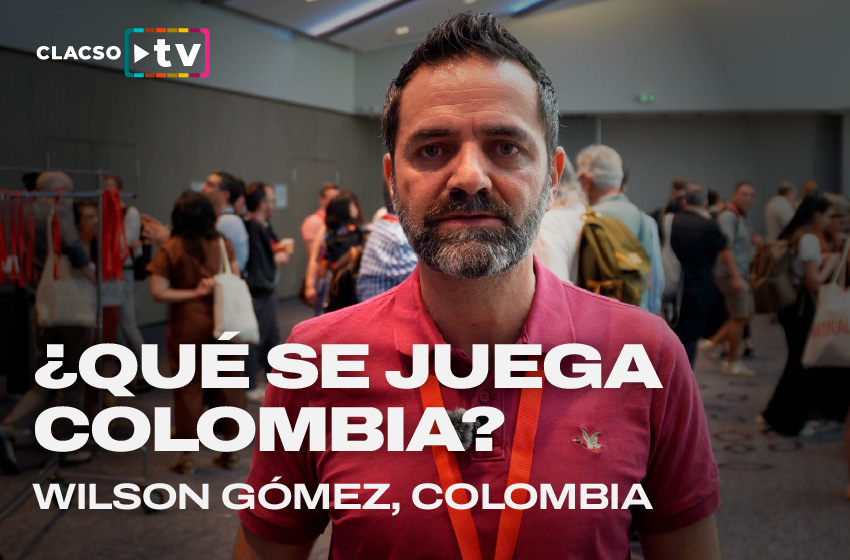
Just hours before the first round of the presidential elections in Colombia, on Sunday, May 31, Wilson Gómez , a member of the CLACSO Steering Committee, analyzes for CLACSO.TV the panorama and prospects that the South American country is going through.
He understands that there is a high probability of continuing the progressive project of the Historical Pact, which has achieved important labor reforms and has guaranteed access to rights for historically excluded populations, such as peasants, indigenous people and Afro-descendants.
“Faced with this advance,” he argues, “the State finds itself in conflict with the project of the new Latin American right.” He describes this model as an attempt to return to “state authoritarianism,” whose objective is to reduce and reverse the rights gained in the last four years. Gómez emphasizes that one of the candidates represents a perspective that is authoritarian, sexist, and misogynistic.
In economic terms, there are projects that present opposing visions. The left-wing project promotes the construction of a "people's economy" based on peasant farming and small and medium-sized industries. This proposal seeks to improve and diversify the productive base to allow access to goods and services for people who have historically been excluded.
Conversely, the opposing project seeks to deepen extractivism, fracking, and an economy centered on extraction for the benefit of a few. In contrast, the progressive model "says NO outright to fracking" and is committed to an energy transition.
In this electoral context, Wilson Gómez points out that democracy, environmental protection, and the right to life are at stake. The left-wing project places at its core the guarantee of life not only for humans, but also for "non-human" beings. This also includes guaranteeing rights for women and non-binary communities.
For the researcher, the issue at stake is the possibility of consolidating a state that guarantees rights. The goal is to reduce the historical gaps in wages and inequality that persist in Colombia.
Finally, he connects this political analysis to the debates within the social sciences in Latin America, specifically in the study of youth. In his meetings with colleagues from other regions, he proposes a debate in the face of research trends of an "Anglo-Saxon" nature.
Wilson Gómez ultimately raises the urgent need to stop focusing solely on violence "committed by young people." Instead, he proposes analyzing "structural and structuring violence against young people," since these are what produce the other systematic violence experienced in our contexts.

