
At night
Camila Valdés León*
In the early morning of June 30, 2021, journalist Diego Charles and feminist political activist Antoinette Duclair were murdered. Simultaneously, in other parts of Port-au-Prince, Haiti, 13 other people were shot and their bodies were found in the streets. Their deaths were not the result of a crossfire, or an attempted kidnapping or robbery. Their murders were clearly premeditated. They were targeted and killed within a specific timeframe and under the cover of night.
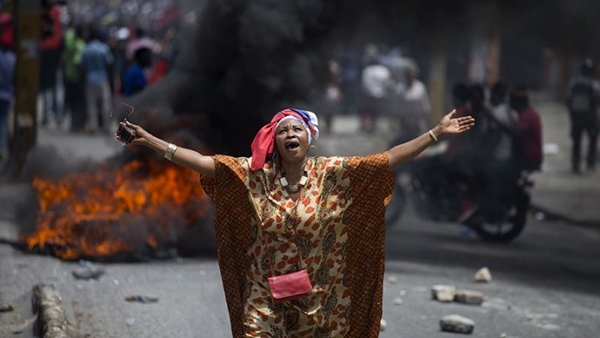
During the month of June, while the country saw COVID-19 infection figures rise as they had not risen throughout the entire course of the pandemic, as well as the number of hospital occupancies and deaths (among them those of great figures of the oligarchic class and the political scene, for example, the president of the Supreme Court of Justice), the community of Martissant, on the road from Port-au-Prince to Jacmel, was forced to take shelter in their own homes or move to other places in the city to preserve life (where friends, in churches, public squares or sports centers): the armed gangs, whose progressive control over this and other areas of the metropolitan area has been increasing in recent years, were fighting over space and resources. The Lakou Bovwa, a leading Vodou center founded by the great houngan and biochemist Max Beauvoir (currently led by Didier Dominique), reported that houngans, mambos, and hounsis belonging to this community had their homes attacked with machetes and fire. The leader of the self-styled G9 coalition, Jimmy Cherizier "Barbecue" (a former member of the national police), announced on June 23, in a highly viral video (with a clear attempt to disguise the origins of these power groups and the predatory nature of their criminal actions), that he had launched a revolution against the oligarchic and government elites. This revolution, he claimed, was manifested in the looting "to feed the people" of port warehouses and large businesses, as well as the murder and intimidation of residents in several neighborhoods of the capital.
Throughout 2021, and since February 7th, demonstrations and protests have taken place at all levels demanding the end of Jovenel Moïse's term. Protesters argue that his presidential term should have ended that day, given the date he actually assumed power (2016). The government, for its part, maintains that his assumption of the presidency occurred a year later and that he still has one year left in office; meanwhile, it is calling for an improper constitutional referendum that has already been postponed twice. Voices and associations of intellectuals, both within the country and from the diaspora, have repeatedly called for an end to impunity and violence, a return to constitutional order, respect for citizens in the exercise of their political power, and the urgent need to reconfigure a legitimate government capable of uniting political forces and social demands (from labor, women's, peasant, and student movements who witness daily attacks on their facilities, the kidnapping and murder of their members, and the complete thwarting of their aspirations).
The "political vacuum," the lack of governance, is real: since 2020 there has been no functioning Parliament (nor have elections been called to fill it) and the executive governs by decree; since 2019, a long-term nomination of a Prime Minister (designated by the President and ratified by Parliament) has not been possible; since 2018, with the uncovering of the Petrocaribe scandal (theft of millions of dollars in Venezuelan aid funds, directly linked to Martelly's presidency and its continuation under Moïse), the streets have frequently been filled with protesters and coalitions of all kinds, despite intense repression, demanding the president's resignation and a thorough investigation into the rampant corruption in the country and the collusion of oligarchies and international powers with the political collapse. Meanwhile, a political opposition is summoning, or rather, trying to capitalize on, the immense popular discontent with the high cost of living, the increase in citizen insecurity, and the economic, health, environmental, and multidimensional crisis that the country is experiencing.
In 2017, the last military personnel from the United Nations missions, which had occupied the country since 2004 (when the political crisis led to Jean-Bertrand Aristide's forced departure from power), finally left Haiti, leaving behind a trail of cases involving sexual crimes, corruption, and collusion with drug trafficking. Although some also began to lament the absence of an external military force at that time, in 2015, the centenary of the start of the American occupation of Haiti, many intellectuals discussed the terrible legacy of dependency and underdevelopment that, as Suzy Castor had stated long before, was consolidated as a strategy through foreign occupation.
And yesterday, July 7, 2021, once again under cover of darkness, with crickets chirping and scant streetlights, another murder was committed: Jovenel Moïse, 53, his wife, and family were attacked at their home in the Pelerin neighborhood (in the Port-au-Prince highlands) by an unidentified armed group carrying long guns. According to a government statement, some of the perpetrators spoke Spanish; according to videos circulating on social media, some spoke English. Moïse died at the scene; his wife, Martine, was rushed to a hospital, and it emerged hours after the news of the assassination was announced that she was out of the country, in Miami, receiving specialized medical care.
The elected representatives of the governing bodies, in an emergency meeting, decided to ratify the self-proclaimed Claude Joseph (the sixth prime minister, who had resigned and been replaced on Monday, July 5, by Ariel Henry) as interim president until presidential elections, announced for September, are called. A state of siege and a 15-day period of national mourning have been declared. All international flights are currently canceled. The neighboring Dominican Republic has closed its air and land borders and deployed its military personnel. Haitian and foreign reporters in the country attest to the apparent calm in Port-au-Prince, where the flow of pedestrians, vendors, and traffic is practically at a standstill; however, internal reports, circulated among citizens on social media, warn of street blockades, shootings, and areas of complete insecurity.
Several countries (from Latin America, the Caribbean, and Europe) quickly commented on the incident. Particularly noteworthy were the statements from the White House, which indicated its intention to provide interventionist assistance; Iván Duque's statement, which specifically called on the OAS to intervene; and the OAS's own statement, which condemned the assassination as a political crime that should not be tolerated. Security committees of regional organizations and alliances (such as the UN and CARICOM) have convened emergency meetings to analyze the situation, which undoubtedly strains regional geopolitics while dangerously concealing intentions of intervention and control over a rich and strategic territory. Many associations and individuals inside and outside Haiti have warned of this potential risk.
Common sense, trained to simply say, after mentioning Haiti, "the poorest country in the Americas" (as if it were a settled matter), might think that a presidential assassination should be a commonplace and repetitive news story. The truth is, since 1915, there hadn't been an assassination of a Haitian president. On that occasion, it was Vilbrun Guillaume Sam. In the surrounding seas, President Woodrow Wilson's American troops awaited this kind of signal of a final political collapse, ready to militarily intervene. They wouldn't leave Haiti until 1934, and during that time they were also occupying the neighboring Dominican Republic and Nicaragua, consolidating an evolving strategy of regional control.
Given the sustained accumulation of deaths and violence, the deliberate obscuring of the causes and motives behind so many events, and the international apathy toward the Haitian issue, barely stirred by yesterday's murder headlines, who can be held responsible today for this latest terrible act in a chain of vile events? What can the average citizen expect: the street vendor struggling to earn the bare minimum for a human life, the university student whose classmate is kidnapped by armed gangs, the activists demanding justice in the face of escalating violence against women, the farmer battling storms, droughts, and destitution, the journalist forced to migrate because their life and the lives of their family are threatened with death for doing their job, the artist whose work is created in and from the most absolute insecurity, the religious practitioner whose spaces of communion and fulfillment are attacked or exploited, the migrant left orphaned by the law and at the mercy of sharks on land and sea? Who benefits from this latest escalation of the gangsterization of politics?
July 8th, 2021
Camila Valdés León directs the Center for Caribbean Studies at Casa de las Américas. Article published in “La Ventana – News Portal of Casa de las Américas”
If you would like to receive more information about CLACSO's training programs:
[widget id=”custom_html-57″]
to our email lists.

