
"In the 21st century there is a resurgence of South-South cooperation"
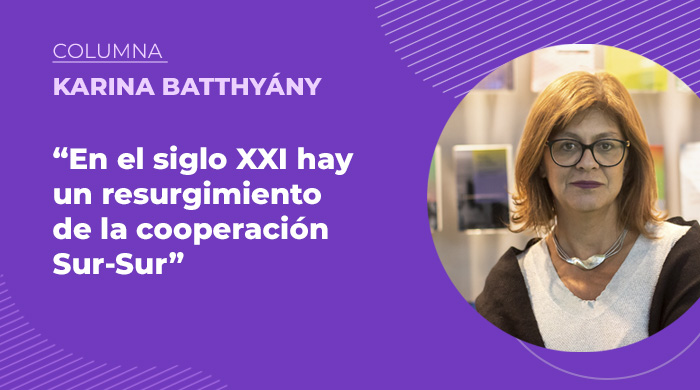
Transcript of Karina Batthyány's column
in InfoCLACSO – April 24, 2024
What is the value of public universities today in Argentina and anywhere in Our America?
This is a struggle for the entire region. Today, it's reaching dramatic levels in Argentina due to the attacks on public universities stemming from the trend toward the commodification of higher education and, consequently, the lack of respect for the right to education. At CLACSO, we defend the right to education for everyone at all levels and throughout their lives. In other words, education must be understood as a public, common, and universal good.
Public universities at the tertiary level play a central role in knowledge generation. In Argentina and Uruguay, for example, 80 percent of scientific knowledge produced originates from public universities, funded by public funds for research, development, science, and technology.
We are deeply concerned about everything that is happening in relation to public universities, from the perspective of those in power in the Argentine government. They want to advance a profoundly conservative, neoliberal, and mercantilist project, and, moreover, they reject all forms of state intervention in knowledge and critical thinking. Today, the streets of Argentina are defending the right to public education and to have excellent public universities.
– We are at the Forum on the New Dynamics of South-South Relations and the Challenges of Latin American Integration. What is the geopolitical context of the most unequal region on the planet, and what is the importance of integration among the countries of Our America?
There are two points I'd like to begin addressing: first, Latin American and Caribbean integration, a pending and unfinished matter in our region. There is clear evidence that if Latin America and the Caribbean were to advance in genuine integration processes, our history and reality would be very different, in terms of development, well-being, and the strengthening of the various dimensions that contribute to collective well-being. From a geopolitical standpoint, if there's one thing that is being avoided, it's the integration of Latin America because of its power: political, cultural, and economic power, as well as its influence on natural resources and environmental issues.
Secondly, it is also important to highlight the resurgence we have observed since the 21st century in terms of South-South cooperation, or this space of the Global South. While we can trace the beginnings of this resurgence (starting in the 1970s) to a complex context, marked by decolonization processes in Africa and Asia and military dictatorships in the Southern Cone, the possibility of advancing this cooperation or integration at the Global South level was quite difficult.
South-South cooperation operates at various levels, including those of states, international organizations, and academic institutions and organizations, where CLACSO plays a leading role with its South-South program. This program aims to advance development goals based on principles of solidarity, equity, horizontal exchange among countries of the Global South, and the premise of interdependence. All our countries are interdependent; no one can find alternatives or solutions to the multiple crises affecting us individually or from within each country alone.
At CLACSO, the foundation of these collaborations is knowledge sharing and the implementation of various programs in training, research, publications, and communication. This also takes place within the framework of the Knowledge Assessment and Academic Evaluation Program, which is our Latin American Forum on Scientific Evaluation (FOLEC). This forum already has the participation of countries from the Global South, the support of the African Council, the Arab Council of Social Sciences, and the Chinese Academy of Social Sciences, as well as support from India and other parts of the Global South.
Ultimately, what we are proposing is how to construct different perspectives on the knowledge production process that allow us to incorporate multiple forms of knowledge and carry out the necessary epistemological critiques from the Global South. We must understand this notion of an ecology of knowledges—that is, a dialogue and respectful coexistence among different forms of knowledge—which includes traditional scientific knowledge but also knowledge from peasants and peasant movements in Latin America and the Caribbean, Indigenous movements, and other non-Western cultures.
Likewise, it is an intercultural and integrative perspective of these different cultural dimensions, with the purpose of continuing to decolonize knowledge that today unfortunately still maintains tremendously hierarchical patterns, which causes the science of excellence in all disciplines to be concentrated and valued in the North.
Furthermore, scientific development in Latin America is significantly hampered by the criteria used for merit-based scholarships to recruit students, contributing to the "brain drain" that results in these programs being developed not in the Global South but in universities in the Global North, primarily the United States and Europe. With this in mind, we believe these are key principles to consider in the discussion on South-South cooperation, the geopolitical reality, and Latin America's role in all these issues.
From FOLEC-CLACSO and Knowledge Assessment, we propose other criteria that will allow the scientific output of these regions of the world to be recognized, made visible, and valued. Among other elements, this implies changes in the hierarchy of knowledge and the languages in which that knowledge is disseminated. There is also a need to place not only linguistic diversity but also cultural diversity at the center of the criteria, so that the more regional or local expressions of knowledge associated with the cultures of different parts of the world can be recognized.
We also propose changing the evaluation metrics that are currently governed almost exclusively by what can be published in certain scientific journals valued by industries that are, in reality, commercial publishers with political aims, distorting the knowledge landscape. Of the hundreds of journals produced in Latin America and the Caribbean, very few are represented in these catalogs, with the exception of the esteemed Redalyc catalog, which makes visible, recognizes, and prioritizes the knowledge produced in Latin America and the Caribbean.
– How important these meetings on South-South Relations are, because talking about geopolitics means talking about the current logic of a multipolar world, the ups and downs of international relations between countries and peoples over time, but how many other issues are incorporated into the logic of geopolitics and sometimes it is not so clear what the concrete impact is, for example, on scientific research…
When we talk about South-South cooperation, we tend to think about other types of cooperation or the geopolitical problems you mention. In reality, our main activity as CLACSO, which is the production and articulation of this knowledge with public policy, social movements, and organizations, is also affected by these discussions.
I also want to emphasize that all these elements to be discussed at the Forum The New Dynamics of South-South Relations and the Challenges of Latin American Integration are framed within our Platforms for Social Dialogue project, because these issues are present in the strategic axes that we have chosen to develop our PDS, which prioritize Latin America but also extend beyond the Latin American and Caribbean region.
If you would like to receive more information about CLACSO's training programs:
[widget id=”custom_html-57″]
to our email lists.

