
"In Ecuador, the stakes are for the consolidation of a progressive pole or a conservative alliance in the region."
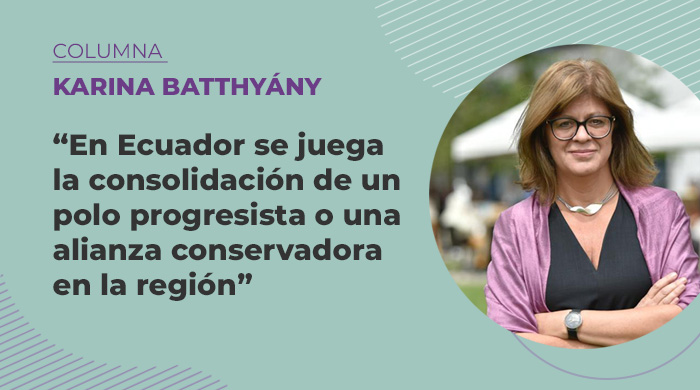
Transcript of Karina Batthyány's column
in InfoCLACSO – April 2, 2025
Today we will discuss a central topic: the upcoming presidential elections in Ecuador. The struggle between democracy and authoritarianism in Latin America will enter a new chapter on Sunday, April 13, when the current president, Daniel Noboa, heir to a wealthy banana company and representative of the Ecuadorian right, faces Luisa González, candidate of the Citizen Revolution, a progressive, anti-neoliberal alliance, in the second round of the presidential elections.
The democratic front led by Luisa González expanded with the recent signing of an agreement in favor of a country free of violence, for peace and life, with the Indigenous Movement of Plurinational Unity Pachakutik, which came in third in the first round of voting on February 9 with 5,25% of the vote and is a leading force in the fight against the expansion of oil activity in the Amazon. Furthermore, other regional and local organizations have indicated they will support Noboa.
Let's remember that the first round ended in a virtual tie, far from the triumphalism of the right wing that predicted a first-round victory. Noboa obtained 44,17% of the votes compared to González's 44%. The difference between them was less than 17 votes.
Luisa González and Daniel Noboa already faced each other in a runoff election in the previous presidential elections of October 2023. At that time, Noboa presented himself as "the new face" and won by a margin of 3,6 percentage points. He took office on November 22, 2023, and since then, his administration has been plagued by very poor economic and social indicators for the general population, not to mention the rampant insecurity, the rise of drug trafficking, prison conflicts, and serious problems with the electricity supply, including recurring blackouts.
Daniel Noboa is the son of Álvaro Noboa, the so-called "banana king," who has been a failed presidential candidate in Ecuador on more than one occasion. Ecuador is the world's leading exporter of bananas. According to the Pandora Papers, the current president owns a number of companies in tax havens, but the local justice system seems uninterested in pursuing him. He was elected to complete the term of banker Guillermo Lasso, who was forced by the economic crisis to call early elections in October 2023.
In nearly a year and a half at the helm of the Ecuadorian executive branch, Noboa has already shown his true colors. Shortly after taking office, he declared a state of “internal armed conflict” by decree, which allowed the Armed Forces to operate against drug trafficking gangs, considering them terrorist targets—a policy fully supported by the United States, with whom Noboa signed several agreements that, among other things, grant immunity to U.S. military personnel. Furthermore, since Donald Trump's arrival at the White House a few months ago, Ecuador has been offered as a beachhead for militarizing the region and for re-establishing U.S. military bases in the country, including in the Galápagos Islands.
Security is one of the main concerns of the Ecuadorian population, as evidenced last April in a referendum launched by the president. The referendum passed with a majority "Yes" on issues such as the continued presence of the Armed Forces in internal patrols, although the "No" vote prevailed on questions related to the neoliberal economic plan. The fight against organized crime is Noboa's justification for his authoritarian policies, which, not coincidentally, also target all opposition demonstrations, restricting civil liberties.
In this context of electoral dispute, we cannot ignore the scandal of the invasion of the Mexican embassy in Quito in April 2024 to illegally capture former Ecuadorian Vice President Jorge Glas, who was seeking asylum there. This led to the severing of relations between the two countries and widespread international condemnation. Even less can we forget the disappearance and subsequent murder of four children between the ages of 11 and 15 in late 2024 in Guayaquil, a crime for which the military was responsible—a reprehensible act denounced by the Inter-American Commission on Human Rights and subsequently covered up by Noboa.
Faced with a highly polarized landscape, much more than the country's fate is at stake in Ecuador on April 13th. The consolidation of a progressive bloc or a conservative and authoritarian alliance in the region is also on the line. Fearing electoral defeat, the ruling oligarchy is deploying its entire media arsenal, disseminating fake news and thinly veiled threats to try to sow panic among a population fed up with insecurity but also burdened by an economic crisis that is hitting their wallets and their standard of living hard. And, once again, the specter of electoral fraud looms over one of our countries, a potential threat to a democratic and progressive proposal that could prevent it from reaching the government.
The answer will lie in the citizen control of the more than 13,7 million Ecuadorians called to vote in 11 days, in a country where voting is mandatory.
In short, we are once again in an electoral struggle between democracy and authoritarianism in Our America.
– Understanding that the dimension of any election in Our America has repercussions in other countries, it is central to think of each of these elections as a matrix of consequences throughout the region, whatever the result, right?
– Absolutely. We said it at the end of last year at InfoCLACSO about the cycle that was beginning in Our America with the election results in Uruguay. The results in each of those countries, with their electoral processes and being at a crossroads between progressive and extreme conservative governments, could set the course for our entire region. We have already seen some results in 2025, and the electoral cycle continues.
If you would like to receive more information about CLACSO's training programs:
[widget id=”custom_html-57″]
to our email lists.

