
“In Chile, these are times of transformation and of taking on challenges.”
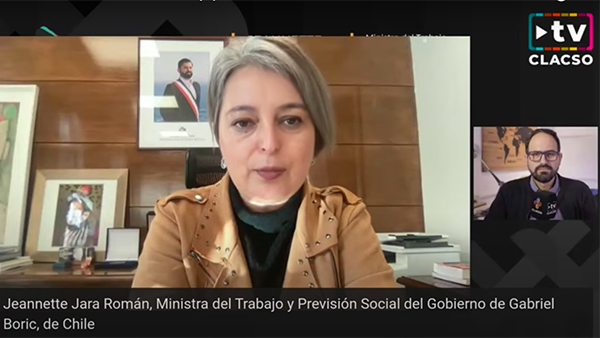
Chile's newly appointed Minister of Labor and Social Security, Jeannette Jara Román , participated in the InfoCLACSO event on May 18th, where she outlined the main challenges facing Gabriel Boric's administration, focusing on changes in the labor sector and, in particular, on pension reform, for which they have called for tripartite dialogues between workers, employers, and the Government.
Interviewed by Gustavo Lema
-I understand that the challenges are significant; it's a very important transformation process, and the tensions related to what might happen are also considerable. In principle, what are the main challenges and new guidelines for this administration?
Undoubtedly, we are at a crucial moment in Chile, where opportunities for transformation are emerging, along with the challenge of beginning a government administration in a country already facing significant internal difficulties in social cohesion and socioeconomic issues stemming from the pandemic. Therefore, we must address two key areas continuously: firstly, the immediate crisis and the assistance families urgently need to overcome the current situation, marked by high inflation by Chile's macroeconomic standards, which means that the cost of living, especially for the country's most vulnerable families, has risen considerably; and secondly, the transformative approach that requires a sustained effort to advance the changes outlined in your question, with the fight against inequality and abuses being fundamental. Chile emerged from military dictatorship thirty-two years ago and did indeed make progress during this period with many public policy initiatives that contributed to reducing poverty and extreme poverty levels. However, inequality itself has persisted and has often worsened. Therefore, the neoliberal state, in all its manifestations, has left this legacy on Chilean society. Following the Popular Revolt and the social uprising, there is now an opportunity to forge a new social pact.
-Minister: In this discussion, and in the power struggles that began this conversation, we talk about the traces left by the dictatorship, which are clearly not limited to a change of government, but rather involve very profound transformations. Specifically in the labor sphere, how are these changes projected, considering the tensions that may arise with sectors that have perhaps always been more accustomed to winning and with sectors that, for many years in all Latin American countries, have unfortunately always been accustomed to losing? How are these tensions managed when there is significant inequality in how, with the power they have, they can exert pressure and generate different alternatives when changing certain policies?
There is quite a bit of power asymmetry from a low rate, let's say. Thinking that an individual worker can negotiate or improve their conditions is a fallacy. We know that the bargaining power of workers lies precisely in their ability to organize. The labor and social security legislation in Chile that governs is that which was imposed during the dictatorship with some changes that have been introduced. Today, the possibilities that are opening up, particularly in terms of reforming the pension system, which is also one of the pillars of the Chilean financial market, compel us to have a very important space in which we can move forward with an effective dialogue. I point this out because we have a parliament in our country that has a very diverse political representation, and many of the reforms obviously have to be made viable through the legislative sphere. That is why we are promoting what is called tripartite dialogue from the Ministry of Labor and Social Security. President Gabriel Boric has placed four guiding principles at the center of the government, one of which is to advance decent work. We are convinced that decent work is built on social dialogue and tripartism. Therefore, both in the substantive reforms we make to the provisional reform and in the real issues we address, we are working together with employers and workers, discussing and seeking areas of agreement that will add support to the projects and allow us to have a more effective legislative process. I was part of the government of former President Michelle Bachelet, we also tried to make a provisional reform and eight years have passed. Then, during the right-wing government, President Sebastián Piñera attempted to modify the pension system by strengthening the AFPs, but he evidently made no progress either. Today we have a commitment to establish a Social Security system in Chile that one might think, perhaps from other countries that view this situation, where it is evident that in terms of pensions there should be a social security system, but in Chile it does not actually exist. For the past 40 years, what we have had is private individual pension insurance operated through the AFP as a lucrative industry that has turned pensions into a business, and producing the changes that could not be done during Bachelet's presidency nor were any advances made under Piñera will undoubtedly require bringing together different groups of people. And there is a window of opportunity, because while the social uprising puts at the center the protest against the sustained abuse of many things and the absence of collective rights, it also opens up a possibility: How do we agree on moving forward in the society we are building? And in that exercise we are not only as a country in the constituent process that is underway and that this September 4 will have its plebiscite in order to review the opinion regarding the approval or rejection of the New Constitution, but also in the agenda and the government itself that is carrying it out.
-Throughout this process, you just mentioned some issues related to pension reform. What are those key points and what structure needs to be modified? Because we understand that these are issues deeply rooted in social dynamics, and the transformation will likely be not only political but also cultural, so that a large part of the population, who may not yet fully grasp the complexities of the lack of reform, can begin to understand the situation…
This is a fundamental question. We've seen generations whose pensions are simply referred to as individual capitalization, where, by definition, the risks of aging are assumed solely at their own expense and risk. In Chile, there's a popular saying: "Everyone's on their own two feet." This saying encapsulates the philosophy behind the so-called individual capitalization system managed by the AFP (Pension Fund Administrators), and it also reflects the behavior in the world of work. In countries like Chile, where wages are declining, very close to the minimum wage, which attracts not only those who can afford the bare minimum but also all those whose salaries are tied to it (the minimum wage earner), who have gaps in their pension coverage, and who experience gender pay inequality, all of this is reproduced in the labor market. Therefore, the essential first step is to establish the concept of Social Security not only in the legal framework but also in the cultural context. And that's a tremendous challenge in a society like ours, because while we all know we can't continue like this, it's in building an alternative that we're talking and reaching agreements. So, we're currently conducting a decentralized tripartite dialogue process between employers, workers, and the government. Chile is a long, narrow strip of land with 16 administratively defined regions, and this tripartite dialogue is taking place in each of these regions, where participants are invited to discuss the principles of social security, solidarity, universality, and equity within the system. There's also a reflection on whether the current contributory and non-contributory pension pillars are consistent with these ILO (International Labour Organization) principles.
-I understand it to be a much more collaborative structure, where social logic takes precedence over individual logic. And that, I think, is the core of cultural transformation, isn't it?
I think that's the key, plus a phenomenon has occurred. Because in our country the contributory pillar is paid only by the worker (in Chile there is no employer contribution). Furthermore, the quotation is half the amount of the world average quotation, it is 10%, and it is of an individual nature. So, the worker contributes only to their own account and obviously at the end of their life they will be able to retire with what they have left in that balance: more loss or more gain, but a more complex or very difficult issue arises for the public to understand. Because the funds in that individual capitalization are exposed to the risks of the financial market with profits or losses, but there is no correlation between the remuneration that the worker pays to the AFP, because it is paid based on the flow based on his salary, and the result of the fund. So when the fund does well, the worker pays a commission to the AFP; and when the funds do poorly, the worker pays exactly the same commission to the AFP. The incentives are not aligned. At its core (more or less technical) the focus will be on understanding that Social Security is a human right, which belongs to all people and which bases its principle, among others, on solidarity, which is different from individual capitalization. It is quite likely that we will arrive at some kind of mixed solution in our country. There are some social security instruments here in Chile that already recognize this mix between the individual and the collective, such as Unemployment Insurance which has individual accounts and a solidarity unemployment fund, but it is a discussion that we are having. In our country, moreover, for a long time (something that is common and usual in International Social Security) they have been demonized. For example, regarding the pension system, it has been pointed out that it is a cash cow that spends money today, and by tomorrow, just when it's your turn to retire, there's not a penny left. We know that modern distribution uses actuarial techniques that ensure the sustainability of benefits for the future, which is an obligation and commitment of the State in this matter. Here in Chile there are only private non-profit institutions in the area of pensions, and it is also in the interest of our government that there be a public institutional framework. Then, on the other hand, it's meant to be a caricature, suggesting that this would allow politicians to steal the money. We are talking about highly technological institutions, protected by constitutional ranks. There is a very extreme debate, but we are still confident that we will reach an agreement, because the need to improve pensions is so high, serious, profound and important for Chilean society, that we will all have to compromise on our most rigid positions in order to unite efforts and move the project forward, because we have been waiting for a long time.
And lastly, you were talking about the pandemic at the beginning. There were two very significant moments related to the pandemic, one of them even within some academic circles, with a certain social expectation that it could be a very transformative moment, in which the logic of individualism began to develop different dynamics. Unfortunately, after two very difficult and challenging years of the pandemic in different parts of the world, it doesn't seem that this transformation has occurred; rather, the logic of inequality has hardened in many parts of the world. What is your analysis regarding what happened to workers in Chile during this period, which was largely under a right-wing government like that of Sebastián Piñera? What happened to work in Chile during the pandemic?
It was a very hard blow, I imagine not only in economic terms but also emotionally. I think none of us expected to face a global pandemic. One can imagine various things that will happen in life, because they could eventually happen, but a pandemic was more difficult to predict or foresee. In terms of employment, we had high levels of unemployment caused by fairly strict quarantines at first. The transition in other countries must have been similar in this respect… We ended up losing about 20% of the workforce in terms of employment; we had 2 million unemployed people without state aid. The government of then-President Piñera had a very restrictive policy, especially at the beginning, on this type of matter, and the parliament later pushed for them to provide support and assistance. In Chile, community kitchens and soup kitchens, as they are called here, have reopened in areas that had not been seen since the worst economic crisis during the last dictatorship. Yes, later on, there were fiscal transfer processes accompanied by the withdrawal of capitalization funds, which at the worst point of the pandemic also allowed us to overcome this situation. But in terms of the labor market, we have not yet recovered. At the height of the pandemic, women regressed as if we had been ten years behind in terms of labor force participation. Today we still have jobs to recover from before the pandemic. We haven't even recovered the jobs we had before the pandemic, but the quality of employment is something that worries us (regarding the recovered jobs), both because of the number of working hours that people are currently employed with the same salary level, and also because the jobs that have been recovered are informal. Therefore, without social security, without occupational health, without equity, without all the conditions of what constitutes decent regulated work. And that matter has us worried. We have challenges ahead, I would say, that have to do with recovering jobs and formalizing them, as well as (re)enchanting the affection that workers can once again join formal employment. In Chile, between this week and next, we will be discussing a minimum wage increase that has been the largest in 25 years. In addition, it comes with a subsidy for small and medium-sized enterprises so that they can absorb this minimum wage increase, which is more than 14%. But as the cost of living is rising, it still feels like it's not enough, but it is a help and a support. We know that this is the most significant historical increase on record, but we also know that there are many needs in the lives of workers. So, we're facing different kinds of challenges. What has happened to us is that many informal workers have discovered that by working on weekends or a few hours a week, they can often generate an income very similar to the minimum wage. If we want to promote formal employment, we have to improve the working conditions of workers who are in formal employment. And that's why we are committed to raising the minimum wage to a standard. In Chile, there has been a debate for many years about whether to raise the minimum wage to 5, 10, or 3 dollars. In reality, neither the cost of the basic food basket, nor the poverty line, nor any other indicator is considered. So, what President Gabriel Boric has set as a challenge for us is to generate a wage policy and move towards a poverty line standard. We will also work on reducing the working day to 40 hours and we will implement it gradually so that it does not affect employment: we will do it because we are convinced that it will contribute to a good life and because Chile, which belongs to the OECD (Organization for Economic Cooperation and Development), is one of the countries with the longest working days and the lowest productivity rates. So, we have something to review there. And since the pandemic, mental illnesses have also increasingly emerged from both the world of work and the common health system. So, we're going to move forward with the minimum wage in a 40-hour work week, with formalization and employment, and also with the Pension Reform. These are the four pillars on which we are working with all our strength in this year 2022, because we know it is important to advance in social justice.
If you would like to receive more information about CLACSO's training programs:
[widget id=”custom_html-57″]
to our email lists.

