
“In Brazil, educational inequality is a very strong characteristic.”
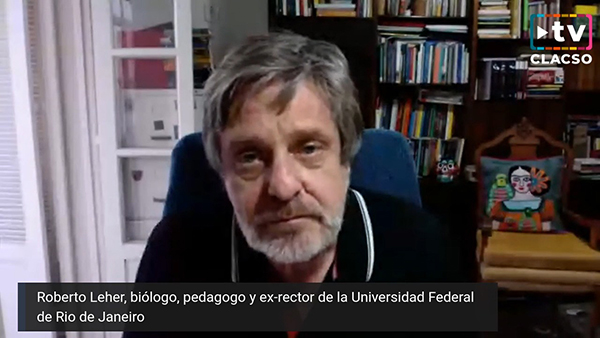
On August 13 and 14, the International Conference “Challenges for educational research from the pandemic” was held virtually, organized by the Ministry of Education of Argentina, the Latin American Council of Social Sciences, the CLACSO Working Group “Educational policies and the right to education” and Education International for Latin America.
Important figures from the education systems of countries in the region participated, including Professor Roberto Leher, biologist, pedagogue and former rector of the Federal University of Rio de Janeiro, in Brazil.
Eric Domergue interviewed
Roberto Leher understands that “there is no possibility of a new normal without questioning the determinants of social inequalities in Brazilian education that the pandemic has made very clear, very explicit. In Brazil, educational inequality is a very strong mark; a large part of the youth didn't even complete their basic education, and even today few students have access to free, public higher education. In Brazil, 80% of students are in private institutions, but private institutions with a profit motive, private institutions with commercial aims, and this brings immense inequality… Furthermore, today I believe that 50% of Brazilian students—some 25 million—do not have regular and good access to the internet. So, in the context of the pandemic, many students have no means of virtual learning, of virtual interactions, not only due to difficulties with internet access, but also because of their harsh living conditions, the infrastructure of their homes, which is a very worrying situation.”
If you would like to receive more information about CLACSO's training programs:
[widget id=”custom_html-57″]
to our email lists.

