
“In Latin America and the Caribbean we have a debt to the Afro-descendant population”
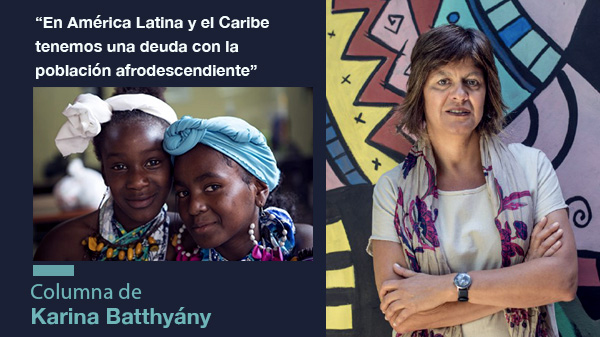
(Transcription of Karina Batthyány's Column)
(In InfoCLACSO – September 8, 2021)
Fortunately, reality provides us with some newsworthy topics to discuss, which have led us to many of the columns we've written here at InfoCLACSO. The first is Mexico. Why? Because this Tuesday, September 7th, at noon, the Supreme Court of Mexico took a truly historic step by decriminalizing abortion. The ten justices unanimously ruled to invalidate an article of the Coahuila State Penal Code that punished early pregnancy termination with one to three years in prison. Until this ruling, it's worth remembering, abortion in Mexico had been addressed exclusively by the legislation of each of the states that make up the Mexican nation.
The Supreme Court's ruling will have general effects in all states. From a practical standpoint, women who choose to have an abortion can no longer be imprisoned anywhere in the country. Of the 32 federal entities that make up the United Mexican States, only four currently allow legal abortion, freely and at the woman's request, up to twelve weeks of gestation. These are: Mexico City, Oaxaca, and more recently, Veracruz and Hidalgo.
With this ruling, then, this will now be possible throughout the country. This judicial decision is undoubtedly an institutional endorsement of the struggle of the Mexican Women's Movement and the Women's Movement in Latin America and the Caribbean. It was very interesting to hear the President of the Court explain this ruling. And this news will begin to generate repercussions and pressure throughout Mexico.
At his weekly press conference, Mexican President Andrés Manuel López Obrador declared that the unanimous decision of the Supreme Court must be respected, and representatives from the various political parties in state legislatures began to state their positions. Why are we reporting this? Because approximately 97% of Latin American and Caribbean women of reproductive age live in countries where abortion is illegal. Furthermore, it is estimated that between 5 and 10 women die each year from unsafe abortions in Latin America and the Caribbean.
So, as happened previously in Uruguay, and more recently in Argentina, we hope that Mexico will now take this step toward a more democratic and egalitarian society, where women can make decisions about their bodies and their life plans. And, importantly, the States must create the conditions to guarantee the exercise of these rights. I believe this news really needed to be discussed here at InfoCLACSO.
-This is truly important news coming from Mexico. And I understand—I liked your reflection before moving on to the second topic—about the work of the various feminist movements in Latin America and the Caribbean. Because we know it's an interconnected effort, where what happens in one country is carefully considered in order to bring those experiences to others… And I think it's a very important struggle, isn't it?
Absolutely. The Green Wave, as we often call it specifically in this context, is undoubtedly an achievement of the Latin American Feminist Movement, which is gaining ground in various countries. The news from Mexico is cause for celebration, and we must continue to move forward on this critical issue and one of the rights that Latin American and Caribbean women demand.
-Do you have a second topic to propose and discuss?
I suggest we theoretically go to Durban, South Africa, because August 31st was the International Day for People of African Descent, celebrated for the first time in 2021. 2020 marked the halfway point of what is known as the International Decade for People of African Descent, which was launched in Durban, and it's worthwhile to review what has been happening since the United Nations declared this day the International Day for People of African Descent. In this Decade—as it has been named, and we reached its halfway point last year—while progress has been made in legislative, regulatory, and institutional spheres, what we can say is that people of African descent still suffer interrelated and complex forms of racial discrimination (racism), marginalization, and exclusion.
These early years of the Decade, coupled with the Coronavirus pandemic, highlight the absolute urgency of addressing these persistent structural inequalities and the systematic racism we observe in the world, and particularly in Latin America and the Caribbean.
Let us remember that the lack of recognition is still one of the main obstacles preventing people of African descent from fully and effectively enjoying their human rights. Twenty years have passed since the World Conference against Racism in Durban, which addressed racism, xenophobia, and other forms of intolerance. This event, which we sometimes forget, was a landmark in itself, because it allowed for the systematization of a process in terms of the contributions to humanity of a program that, to this day, is considered the most powerful anti-racist program ever undertaken.
And this was important because, of course, it had broad and diverse international consensus, but it was led by people of African descent. So, halfway through this International Decade, which runs from 2015 to 2024, the goals that gave rise to the Decade—Recognition, Justice, and Development for People of African Descent—have seen very limited progress, and we continue to have a debt to people of African descent, especially in Latin America and the Caribbean. This debt is significant in our region because it has the largest population of people of African descent in the world, with estimates ranging from 120 to 170 million, and Brazil alone has the largest population on the continent with 112 million.
Despite the fact that one in four Latin Americans identifies as Afro-descendant, this situation of structural inequality and discrimination persists. The pandemic exacerbated it, and we have figures that provide evidence of how these inequalities and forms of discrimination persist. For example, Afro-descendant people in Latin America and the Caribbean are 2.5 times more likely to live in poverty than non-Afro-descendant people. Furthermore, and this is another important statistic, they have, on average, fewer years of schooling, higher unemployment rates, and less representation in decision-making positions at all levels, both public and private. These are indicators of discrimination and structural inequality.
Therefore, we must understand racism; it is also a central part of the culture of privilege that is so prevalent in our countries. Racial inequalities are structural, affecting rights and resulting in poverty and deprivation of access to essential elements of social welfare and public goods such as water, sanitation, electricity, and the internet, which is so necessary today, among other things.
We must continue working on this issue because it is clear in Latin America and around the world that it is impossible to move towards sustainable, fair, and democratic development without deconstructing the matrix of inequality, the culture of privilege, and the structural inequalities that refer, for example, to racism.
So, I wanted to put these two topics here in today's InfoCLACSO weekly column.
If you would like to receive more information about CLACSO's training programs:
[widget id=”custom_html-57″]
to our email lists.

