
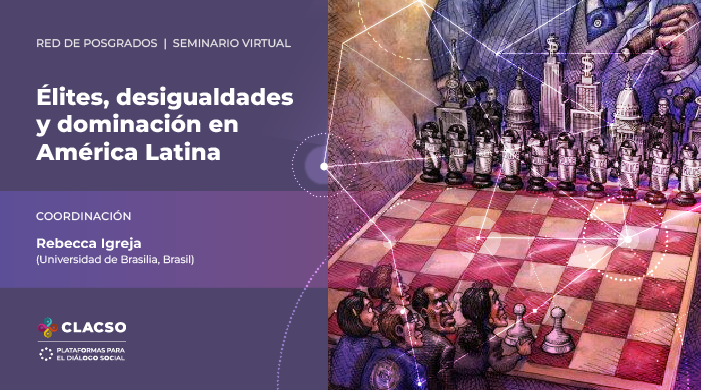
Elites, inequalities and domination in Latin America
Seminar 2323
Chair : CLACSO
Coordination : Rebecca Forattini Lemos Igreja (University of Brasilia, Brazil)
Teaching team: Rebecca Forattini Lemos Igreja (University of Brasilia, Brazil) | Danilo Uzêda Da Cruz (FLACSO-University of Brasilia, Brazil) | Nathalia Vince Esgalha Fernandes (University of Brasilia, Brazil) | Gianmarco Ferreira (University of Brasilia, Brazil)
Start date : 08/08/2023 | Registration : 27/06/2023 to 07/08/2023
Workload: 12 weeks – 90 hours.
Many empirical studies have focused on portraying the situation of vulnerable populations, analyzing their sociocultural profile and socioeconomic conditions. Few, however, have dedicated themselves to developing the same profile of national elites, especially those who control public institutions and national decision-making processes. What is their cultural, racial, and socioeconomic profile? How do they think, how do they act, and what values do they defend? In times of rising neoconservatism and the far right, as well as increasing inequalities in Latin America, it is urgent to examine studies based on empirical research that offer an analysis of these political elites in the various branches of power within nations, in order to understand how they think about and operate the oppressions they legitimize. The purpose of this seminar is to discuss these issues from the perspective of sociological and anthropological studies, including the intersections of gender, race, and ethnicity.
In this seminar, we will begin with Professor Danilo Uzêda's presentation on inequalities and their mechanisms of reproduction. Following this, we will open the discussion to the theoretical and methodological frameworks of elites and bureaucracies, while also considering the current political context of rising neoconservatism and de-democratization, which is altering political participation and repositioning the country's conservative political elites. We will continue our approach with Professor Gianmarco Ferreira's contribution, who will address the profile of elites and the whiteness that characterizes them in Latin America. Professor Nathalia Vince will then take up the discussion, incorporating gender and intersectional perspectives into this profile of elites. Building on this discussion, Professor Ferreira will return to his argument, now considering the public bureaucracy and the elites that control it. Professor Rebecca Igreja now introduces the discussion on judicial elites and their role in guaranteeing the fundamental human rights of citizens. She continues her line of reasoning by discussing academic elites and the policies and perspectives that seek to transform them, thus concluding the discussion of the public sector. Finally, she addresses the profile of business elites, followed by Professor Nathalia's proposal to discuss skilled and elite migration, especially expatriates. It is important to note that the course begins with a theoretical/reflective approach, while continuing to incorporate empirical studies/research on the country's elites, who often contribute to the reproduction of inequalities, internal colonialism, discrimination, and Eurocentrism that persist in our society.
GENERAL PURPOSE
To analyze and understand the dynamics of power, inequality, and domination in Latin America, focusing specifically on the study of political, academic, judicial, and business elites. Through sociological and anthropological approaches, the aim is to examine the cultural, racial, and socioeconomic profile of these elites, as well as their values, actions, and roles in the reproduction of inequalities and oppressions in the region.
SPECIFIC OBJECTIVES
Upon completion of this course, students will be able to:
1. Understand the concept of elites and their relationship with power structures in Latin America.
2. Critically analyze the cultural, racial, and socioeconomic profile of national elites and their influence on political and economic decisions.
3. Identify the forms of domination and oppression exercised by elites in different areas of Latin American society.
4. Reflect on the existing inequalities in our region and their relationship with the actions and policies of the elites.
5. Explore the intersectionality of gender, race, and ethnicity in the study of elites and inequalities in Latin America.
6. Analyze cases and empirical studies that allow us to understand how political and economic elites operate in different Latin American contexts.
7. To promote dialogue and the exchange of ideas on possible alternatives and strategies to address inequalities and domination in our region.
8. Develop research and critical analysis skills through reading academic texts and participating in course discussions and activities.
- Latin American inequalities and the construction of elites
- Bureaucracy, domination and public policies: interdisciplinary analyses
- De-democratization, neo-conservatism, and political participation
- Racial inequality and whiteness in Latin America
- Elites, gender inequality and intersectionality in Latin America
- Elite public careers
- Judicial elites
- Latin American academic elites
- Profile of business elites and diversity
- Migrant business elites
- ALMEIDA, Frederico Normanha de. As elites of Justice: institutions, professions and power in the politics of Brazilian justice. Journal of Sociology and Politics (Online), v. 22, 2014.
- ANDRADES MARULANDA, NL, Palacio Flórez, AK, & Blanco-Ariza, AB (2019). Female empowerment and gender equality in organizations. Strategic Leadership.
- AZEVEDO, LF DE; CAMPOS DE ALMEIDA DUTRA, R. . Foreign doctor training policy and legitimacy of the academic elite in contemporary Brazil. Antropolitics - Revista Contemporânea de Antropologia, n. 53, 2 Dez. 2021.
- BÁRCENA Arévalo, E., 2018. Judicial reproduction and legal culture. The personnel appointment system in the Mexican Supreme Court. Oñati Socio-legal Series[online], 8 (5), 739-759. Received : 30-01-2018 ; Accepted : 11-10-2018.
- BENSON, Michaela Caroline. Class, race, privilege: Structuring the lifestyle migrant experience in Boquete, Panama. Journal of Latin American Geography, 2015.
- CERÓN, H. Humble skin color, privileged skin color. Elites and whiteness in Latin America. Nueva Sociedad, v. January-February, n. 303, 2023.
- CHEIBUB, ZB A diplomatic career in Brazil: The bureaucratization process of Itamaraty. Public Administration Magazine, v. 23, no. 2, 1989.
- COELHO JUNIOR, Pedro Jaime. Black executives: racism and diversity in the business world – A socio-anthropological approach. 2011. 553 f. PhD in Social Anthropology – Faculty of Philosophy, Letters and Human Sciences. USP, São Paulo.
- CRUZ, Danilo Uzêda da. Persistent inequalities in Latin America. IN: CRUZ, Danilo Uzêda da. The contemporary state in Latin America: History and Political Theory. Salvador: Pinaúna Editora, 2021.
- CRUZ, Danilo Uzêda da. Social policies and conservative agenda of the Bolsonaro government: dedemocratization and political degradation. IN: ZIMMERMAMM, Clóvis Roberto; CRUZ, Danilo Uzêda da. (orgs.) Social Policies in the Bolsonaro Government: between failures, setbacks and clearings. Autonomous City of Buenos Aires: CLACSO; Salvador: Pinaúna, 2022.
- ETHOS, INSTITUTE. Social, Racial and Gender Profile of the 500 largest companies in Brazil and their affirmative actions. São Paulo, mai. 2016.
- FERREIRA, CLÁUDIA APARECIDA AVELAR; NUNES, S. Black women in the labor market: intersectionality between gender, race and social class. XLIII MEETING OF ANPAD, 2019.
- FERREIRA, EM; TEIXEIRA, KMD; FERREIRA, MAM. Racial and gender prevalence in the profile of higher education teachers. Katálysis Magazine, v. 25, no. 2, May 2022.
- FERREIRA, GL (Des)igualdade no public service: bureaucracy, ativism and as affirmative actions raciais in Brazilian diplomacy. Curitiba: CRV, 2023. pp. 47-77. GOBO, K. Da exclusão à inclusão consentida: negroes e mulheres en brazilian diplomacy. Politics & Society, v. 17, no. 38, 2018.
- HIRATA, Helena. Gender, class and race: intersectionality and consubstantiality of social relations.” Tempo Social, Revista de Sociologia da USP, São Paulo, v. 26, June 2014.
- MENDOZA, Cristóbal. Migration and mobility of companies' foreign skilled workers in Mexico. Journal of social sciences and humanities, v. 39, n. 84, 2018.
- PEREIRA, Edilene Machado et al. Intersectionality of gender and race inequalities in elite positions. Scientific Interfaces-Direito, v. 5, no. 1, 2016.
- QUIJANO, A. Coloniality of power, Eurocentrism and Latin America. In: LANDER, E.(ed.). The coloniality of knowledge: Eurocentrism and social sciences. Buenos Aires: Clacso, p. 227-278, 2005.
- SARRABAYROUSE Oliveira, María José. Groups, loyalties and practices: the case of Argentine criminal justice. Revista de Sociologia e Política [online]. 1999, (13), 81-104 [accessed June 23, 2023]. ISSN: 0104-4478.
- SCHWARTZMAN, LF The integration of the white into the community of color, or how the Europeans became Brazilian in the twentieth century. Transmodernity, 2018.
- SILVA, Ana Karolina Morais da. Contrarreação hegemônica ea ascensão da reita na América do Sul: o rolo de interventionismo norteunidense IN: MECHI, Patrícia Sposito; DULCI, Tereza M. Spyer [Orgs.] Extrema-direita e neoconservatismo na América Latina e no Caribe. São Carlos: Pedro & João Editores, 2023.
- SOLANO, Esther. Crise da Democracia e extremismos de Direita. IN: ANALYZE. No. 42. 2018.
- SOUZA, LMF; FERREIRA, GL; REBOUÇAS DOS SANTOS, M. DO C. Direito e meritocracia contra as cotas ciais: readjustments of the device of transparency. Espaço Acadêmico Magazine.
- THERBORN, Göran. The extermination camps of inequality. Autonomous City of Buenos Aires: Fondo de Cultura Económica, 2015.
- TILLY, Charles. Persistent Inequality. Autonomous City of Buenos Aires: Manantial, 2010.
- VILLALOBOS, C.; QUARESMA, ML; FRANETOVIC, G. Mapping the elite in Chilean universities. A quantitative-multidimensional analysis. Revista Española de Sociología, [S. l.], v. 29, n. 3, 2020. DOI: 10.22325/fes/res.2020.33.
- WEINAR, Agnieszka; KLEKOWSKI VON KOPPENFELS, Amanda. Highly-skilled migration: between settlement and mobility: IMISCOE short reader. Springer Nature, 2020. - Chapter 2 Highly Skilled Migration: Concept and Definitions.
- ZUVANIC, Laura; IACOVIELLO, Mercedes; GUSTÁ, Ana Laura RODRÍGUEZ. Bureaucracy in Latin America. IN: Central American Journal of Public Administration. January 2011.
|
|
Discount for one payment until 04/08 |
In one payment after 04/08 |
|
CM Plenos |
$75 |
$150 |
|
CM Associates |
$95 |
$190 |
|
No link |
$95 |
$190 |
FAQ
The basic requirements for taking a seminar are:
- Availability of at least 4 hours per week to dedicate to the seminar course.
- Internet access.
- Reasonable handling of communication and computer tools.
- Language proficiency in the language in which the course will be taught. The official languages are Spanish and Portuguese.
|
|
Discount for one payment until 04/08 |
In one payment after 04/08 |
|
CM Plenos |
$75 |
$150 |
|
CM Associates |
$95 |
$190 |
|
No link |
$95 |
$190 |
More information: [email protected]

