
Petro's triumph in Colombia: democratic revolution and geopolitical aspects
Gabriel Esteban Merino [1]
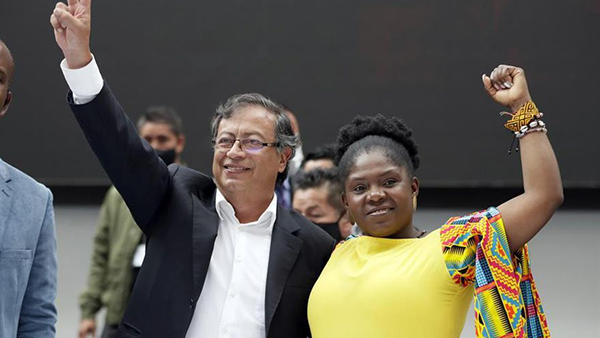
The mere triumph of Gustavo Petro and Francia Márquez in Colombia is a historic event. It expresses a profound republican and democratic transformation, something that, unlike in other Latin American countries, was thwarted in Colombia during the 20th century. The assassination of Jorge Eliécer Gaitán in 1948 blocked the process of transforming the oligarchic conservative-liberal republic into a popular democratic republic and marked the political course of the coffee-growing nation.
From that moment on, the political and social fracture marked the country, while the political violence between the dominant classes and power groups—the secular wars between liberals and conservatives—transformed into a great permanent civil war between these dominant groups and the popular classes, in a great continental cauldron.
The Peace Accords (2010-2018) during the presidency of Juan Manuel Santos ushered in a new era, with a sector of Colombia's dominant groups understanding that they needed to end the conflict to achieve a qualitative leap in the process of economic accumulation and regional leadership. This was supported by the Obama administration in the United States, which sought to regain regional leadership by presenting a new image. These accords were forged amidst the first wave of Latin American national popular movements, the advancement of regional integration with an autonomist perspective, crystallized in UNASUR and CELAC, and the abandonment of armed struggle by the FARC, a point emphasized by both Fidel Castro and Hugo Chávez.
In addition to preventing a political resolution to the conflict, armed struggle was observed to be a central argument for legitimizing ultraconservative governments centered on the doctrine of the internal enemy, justifying systematic human rights violations, and perpetuating the oligarchic regime. Furthermore, it was a key element in legitimizing the presence of the US military and security and intelligence agencies.
Colombia holds a highly relevant geopolitical position for the United States and the region. Firstly, because it is part of the Caribbean basin—considered the United States' mare nostrum and its first ring of influence—where Washington has not hesitated to intervene directly when certain political and social processes were deemed to threaten the interests of its power groups and ruling classes. Secondly, because of the importance of controlling the passages between the Pacific and the Atlantic, something Colombia already experienced when the United States supported and encouraged Panamanian groups seeking to secede from Bogotá in order to control the future interoceanic canal, which occurred in 1903 after the Thousand Days' War.
Another key element of its geopolitical importance is that Colombia is the only South American country with access to both the Pacific and Atlantic Oceans (via the Caribbean Sea). This political geography bridges the great divide that runs across the continent between its Atlantic and Pacific coasts. Furthermore, its territory connects the Andean region with the Caribbean and Amazon regions, three major areas of the continent.
For Washington, exerting decisive influence over this country has been a cornerstone of its hemispheric policy. Plan Colombia, launched in 1999, sought to reinforce this policy precisely as the first signs of the Washington Consensus and hemispheric hegemony began to emerge with the rise of Hugo Chávez in Venezuela and the political fallout from the 1999 Brazilian crisis, the 1999-2002 Argentine crisis, and the 2000 Bolivian Water War. Plan Colombia also solidified Colombia's position as the world's leading cocaine producer, accounting for 40% of global production. The United States and Europe are its primary consumers, but also its main beneficiaries in the trafficking and money laundering industries. Furthermore, Colombia, along with Mexico, is now a major producer of opioids.
Colombia has been a NATO global ally for four years. It is the only Latin American country with this status, which it shares globally with Japan, Australia, New Zealand, and South Korea. In May, faced with the “worrying” electoral landscape that showed the ticket of Gustavo Petro and Francia Márquez as a possible winner, Colombia was declared a major non-NATO military ally by Washington, a status held at the continental level only by Argentina (since 1998) and Brazil (since 2019).
At the time, Petro spoke out against NATO: “NATO stands for North Atlantic Alliance. We are from the Caribbean and the Pacific, and very, very Latin American.” The question will be when he assumes the presidency and must decide whether, in international policy, progressivism aligned with globalist forces and liberal political sectors in the United States and “the West” will prevail, or a national-Latin American perspective with a focus on regional integration and autonomy. Or, at least, to define the proportions of these different, antagonistic approaches.
The Historic Pact
The Historical Pact, in political terms, emerged under the leadership of Gustavo Petro and represents an electoral alliance comprised of Colombia Humana, the Patriotic Union-Communist Party, the Alternative Democratic Pole, the Indigenous and Social Alternative Movement, the Labor Party of Colombia, Democratic Unity, and Todos Somos Colombia. Political groups such as ADA, Modep, Citizen Power 21st Century, and the Congress of the Peoples and Commons (formerly the FARC party) also joined the Historical Pact. In short, it is a large and diverse political front with a broad social base.
The triumph of the Historic Pact institutionally expresses the surge in popular struggles that began in Colombia from November 2019 to February 21, 2020, demonstrating the exhaustion of the regime under a program of peripheral neoliberalism. Regressive adjustment policies and reforms, a lack of commitment to the peace agreements, reactionary ideological conservatism, and the systematic assassination of social leaders were the fundamental reasons for the uprising.
This process was observed to a greater or lesser extent throughout the Andean region, particularly in those countries that did not experience populist national governments in the 2000s, such as Chile and Peru, to which Mexico should also be added, although in a different context. This is a key aspect of the second progressive/popular national wave that has been developing since 2019, although it has not yet fully emerged.
Both ideologically and politically, the framework expressed in the Historical Pact is extremely heterogeneous and contradictory, but it was able to take shape thanks to the existence of leadership, a clear objective, and a set of basic principles, such as, first and foremost, guaranteeing certain minimum levels of democratic republicanism. Ending the systematic assassination of social leaders would already be a tremendous achievement in a country where, from the signing of the agreements in November 2016 to March 2022, the number of victims rose to 1327.
The demands of Afro-descendant communities, the women's movement, Indigenous peoples, and environmental groups are part of a diffuse yet profound democratic republican program, which appears in both its progressive liberal and populist perspectives—where a contradiction is evident. Added to this is a redistributive promise from the "revolution of the nobodies," central to the second most unequal country in Latin America, which crystallizes in one of the first clear proposals of the future government of Gustavo Petro and Francia Márquez: a tax reform that would undo Iván Duque's and allow for the collection of some 12 billion dollars for redistributive policies.
As in geopolitical discussions, the crucial question is whether Colombia's prevailing political course will be progressive liberalism, aligned with Western liberal and globalist forces, or whether it will be national populist and Latin Americanism, with a horizon of more structural transformations and a commitment to regional autonomy. In reality, there will likely be a kind of unstable mix between these two approaches (which are not just two, by the way), in a complex transition process, like the one the entire region is undergoing—with certain aspects similar to that of 1999-2005.
In any case, both the socio-political process that began in 2019 but has its roots deep in 74 years of history, and the triumph of the Historical Pact in the political and institutional sphere, express a great setback for the Colombian oligarchic regime and a great advance for the ongoing democratic and popular republican revolution.
[1] Institute for Research in Humanities and Social Sciences – UNLP/CONICET. Co-coordinator of the CLACSO Working Group on China and the map of world power. A first version of this article was originally published at: https://www.diagonales.com/opinion/petro-en-colombia–revolucion-democratica-y-aspectos-geopoliticos_a62bf7c764a6fb2297aca1da3.
If you would like to receive more information about CLACSO's training programs:
[widget id=”custom_html-57″]
to our email lists.

