
“The pension system, a commitment to the entire population”
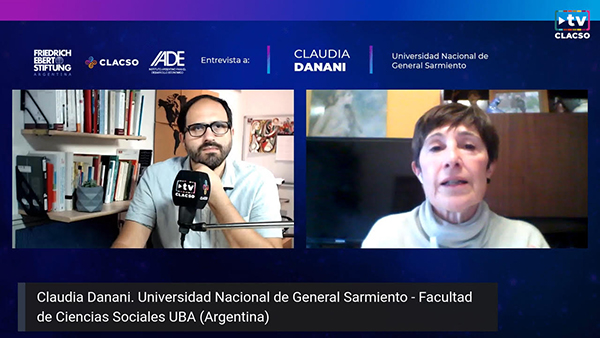
Argentine researcher Claudia Danani, from the National University of General Sarmiento and the Faculty of Social Sciences of the University of Buenos Aires, participated on Monday, September 14, in the 4th meeting of the virtual Conversation on social security and pension system: What does the Argentine pension system need to change?, organized by CLACSO, the Friedrich Ebert Foundation, the Argentine Institute for Economic Development (IADE) and the CLACSO Working Group on Social Security and Pension System.
Interviewed by Gustavo Lema
Claudia Danani explained that “the long, much-discussed, and debated path ahead, which will require a great deal of work but is well worth undertaking, is one in which we can reconsider the nature of the protection afforded by what we currently call the pension system—from a system to protect retiring workers to a system that protects the entire elderly population. That is, to broaden its scope as much as possible, to consider it a commitment to the entire population. It probably isn't, and shouldn't be, absolutely equal across all levels, but it should, in any case, approximate the living conditions that, at that stage of life, depend much more heavily on monetary transfers. In other words, a system that doesn't simply replace income, because the old, traditional pension systems were tied to a heroic history of the working classes' struggle for better living conditions, as well as to the solidarity of very immediate groups. The transformations in work and in the working classes mean that today we must think about solidarity in a very different way. I believe that being able to think about it in a A broader and more equitable approach is made possible by the ethics that precede any technical decision, and of course, any decision regarding resources. Is distribution limited to the pension system? No, of course not. This certainly extends beyond the pension system and involves—and this is much more difficult—confronting the overall economic and institutional functioning. That's why I say it's a long-term issue, but I think it also speaks to the value of the discussion.”

They also presented at the discussion:
Fernanda Vallejos. Member of the Argentine National Congress.
Miguel Fernández Pastor. Lawyer. Former director of ANSES (National Social Security Administration of Argentina) and of the Inter-American Center for Social Security Studies.
Elsa Rodríguez Romero. Lawyer and professor. She heads the Social Security Commission at the Argentine Federation of Bar Associations.
If you would like to receive more information about CLACSO's training programs:
[widget id=”custom_html-57″]
to our email lists.

