
“The role of higher education in addressing the social challenges of Latin America and the Caribbean”
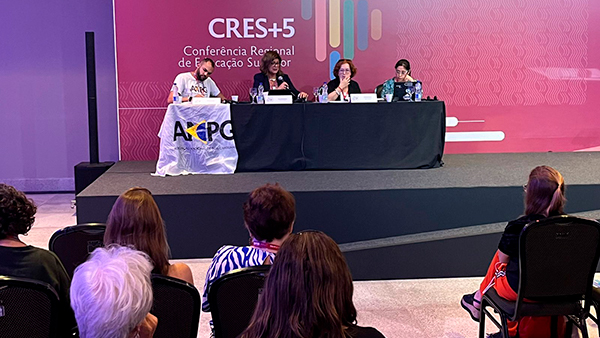

Within the framework of the Regional Conference on Higher Education (CRES+5), which met in Brasilia from March 13 to 15, the Executive Director of CLACSO, Karina Batthyány, participated on Wednesday the 13th in the Symposium “The role of higher education in addressing the social challenges of Latin America and the Caribbean".

The Third Regional Conference on Higher Education in Latin America and the Caribbean (CRES 2018), held in Córdoba (Argentina) in June 2018, adopted a Declaration and Action Plan 2018-2028 and, at the same time, committed to holding a follow-up meeting five years later (CRES+5) to promote a participatory process that would highlight the progress made, as well as the remaining challenges and emerging issues, especially in the wake of the COVID-19 pandemic crisis.

CRES+5 thus becomes an opportunity to analyze the achievements of higher education in Latin America and the Caribbean and, at the same time, to establish priorities for the next Regional Conference on Higher Education in 2028.
The Academic Secretary of CLACSO is participating, Pablo Vommaro, and various Working Groups.
At the opening ceremony, Brazil's Minister of Education, Camilo Santana, emphasized that with CRES+5, Brazil is resuming the dialogue on expanding and improving higher education in Latin America and the Caribbean, and the importance of universities and federal educational institutions in defending democracy and social development. He also highlighted that the development of higher education in Brazil has seen its greatest progress in the last 20 years, beginning precisely with the first administration of President Luiz Inácio Lula da Silva, a president without a university degree.
Santana also used the ceremony to announce the launch of two new programs to promote higher education and integration with the other countries participating in the conference, with investments of over 120 million reais. In the first program, the Brazilian government will invest 102 million reais over eight years in the Montevideo Group (AUGM), which brings together 41 universities from Brazil, Argentina, Bolivia, Chile, Uruguay, and Paraguay. The second program, Mova La América, will invest 20 million reais to offer 500 master's and doctoral scholarships to students who want to complete internships at Brazilian federal institutions. Finally, Camilo Santana emphasized that investing in the expansion and improvement of higher education in Brazil is not an option, but an obligation.
Stefania Giannini, UNESCO's Assistant Director-General for Education, participated in the opening with a recorded video message in which she highlighted the four priority points of UNESCO's agenda in higher education: defending the universal right to higher education, as inequalities in access still persist; ensuring quality to promote and encourage academic excellence and scientific research; promoting internationalization to foster cooperation and regional integration, as in the case of UNESCO's Regional and Global Conventions; and transforming higher education, adapting it to current and future challenges.
The director of UNESCO in Brazil, Marlova Jovchelovitch Noleto, emphasized that education is a fundamental right for guaranteeing access to all other rights, being “the cornerstone and driving force of more just, inclusive, resilient, and democratic societies.” Marlova noted that expanding access to higher education is crucial for reducing inequalities in the Latin America and Caribbean region.
DOWNLOAD FINAL DECLARATION CRES+5
If you would like to receive more information about CLACSO's training programs:
[widget id=”custom_html-57″]
to our email lists.

