
"Structural racism is still present in our societies."
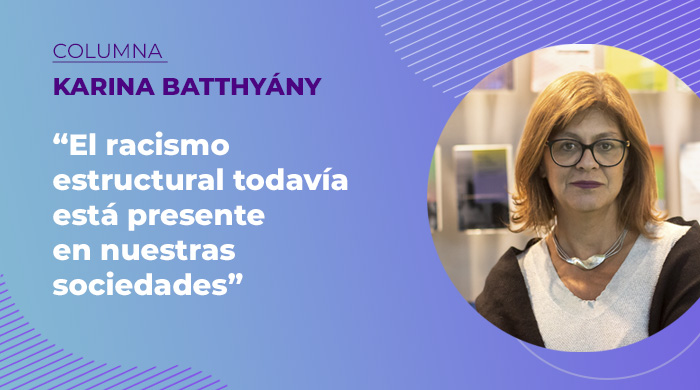
Transcript of Karina Batthyány's column
in InfoCLACSO – June 21, 2025
The 30th March of Silence in Uruguay
The reason we hold our 30th March of Silence in Uruguay every May 20th is because of the wounds of the past. We all gather on Avenida 18 de Julio, the main street of Montevideo, to march to Plaza Libertad with signs bearing the names of those who disappeared during the last civic-military dictatorship, demanding Memory, Truth, Justice, and Never Again.
This year, the 30th March's slogans were "Never Again 30 times" and "Know How to Fulfill Your Promises. Where Are You?" alluding to two elements. One is the central part of our National Anthem, and the other is "We Will Know How to Fulfill Our Promises," which the Broad Front, along with current president Yamandú Orsi, used during their election campaign.
The March of Silence is one of the largest and most moving marches in Uruguay, where the main avenue of our city is left in absolute silence and any noise seems strange among the hundreds of thousands of people who march in demand of the disappeared and for the construction of collective memory.
Each year more and more of us participate in the march and the work throughout May as "Month of Remembrance", intervening in different ways in the urban spaces of Montevideo and other cities in the country to demand Memory, Truth, Justice and Never Again.
I highly recommend this march to anyone who happens to be in Montevideo on May 20th and is able to participate. It will be an unforgettable experience, a deeply moving event from the moment the main column approaches Plaza Libertad to the naming of all the disappeared persons from that dark period in our country's history.
I want to emphasize, once again, that it was a massive march with the participation of many young people, which guarantees the continuity of our struggle.
African American identity, yesterday and today
On the other hand, every May 21st, Colombia commemorates "Afro-Colombian Day" to celebrate the abolition of slavery in the country on this day in 1851. It is a day not only to remember what slavery was, but also to highlight the moral strength of the Afro-Colombian community, as well as to reclaim its cultural identity and origins.
The history of the African presence in Latin America is marked by the most brutal form of human exploitation: slavery. For more than four centuries, people of African descent were subjected to such cruel and degrading conditions, but they also resisted and fought for their freedom.
According to historical accounts, this occurred when Spanish colonizers saw a drastic reduction in the workforce of the enslaved indigenous population due to mistreatment, deplorable conditions of forced labor, and diseases imported from Europe. It is worth remembering that between 1.500 and 1.750, the native population of Spanish America fell from 41 million to 13 million.
From that point on, the oppressors of the time promoted a law that allowed the purchase and importation of enslaved Africans to replace Indigenous people in the hardest agricultural and mining jobs. Thus, from the beginning of the 16th century until the mid-19th century, 15 million men, women, and children were victims of the transatlantic slave trade.
The first enslaved Africans arrived in 1.501 on the island of Hispaniola, now shared by the Dominican Republic and Haiti. Chained and severely malnourished, they were crammed into the holds of ships. It is estimated that 30% died at sea or fell ill from infections and were simply thrown overboard.
Upon arrival in the Americas, a chief physician inspected them before they disembarked. After this procedure, the contractor—who enjoyed the privilege of importing enslaved Africans—paid the duties to Customs and proceeded to register them by branding the owner's initials on the back or shoulders of the enslaved men and women with a hot iron, a method legitimized by law. Then, they were confined to dark and unsanitary barracks, chained until the auction and sale. Once sold, the new owner would usually brand them again with a red-hot iron to definitively establish ownership.
The lives of enslaved men and women in the Americas differed from colony to colony, but they shared one common aspect: they had no rights as human beings and were the property of their masters, like a cart or a mule, which they discarded when no longer useful. The treatment they received on the plantations and in the barracks where they slept was generally ruthless, and they were severely punished for any act considered disobedience by their masters. Despite this, they rebelled and escaped, creating palenques or maroon camps, where their owners pursued them and inflicted exemplary punishments upon their capture.
To this day, the ruling classes in many countries of the region continue to conceal the origins and foundations of slavery, which, with its forced labor, contributed to capitalist accumulation and the industrial development of European countries. This denial is linked to the racism still suffered by people of African descent and their descendants, devaluing their cultures, the role they have played—and continue to play—in our societies, and obscuring the mistreatment and exploitation to which they were subjected for centuries, first as slave labor, then as "cannon fodder" in independence struggles or, for example, in the War of the Triple Alliance from 1865 to 1871 between Brazil, Argentina, and Uruguay against Paraguay. This was compounded by the cholera and yellow fever epidemics that caused widespread death among the poorest, including Afro-descendants in the southern part of the continent.
National Afro-Colombian Day is an opportunity to look back and share with new generations the great events that have shaped our identities and to celebrate the cultural diversity that lives within us. It highlights the struggles for freedom and dignity of the African populations brought to America by force, symbolized by the night of August 22-23, 1791, when a group of men and women, taken from Africa and sold as slaves, rebelled against the system in what is now Haiti to gain freedom and independence. This uprising ultimately led to independence and the abolition of the slave trade in the country in 1804, followed by Cuba, Mexico, and much of Latin America, with Brazil being the last to abolish slavery in 1888.
From this column, we salute the commemoration of Afro-Colombian identity today, in the very country that will host the X Latin American and Caribbean Conference of Social Sciences in less than three weeks, from June 9 to 12 in Bogotá, where contemporary racism will be a topic of debate and analysis in keynote speeches, panels, and roundtables to continue building alternatives to definitively overcome this racism still present in our societies.
– Beyond the abolition of slavery, there is a continuation of the logic of discrimination and structural racism, as well as logics of labor segregation and how extractive industries are closely linked to racist violence. How difficult it is to look at this situation without considering it in the present, not because of slavery itself, but because of its consequences to this day, isn't it?
– Of course. Structural racism is still present in our societies, in educational systems, in the participation of different social structures, and we continue to observe it daily.
If you would like to receive more information about CLACSO's training programs:
[widget id=”custom_html-57″]
to our email lists.

