
Progressivism in the face of the geopolitical, democratic and health crisis
“Progressivism in the face of the geopolitical, democratic and health crisis. Who said that all is lost?” is the theme of the meeting organized by the FES/TomaPartido project of Uruguay on February 8, 2022.
The meeting opened a space for discussion about the current challenges facing progressive governments and parties, with the participation of Karina Batthyány, Executive Secretary of CLACSO, Rolf Mutzenich, leader of the Social Democratic Party (SPD) parliamentary group in Germany, Giorgio Jackson, political coordinator of the government of Gabriel Boric of Chile, and Fernando Pereira, president of the Broad Front of Uruguay, in moderation Dörte Wollrad, FES.
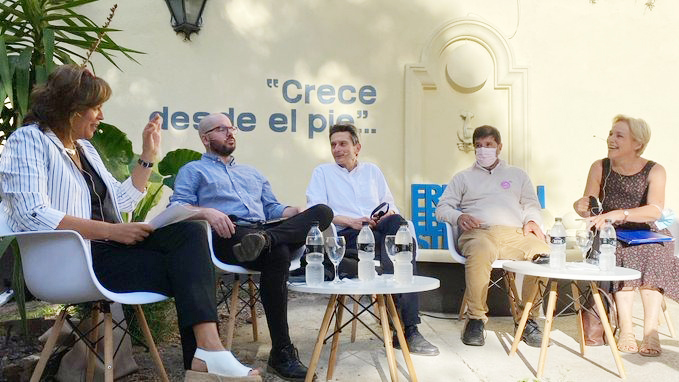
In her introduction, Karina Battyány argued: “I believe that the agenda of our progressive projects should pay closer attention to the fissures in the cultural and political order that permeate our societies, because these fissures affect our spheres of coexistence, from which we build citizenship. These fissures are calling into question achievements we thought were irreversible. Today, in our democracies, old inequalities coexist with new forms of exclusion. That is why we need to revisit some concepts we thought were set in stone, such as Democracy, Citizenship, and also Equality, a concept that, I believe, should be the guiding light of progressivism.”
She then added: “The relationship between feminism and democracy offers us some very interesting insights. I firmly believe in the urgent and imperative need to overcome the culturally homogeneous and patriarchal foundations upon which we have built our states and democracies in Latin America. Democracies that arose from the political exclusion of women, and which, in many ways, persists to this day. Therefore, promoting democratic practice requires making democracy more complex, questioning the liberal notion of democracy—a point where feminism has made a significant contribution, placing the political nature of the private sphere at the center. Our old slogan, ‘the personal is political,’ but brought to the forefront and interpreted in light of this century. This implies placing the everyday and the private sphere at the heart of politics.”
He continued: “We must be very wary of current anti-democratic traps, such as the tension between the market and citizenship, or, if you prefer, between democracy and economic development. We must address the issues of well-being and the need to establish and universalize robust social welfare institutions. This became abundantly clear during the pandemic.”
“How do we deepen and enrich the concept of equality and the recognition of differences?” Batthyány asked. “We must build an alternative perspective on models of coexistence, placing the everyday at the center of politics, constructing new social pacts where we finally change gender relations in a truly more equitable way. And that is only possible if we place the political dimension of everyday life at the center. If we position the commons as something political. And when I say the commons, I don’t just mean the public sphere, which of course is part of the commons. But the commons is something broader: it is a space of social relations, of reciprocal bonds; it is building alternative meanings to our ways of being in the world. All these issues include care, a key theme for gender equality. Creating these new social pacts requires keeping in mind the concepts of democracy, collective action, interdependence, solidarity, and care.”

The two years of COVID-19 reinforced and globalized pre-existing political trends: the crisis of representation, the questioning of democratic norms, increasing aggression and polarization, and the socioeconomic and political exclusion of sectors of society. The responses of conservative parties and even the new far right initially captured electoral attention. But currently, nuances are emerging that have allowed progressive forces to return to government in some countries, including Germany and Chile.
The German Social Democratic Party (SPD) recently regained the leadership of the government after 16 years, during which it participated—with the exception of four years in opposition—as a junior member of coalitions. The victory is attributed to a strategy of balance and unity among the different factions within the party. Now the SPD faces the challenge of governing in a diverse coalition (a "traffic light" system with the Greens and Liberals) in the midst of a pandemic, as well as the ongoing task of party transformation.
In Chile, a new progressive front won the presidency after intense protests and conflicts—in a country considered the most stable, yet one of the most unequal in Latin America. With a constitutional process underway, no parliamentary majorities, and facing a high level of urgency and expectation for reforms, the new government faces the daunting task of defining and negotiating its agenda.
Entering its third year in opposition, Uruguay's Broad Front is settling into its role while debating its agenda for 2024. The party's elections signaled a move toward programmatic reforms, as well as a generational and gender shift. Meanwhile, the new president has a proven track record as a negotiator and embodies a commitment to dialogue and unity. The new leadership faces both high expectations and resistance.
While the context and political systems differ between Germany and Latin American countries (presidential – parliamentary, etc.), bilateral progressive party ties have a long history. In times of increasingly global challenges, internationalist exchange and progressive alliances are more necessary than ever. Taking advantage of the visit of the head of the Social Democratic parliamentary group, Rolf Mützenich, to Uruguay, the FES/TomaPartido project is opening a space for discussion about the current challenges facing progressive governments and parties.
What consensus-building strategies counteract divisions in societies? What lessons from previous progressive governments and from the pandemic should be considered when defining progressive policies? What internal party reforms are necessary in the face of the crisis of representation? How can we clearly differentiate agendas and roles between government, parliamentary groups, and parties? And what can and should we do together in an internationalist effort by progressive forces, which are currently more divided than ever?
If you would like to receive more information about CLACSO's training programs:
[widget id=”custom_html-57″]
to our email lists.

