
“The aging process must be an element incorporated into public policies”
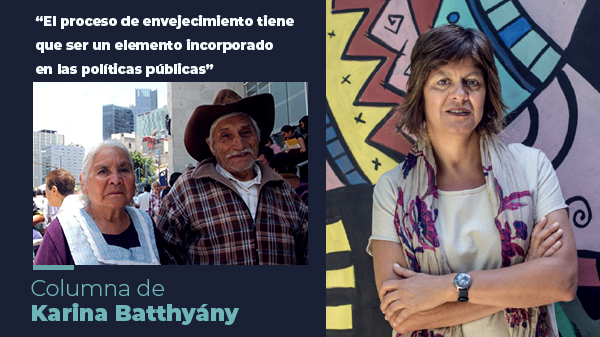
(Transcription of Karina Batthyány's Column)
(In InfoCLACSO – July 21, 2021)
“Living longer” is one of the most structural phenomena in our reality in Latin America and the Caribbean. I propose, then, that we continue with our column on the topic of aging, which we began last week, due to the concern that the World Health Organization (WHO) wants to classify old age as a disease, and we presented our critical analysis of this.
But let's delve a little deeper into this topic. As we mentioned last Wednesday, the proportion of older people is increasing rapidly in our Latin American and Caribbean countries, and this aging population presents many challenges in terms of care—what we call new care needs. This is because the aging process is compounded by two other demographic factors: the decline in births or fertility rates, resulting in smaller households, and the increase in the labor force participation rate of women in Latin America and the Caribbean.
What distinguishes us from the rest of the world is that this aging process is occurring at an alarming rate in our region. In other countries, the issue of care for dependent elderly people has been incorporated into public and social policies as a social "risk" since the 70s and 80s. In our region, however, we have only recently begun to pay attention to it, and this attention should be of particular concern because we have insufficient health services, limited access to retirement plans, pensions, or social security, and a very high percentage of the population working in the informal sector of the economy, thus lacking social security coverage or access to pensions.
In fact, most of the elderly people living in our region today lack formal social security protection in their countries and depend primarily on their families to meet their care needs. And we know very well here—because we've said it on several occasions—that when we say someone depends primarily on their family to meet their care needs, we mean they depend primarily on the women in their family to meet those needs.
Today, we have 8 million dependent older adults in Latin America and the Caribbean. This represents approximately 12% of the population over 60. But that is the situation in 2021. In 30 years, it is estimated that the number of dependent older adults will exceed 27 million. That is, this number will triple, which is why it is urgent to start thinking now about policies or systems for dependency care, these care systems for dependent individuals without the need—I insist—for that care to come from women in the family, and moreover, without pay, as is currently the case in our region. This is the main basis for meeting the care needs of dependent older adults today, and this is what we intend to change. Among other reasons, because the idea that there is always a woman available in every household to care for anyone, whether a child or a dependent older adult, is a myth; Precisely because of our current structure, both demographically and in terms of labor market integration, this situation is no longer the case. Let's also remember that female labor force participation in Latin America was approximately (depending on the country) 20% in the 60s, and today it exceeds 60%.
Obviously, this marks changes, as I mentioned, in the supposed availability, or lack thereof, of women to provide this care within the home. Therefore, what we need are national care systems that address dependency, that care for dependent older adults. This implies the challenge of developing public policies so that these dependency care services can be generated for everyone, and so that access to these services is not determined by economic status or the ability to purchase these services on the market.
We need to analyze the ways in which care is currently being provided in our countries in order to propose alternatives that will alleviate pressure on caregiving, shifting it from homes to public, universal, and high-quality services. To this end, let us remember that we know the main care policies involve service policies, time-based policies, or benefit policies that allow us to gradually transfer the primary responsibility for the care of dependent older adults from homes to the collective and public sphere.
These are the transformations that will ultimately allow us to incorporate the good news of aging and the fact that we all have the possibility of living longer within the framework of available services to address dependency when the time comes, when we reach the age at which these reasons for dependency begin to appear. We should therefore celebrate the good news of increased life expectancy in our region, but remember that this must be accompanied by care policies that ensure everyone receives the care they need without it depending on the women in their families, unpaid work, or the household structures that each of us has.
All the initial anticipation surrounding social measures gives the impression that some governments are trying to downplay these discussions, sideline them, and prevent them from taking center stage. Do you also feel that it's more important than ever to engage in these discussions? Because, seeing that things are settling down a bit with the pandemic, they're trying to push aside these fundamental debates.
Absolutely. Last year, we also mentioned in some of our columns that this was an excellent opportunity to re-evaluate the social contracts or pacts we have in our countries and in our welfare systems. The impression is that, firstly, the events of the past year and a half haven't significantly altered, for example, the gendered division of labor within households, which would have been an excellent opportunity to do so, but it hasn't happened. The research data shows that this division not only persists but, in some cases, has intensified. Secondly, the concern surrounding universal, high-quality public policies, the role of the state and the welfare state in all these issues—a concern that was so prominent at the beginning of the pandemic as a topic of discussion, as a possibility—doesn't seem to be reflected in the measures being taken at a general level. Of course, there are countries in Latin America and the Caribbean that are implementing them.
If you would like to receive more information about CLACSO's training programs:
[widget id=”custom_html-57″]
to our email lists.

