
“The Feminist Movement is the most important social movement in our region in recent years.”
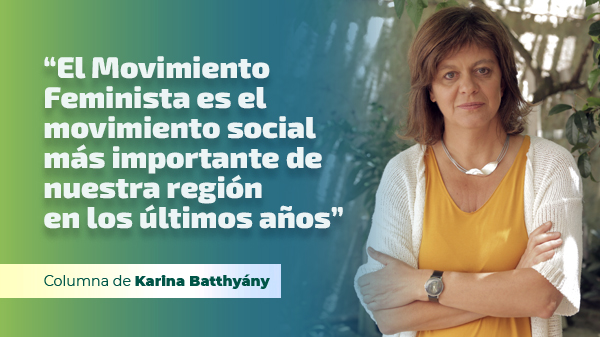
(Transcription of Karina Batthyány's Column)
(in InfoCLACSO – March 2, 2022)
Conflict between Russia and Ukraine
CLACSO calls for an urgent, peaceful resolution to this highly complex geopolitical conflict between Ukraine and Russia, which, of course, has historical roots. We believe it must be resolved peacefully and through negotiation, prioritizing the interests and well-being of the people of Ukraine and Russia and avoiding the high humanitarian costs that always accompany such situations of armed conflict.
We know that people and communities are the first victims of wars and of all kinds of sanctions imposed in these situations – including economic sanctions – and for that very reason, we call for hostilities to cease as soon as possible.
We firmly believe that peace is built through dialogue, consensus, without aggression, without the use of force between states, and respecting a principle that is absolutely fundamental for CLACSO: the self-determination of peoples, and above all, respecting human rights.
We know how the fragile balance of this region has been disrupted, and from Latin America and the Caribbean (declared a zone of peace), we owe it to ourselves to conduct a deeper study of this entire problem. We therefore want to commit to opening a space for debate and analysis from a multidimensional perspective that encompasses the sociological, political, legal, historical, and economic dimensions of this situation.
March, CLACSO Women's Month
-In the last few hours, we witnessed a brutal act of violence involving the abuse and rape of a young woman in a central neighborhood (Palermo) of Buenos Aires. We understand that this is happening in many places, but it serves as a stark example of the brutality that exists today… What are some of the issues you believe need to be addressed during this Women's Month?
-First, we want to revive the idea of Women's Month, which we've been implementing at CLACSO for the past three years, as a way to further highlight the inequalities faced by women in Latin America and the Caribbean. We work on the topic of feminisms throughout the year; gender equality is a central theme at CLACSO, it always has been and it's becoming increasingly so, and we've given it particular prominence in these last three years.
I can already announce that these topics will be addressed at the Ninth Regional Conference #CLACSO2022. It's almost a feminist conference, where feminisms will be one of the central themes of our program. What topics and elements? There are many… But I would focus on the notion of autonomy and the different dimensions of women's autonomy. Economic autonomy, first and foremost, relates to women's integration into the labor market, to income generation, to the possibility of having our own income and not being economically dependent on anyone. And also within that economic dimension, those elements that generally prevent women's full participation in economic life, such as unpaid work and caregiving, which we have addressed so many times in the Info CLACSO columns. Economic autonomy, then, in the terms outlined, but also autonomy in decision-making, refers to the possibility for women to be present in the spaces where decisions are made at the global, national, and local levels, in all areas. This includes, of course, political participation, but not only in unions, in companies, in social movements, but in all places where decisions are made.
And this autonomy in decision-making is also related to another concept, which I find very important, which is breaking down the idea of equity into three "equi": equiphony, equivalence, and equipotence. Obviously, equivalence refers to economic autonomy; equiphony and equipotence refer to autonomy in decision-making, which involves sharing decision-making spaces but also equiphony, so that our voices as women not only have a place everywhere and are heard, respected, and taken into account. Because we often know what happens when we talk to women in different spaces.
So, economic autonomy, autonomy in decision-making… and I've left physical autonomy for last, because it refers precisely to two major elements: the entire chapter on sexual and reproductive rights (which we've also addressed in InfoCLACSO), starting with the recent approvals in Latin America of the Voluntary Interruption of Pregnancy in Colombia (and further back in time in Argentina), but it also refers to gender-based violence. I dare say that if there's one thing common to all the countries of Latin America and the Caribbean, it's the issue of violence against women, a topic that occupies a top spot on the public gender agenda, a top concern. It's a regrettable constant in all our countries, and its forms of expression are many, from femicide, like the deplorable, condemnable, and reprehensible event that occurred in Palermo (Buenos Aires, Argentina) recently, which is not an exception. Unfortunately, it's also a regular occurrence. It recently happened in Uruguay and in various Latin American countries as well; these are brutal and terrible forms of expression of patriarchy and male domination over women in our society.
I was thinking about the multidimensionality you were highlighting in the difficulties of gender violence, the light and shadows in a very diverse Latin America and the Caribbean. Some countries are making progress thanks to feminist struggles, but we also see these setbacks with very brutal situations, or even with conservative sectors that claim a right to representation and try to drag things backward. The panorama is complex because, besides being diverse, it is also highly variable, depending on the region of Latin America where the situation is observed.
Absolutely. It's also worrying how these conservative discourses have gained ground in various Latin American countries, to the point that they loudly proclaim anti-feminism and the absolute fabrication of gender ideology, precisely to counteract what has been the most important social movement in our region in recent years: the Feminist Movement. An example of this is the famous Green Wave, which has spread not only across our continent but also beyond. So, all these issues present both positive and negative aspects. Because we must also acknowledge the progress that has occurred in the last 50 years, but this progress is also severely overshadowed by the brutal setbacks that these two years of pandemic have brought to the situation of women in Latin America and the Caribbean from every perspective. Let's recall the ECLAC report we mentioned a few weeks ago, which speaks of decades of setbacks in the situation of women in our region. That's why CLACSO dedicates a whole month to International Women's Day, because dedicating just one day (March 8th) wouldn't be enough to delve deeply into each of these elements. And that's also why we're planning a series of activities that will take place throughout the weeks of March, and my columns in InfoCLACSO this month will focus on the underlying theme of addressing different dimensions and the current situation in our region from the perspective of gender inequality.
If you would like to receive more information about CLACSO's training programs:
[widget id=”custom_html-57″]
to our email lists.

