
The popular uprising of April 28th in Colombia: between political and historical significances
Jymy Forero Hidalgo *
The popular movement, with its rebellious dignity, has already brought about a significant transformation and earned a place in the other, possible Colombia that is emerging. It has sown and watered the seed of hope, spreading it across the continent and the world!
1. Structural and situational keys to understanding the current popular uprising.
The popular uprising that began on April 28th in Colombia, led by a diverse and multifaceted citizenry, is framed by both recent and medium-term circumstances. On the one hand, the exacerbation of a social crisis resulting from the Covid-19 pandemic, which led to considerable deterioration in all aspects of social life, constitutes a significant contributing factor. This is compounded by a growing and widespread rejection of the Duque administration due to its inept handling of the pandemic, its cynicism regarding the protection of social leaders and its failure to fulfill commitments to the diverse social movement, and its brazen approach to fiscal policy, which led it to propose harmful reforms—such as tax, health, and pension reforms—at the expense of lower-income sectors, ultimately triggering the popular explosion. An additional element that frames this situation is the rise of social struggle at the Latin American and global levels. Therefore, this uprising, qualified by the forces of the pandemic, is the continuation of the discontent and uprising expressed since November 21, 2019 in Colombia, and constitutes the main obstacle to the dominant project of the country.
On the other hand, structural factors include the model and nation-building project promoted and implemented in Colombia for the past 30 years, based on neoliberal doctrine—with disastrous results for social welfare—which is currently converging with a global multidimensional crisis. This crisis, present before the pandemic but exacerbated by it, is characterized by breakdowns and instability in the accumulation regime and the reproduction of the global capitalist system. It is a crisis of multiple dimensions, proportions, and consequences, simultaneously economic, health-related, environmental, financial, and social, and it jeopardizes the existence of all forms of life on the planet. This model, applied throughout Latin America, is based on monopoly, the concentration of wealth, the financialization of life, the commodification of rights, and the control of life and death; a model that has clearly failed and is unsustainable despite the call from the Davos Forum's mentors to "reboot capitalism."
Looking at the bigger picture, the political landscape in the region has grappled with the aforementioned structural factors, from Chile to Ecuador, from Colombia to Argentina, including Bolivia and Peru. In recent years, it has reflected, in diverse ways—whether through social mobilization, electoral processes, or collective action—an undeniable reality: the neoliberal, extractive, and speculative financial model of capitalist accumulation has deepened levels of inequity and social injustice, making profoundly unequal societies more evident. These are societies where, to borrow Gaitán's rhetoric, a deep-rooted "national country" coexists with a privileged elite or "political country." To quell the crisis and establish social control, the ruling classes have resorted to exacerbating authoritarianism, racism, xenophobia, aporophobia, segregation, and, in many cases, fascist mentality.
2. 'Common sense' has been transforming.
In the Colombian case, 20 years ago Uribismo was an alternative for many in the country. The socio-economic crisis, the failed negotiations with the insurgency, and the prevailing institutional rejection at the time gave great approval and support to the Uribista project, which promised to defeat the insurgency on the battlefield and overcome corruption. The initial results in counterinsurgency and economic growth, albeit at a high human and social cost, seemed to intoxicate the elite—who were recovering their profit margins—and a segment of society that perceived not only greater security but also that the country was shielded from the global crisis. Thus, the crisis appeared to be a thing of the past, and therefore, it was deemed necessary to maintain this messianic-charismatic figure in the presidency.
Despite Uribe's interest in a third term, a national, multinational, and transnational financial elite, along with the White House, believed that the neoliberal project could continue without him. Soon, the effects of the 2008 crisis reached Colombia. The fall in commodity prices in the international context weakened the economy, and a new struggle among elites took hold regarding control of the state, the deepening of the existing model, and the embryonic peace negotiations. This was the context for the first major surge of the popular movement in the new millennium, the rebirth of grassroots initiatives, which, over the years, would grow stronger, marking a new period of political and class struggle at the national level.
Let's be clear: Uribismo represented change, for many, in the handling of the crisis at that time. Today, unlike yesterday, it represents the continuation of an even deeper crisis, one that the elites themselves have generated. Consequently, broad social and popular sectors are demanding a change of course; they are fed up with the same old thing: corruption, bad government, and injustice. In other words, faced with uncertainty, people prefer change; faced with stability, people prefer continuity. Twenty years after the emergence of Uribismo, the country is different, one in which a multidimensional global crisis converges with an internal crisis stemming from the exhaustion of the neoliberal economic model and the Uribista political project. This does not mean that the project lacks significant social and economic foundations, nor that a segment of society is unconservative and right-wing; The victory of the "No" vote in the 2016 peace referendum and the election of Duque in 2018 not only gave Uribismo a new lease of life but also demonstrated that it maintained a significant base and a level of popular acceptance, albeit declining, despite the maintenance of regional and illegal powers and the alliance with sectors of the dominant classes.
3. The Duque government treats social protest like a war.
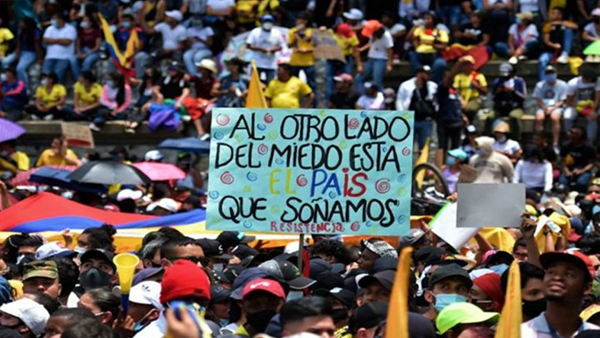
Rebellion and dignity come at a high cost for the people. The Creole ruling classes have reacted treacherously, employing all their power strategies in the face of popular demands for rights and the progress of their struggles. Days before April 28, the national government, private monopolies, and some local governments made repeated calls through their media agencies and conglomerates, urging the organizers of the National Strike to refrain from taking to the streets, citing fears of the spread of the epidemic. This was compounded the day before the strike by a demobilizing ruling from a judge of the Cundinamarca Court, which ordered the suspension of the marches [1] . However, despite these unsuccessful demobilization efforts, the demonstrations took place on April 28 in a massive and creative fashion, taking over streets, parks, monuments, neighborhoods, transportation stations, and avenues from early morning until late at night. As the days passed, citizen participation, demands, slogans, and repression grew. In the first few days, more than 600 of Colombia's 1100 municipalities were part of the festival of dignity and rebellion sweeping the country. From the outset, the protests were concentrated in major cities; Cali had more than 33 roadblocks and demonstrations, and cities like Bogotá, Pereira, Ibagué, Medellín, and Neiva saw numerous gathering points. Starting on May 1st, embassies, consulates, main avenues, and central squares around the world also became gathering points for thousands of Colombians supporting the strike and rejecting police brutality.
Faced with the growing popular enthusiasm for the National Strike, a mixture of accumulated popular discontent and a clamor for social justice, the Duque regime escalated its coercion. On May 1, after three days of mobilizations and with a death toll of nine at the hands of the security forces, President Duque, invoking Article 130 of Law 1801, announced to the country the declaration of “Military Assistance,” understood as “the legal instrument that can be applied when events of serious disruption to security and coexistence so require , or in the face of imminent risk or danger, or to address a public emergency or calamity, through which the President of the Republic may temporarily and exceptionally order the assistance of the military force” [2].
From May 2nd onward, this decision meant a greater presence of security forces, including the ESMAD riot police and the military (Army, Navy, and Air Force), on the streets, using lethal weapons and weapons of war such as Black Hawk helicopters. They established curfews, implemented city lockdowns, disrupted communications, cut off power, and disrupted the supply of food, medicine, and fuel to citizens, as has occurred in Cali. This entire lethal and destabilizing machine, typical of an international war, was complicitly silenced by the official media, with social media being the primary source of documentation of the abuses committed by the security forces.
Spurred on and encouraged by the tweets of Duque's boss - which, in addition to inciting the declaration of "Internal Commotion," clamored for the use of weapons by the public force to defend the life and property of good people and the extermination of the protesters - the coercive and criminal actions of the police and the military were complemented by the state strategy of arming civilians (hired assassins of the State forces) to open fire in the middle of the demonstrations, particularly targeting the Indigenous Minga of the Southwest as documented for the case of Cali in multiple videos and complaints [3] , while organizing the "white shirts" in Cali and Popayán to pit people against people in the best style of the anti-worker squads known as the "black shirts" in the case of Mussolini's Fascist Party, the "brown shirts" of Hitler's National Socialist Party, or the Falangist "blue shirts".
Between May 2 and May 18, the figures for repression increased fivefold. Several organizations and NGOs, such as the Ombudsman's Office, Tembores, Human Rights International, and the "Defending Freedom: Everyone's Business" campaign, have monitored the situation. According to the latter, the Duque government is responsible for at least 51 homicides, 1330 injuries (1040 civilians and 290 police officers), 1502 arbitrary detentions, 87 victims of sexual violence by the security forces, 37 victims of eye injuries, and more than one hundred disappeared citizens [4] . These are terrifying figures that reveal a patriarchal and perverse orgy typical of wars of extermination.
What the Duque regime has done—in just 16 days—is a massacre against its own people, the largest repression during the pandemic worldwide when compared in terms of days, homicides, and human rights violations to what occurred in the USA (May 2020), Peru (November 2020), Colombia (September 2020), and Chile (October 2019). Despite this, the streets remain filled with popular rebellion. Every new death, every rape, every injury, and every instance of suffering endured by the protesters and their families is a further blow to the fall of his regime, the collapse of the model he defends, and his international condemnation.
The dignity and social discontent of the people prevailed over the fear of the pandemic, repression, and the social crisis; that is, the indignation and fear produced by the government's reforms in broad social sectors prevailed, leading them to take to the streets, defying the contagion of the virus, institutional intimidation, and of course, the bullets and terror unleashed at the hands of the State.
4. Cycles of recent popular protest and the configuration of the social-popular subject of change
In Latin America, following the attack and ideological and organizational disarmament of the workers' and popular movements represented by the implementation of the neoliberal project in the late 80s and early 90s, a decade had to pass for the recomposition and renewal of the popular subject. The first signs of this recomposition appeared with the emergence of neo-Zapatismo in Mexico, the Andean indigenous movement, the Piquetero Movement in Argentina, among others. Thus, in the last two decades, we have witnessed the rise of social struggle and the configuration of a new, alternative popular project in the region. The case of Colombia would take another decade; only with the deployment of the indigenous mingas starting in 2008 and the appearance on the public stage of the People's Congress and the Patriotic March in 2010 , the bicentennial year of the republic, did a diverse popular subject begin to take shape, one that is gaining strength and gradually assuming the political initiative.
However, the Broad National Student Assembly (MANE) would constitute the first major national mobilization in 2011, comprised of students from higher education institutions (HEIs). It mobilized broad sectors of society and, after weeks of powerful demonstrations, culminated in a major social victory: the withdrawal by the government of its proposed reform to Law 30 on Higher Education, which had a clear focus on the commercialization of public higher education. Two years later, the National Agrarian Strike raised the banners against the Free Trade Agreement and demanded attention for agriculture, driven by various producer sectors, including potato farmers, sugarcane growers, dairy farmers, and panela producers, among others. President Santos's famous phrase, "that so-called strike doesn't exist," backfired, and massive crowds filled the streets of cities in solidarity with the farmers. This large mobilization culminated in the installation of tables that gradually deteriorated over time due to the lack of governmental political will.
What happened from November 21, 2019, and April 21, 2021, are popular uprisings, called by the political, social and trade union organizations that are part of the National Strike Committee (CNP), but also self-organized by a diverse and belligerent citizenry that does not converge in the CNP, where the youth movement, the women's movement, territorial expressions, the artistic and cultural movement, have played a leading role and that configure at least three aspects of the new social-popular subject of change.
Between these recent and earlier expressions of national mobilization, other significant events have occurred. The Indigenous mingas of 2011, 2014, 2017, and 2019 have made the invaluable contribution of exemplifying for the rest of society a collective path of struggle, persistence, and the construction of autonomy, as have the civic movements in Buenaventura demanding democracy and driven by port workers, artists, community councils, the unemployed, motorcycle taxi drivers, and others. The exemplary struggles of teachers in 2019 and, during the pandemic, the mobilization known as the "red rags" as a form of community solidarity demanding a "basic income" to mitigate the social effects of the pandemic, and later, the protests against police brutality and the assassination of social leaders in September 2020, led primarily by urban youth and the feminist movement, complete the picture.
As we can see, a diverse and alternative popular subject, a blend of classic leftist traditions with renewed currents of resistance, was taking shape along this path of political struggle. This alternative subject, both organized and unorganized, and cycles of sector-specific protest, oscillating between the local-regional and the national, resulted in social gains that were later lost, only to be fought for again, or ended up in technical negotiation tables and agreements with the government that were never fulfilled. Only from the struggles that marked November 21st and were reiterated on April 28th was it possible to unite the diverse demands and claims of different social, political, labor, and territorial sectors into a single struggle, each time with a less purely protest-oriented and more political character, questioning the economic and political model—not just the regime—the type of democracy, and considering the possibility of building their own popular political project, autonomous and independent of the project of the dominant classes.
5. The culture of rebellion and mobilization as a way to promote political action.
The transformations in the political and cultural spheres are not limited to the institutional level. The political achievements attained thus far are invaluable: overturning the tax reform, forcing the resignation of Finance Minister Carrasquilla, and delegitimizing the healthcare reform. But clearly, this movement has the potential to go further. The last decade, and particularly the popular mobilizations and uprisings that have taken place in Colombia since November 2019, have driven and represented a transformation in the cultural sphere, a democratization of ideas and subaltern political practices. It is a moment of the emergence of a popular protagonism that finds in demonstrations, in the streets, a way to express and appropriate social reality, common and diverse aspirations and demands, where complex and multifaceted national problems are discussed in popular assemblies. It has signified a break with a conservative popular hegemony, which oscillates between passivity and waiting for a solution from some strongman or messiah, or, in the worst cases, actively defending the established order. It is a struggle of a diverse, multi-class, and multi-sectoral popular movement within a mobilizing popular environment that identifies massive, broad, and even radicalized struggle as the means of influencing and participating politically in public and national affairs.
Where?
The challenge that has arisen in recent years for the popular movement suggests bringing together and aligning, within a single programmatic and organizational framework, the three broad strands that constitute the social-popular subject of change today. These could be characterized as follows: (a) An organized popular movement whose composition includes historical expressions of parties, political movements, social and labor organizations (workers, public employees, students, peasants), and territorial organizations, a significant portion of which converge in the CNP; (b) a renewed and organized movement beyond party lines, expressed in feminist, gender, environmental, youth, and cultural collectives, Afro-descendant, ethnic, and digital organizations, and frontline groups; (c) a broad, territorially localized, unorganized citizens' movement that has mobilized in solidarity with the struggles since 2011 and more actively since 2019.
A common project that gathers the aspirations, demands, repertoires and needs of each aspect could work towards 4 initial elements: i) demilitarization of territories, end of the criminalization of protest, the genocide of popular leaders and sanction for all gender-based violence; ii) exercise of political, economic, cultural and self-protection autonomy; iii) basic income, strengthening of public health systems and ecological tax on companies; iv) democratization of society.
* University lecturer and independent social researcher. Member of the CLACSO Working Group on States in Dispute.
[1] “Cundinamarca Court orders suspension of this week’s marches.” El Tiempo, April 27, 2021.
[2] What does military assistance in cities mean and how
Does it work? The Weather 02-05-2021.
[3] Circulated on social media and uploaded to human rights platforms
[4] https://defenderlalibertad.com/
If you would like to receive more information about CLACSO's training programs:
[widget id=”custom_html-57″]
to our email lists.

