
The lifting of the Inti Raymi on June 22
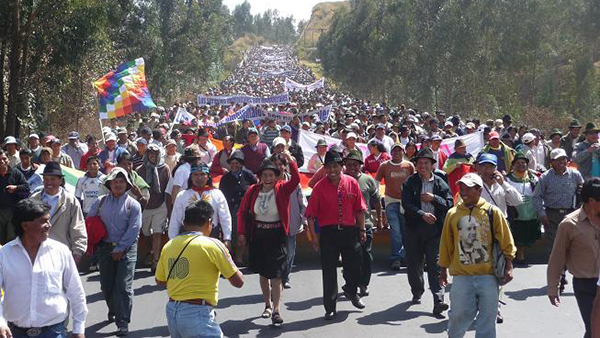
The return of the rainbow warriors
Pablo Dávalos [1]
Introduction
On May 25, 2022, Leonidas Iza Salazar, President of the Confederation of Indigenous Nationalities of Ecuador (CONAIE), warned the country that a National Strike would take place on June 13 of that year, similar in its characteristics to the one in 1990. In this instance, the CONAIE leader's reference to the movement's origins reflected the expectations the National Strike leadership had regarding the announced mobilizations. History would prove that those expectations were met, and then some.
The indigenous leader's warning came the day after President Guillermo Lasso's annual address to the National Assembly, where he took the opportunity to reaffirm his intention to continue his program of adjustment, reducing the size of the State, public disinvestment, and privatizations, in such a way as to expedite compliance with the conditions agreed upon with the IMF.
On June 13, 2022, as announced by Leonidas Iza Salazar, the Ecuadorian indigenous movement began an uprising that it described as having a national, territorial, and indefinite dimension. It was national because its agenda encompassed most social sectors; that is, it was not solely an ethnic agenda. It was territorial because the indigenous resistance began in the territories of the communities. And it was indefinite because its resolution depended on the government's political will to reach agreements based on the demands made.
The political agenda of this uprising was called: “National Struggle Agenda”, and it is summarized in ten points in which public policies of social care are claimed and demanded and, in addition, through this Agenda, the indigenous organizations try to stop the neoliberal drift that had become radicalized with the government of Guillermo Lasso.
For 18 days, the national mobilization steadily increased, a process in which the Guillermo Lasso government progressively accumulated errors while the Indigenous leadership demonstrated a more strategic vision. As the days passed, the government lost ground in terms of social legitimacy, while CONAIE, FEINE (an organization of evangelical Indigenous people), and FENOCIN (an organization of Indigenous farmers and Afro-descendant communities), the organizations that convened and organized the national mobilization, gained ground.
This indigenous uprising demonstrates that, since that mobilization of 1990, the Ecuadorian indigenous movement has become a political subject that demonstrates an organizational capacity to paralyze almost the entire country, control the territories in which it has organizational structures, articulate a programmatic agenda that arouses the adherence of many social sectors, and maintain a leadership that attracts and arouses consensus and national recognition.
It is therefore necessary to look inward at the Indigenous movement to understand how this mobilization was organized, how its agenda was structured, and how organizational, logistical, and strategic aspects were handled. Ultimately, it is about understanding how the largest social mobilization in Ecuador since that of October 2019 was conceived and carried out, from the perspective of the political actor that led it: the Ecuadorian Indigenous movement. Undoubtedly one of the most important and influential social organizations in all of Latin America, they achieved what seemed impossible: getting the neoliberal and ultraconservative government of Guillermo Lasso to sign an agreement with Indigenous organizations as direct interlocutors with the government, thus disrupting, in a way, the neoliberal agenda of his administration.
The Agenda
First, it is necessary to analyze and understand the political agenda of the indigenous movement for this situation, the so-called: “ National Struggle Agenda ”, because the construction of this platform was a process of dialogue and community consensus that began to take shape as soon as the new leader of the indigenous organization, Leonidas Iza Salazar, was elected in mid-2021.
The National Struggle Agenda, with which CONAIE, together with FEINE and FENOCIN, legitimize and organize their uprising and mobilization, was built collectively and expressed the phenomenal forms that the accumulation of capital assumes and its effects on communities and popular sectors.
Indeed, for those who experience the consequences of neoliberalism in their daily lives, it manifests itself in increasingly expensive transportation costs, increasingly unsustainable agricultural production costs, increasingly inaccessible basic goods, unemployment, neglect of health centers and public hospitals, and schools without teachers and infrastructure, among other things; therefore, the community dialogue process initiated by the president of CONAIE and allied organizations was a political process that catalyzed their demands.
This process of community-based political agenda building transforms the leadership into a kind of spokesperson, where Indigenous leaders must "lead by obeying." They cannot deviate from this agenda, regardless of their own convictions and ideology.
Since mid-2021, the new national leadership of CONAIE, headed by Leonidas Iza Salazar, made a gigantic effort in just a few months to visit, literally, commune after commune, and indigenous and social organization after indigenous organization, to build, discuss, debate and validate CONAIE's political agenda and then reach a consensus with allied organizations such as FEINE and FENOCIN.
In these discussions, the community members are aware that their agenda has no chance whatsoever of being accepted by the government without a process of social pressure and resistance, because, in fact, they had already tried several times without success. History has taught them that all dialogue with those in power is mediated precisely by mobilization and social struggle. Thus, building the agenda is also the process of establishing social mobilization. The community members who discuss each point of this agenda in their communities are aware that the only way for this agenda to enter the political debate and be addressed is through mobilization, and furthermore, that the strength of the agenda depends on the strength of the mobilization; this mobilization must be forceful and must go to the furthest extent, because they are clear that they must confront a government that is radical and fundamentalist in its neoliberalism.
Thus, building the political agenda from within the communities simultaneously becomes organizing the mobilization. It is at this point that community members decide on an agenda encompassing national interests that include the poorest, while proposing mobilization from their territories and, from there, expanding it to include more and more sectors and continuing until their objectives are achieved.
This means that the mobilization does not originate from or define the CONAIE governing council or its president, Leonidas Iza Salazar, nor the leadership of FEINE or FENOCIN, but rather is the direct expression of the will of the community members in this process of building their political agenda. This is important to clarify because it marks a key difference from the way politics is conducted in the political system and in the Western world.
Political parties, those oligarchic machines as defined by political scientist Robert Michels (Michels, 2001), generally do not consult their members when making important decisions. They play politics behind the backs of their voters, their base, and even their own members. In fact, they have a habit of never validating their decisions and then justifying them after the fact, even if they contradict their ideological principles. Precisely for this reason, voters reject these practices and the politicians themselves, whom they accuse, with good reason, of opaque and unethical procedures.
However, when the political system and the government are confronted with a political event such as an indigenous uprising, they believe that by negotiating with the leadership, they can intervene in and dismantle the mobilization. They assume that the indigenous leadership can control the mobilization, when in fact the opposite is true: the mobilization controls its leaders, because these leaders are the expression of the community's will, the will that has shaped the agenda and organized the uprising.
This epistemological and political misunderstanding led Guillermo Lasso's government astray, which never managed to decipher the indigenous movement, as well as leading the press associated with the government, and the analysts, intellectuals, academics and political operators aligned with the regime, although it also led some left-wing analysts and intellectuals astray.
None of them, in fact, have ever been able to decipher the enigma of the indigenous organization. They have an epistemic incapacity to understand the motto of “leading by obeying.” Their obstinate adherence to the liberal framework of politics constitutes a serious theoretical obstacle to understanding the indigenous movement.
Just as when learning a new language and needing to translate it into one's own language, so too was the attempt made to "understand" and "interpret" the indigenous uprising, and in this way, it was interpreted and understood, basically, from a liberal perspective. Hence, this understanding and analysis has oscillated between pure and simple racism that ignores the political capacity of the indigenous movement and turns them into objects of other interests (in this case, the so-called "Correism" or also "narco-Correism"), to an attempt to see it as a threat to peace, the security of the State and democracy (the discourse of "terrorism" and "vandalism").
However, it is necessary to delve a little deeper into the National Struggle Agenda, to interpret it in a more political way and in terms of the indigenous movement as a subject, and in the context of the country's situation and the consequences it generated; in that sense, at least the following guidelines can be observed in this National Struggle Agenda:
- A strategic line that directly targets the neoliberal model and seeks to stop it;
- A current situation that allows for convergence and national consensus on its relevance, legitimacy, and fairness;
- A tactical line that allows the mobilization to graduate the struggle and make it more flexible in moments of negotiation, as actually happened;
- A line of accumulating forces, which allows the indigenous organization to de-escalate the conflict while awaiting its resolution, so that it can resume it later if the established agreements are not met.
The strategic line
The strategic line of the National Struggle Agenda, which served as the reference point for the mobilization, directly confronts the neoliberal model and is present in point 1, which calls for “a reduction and no further increases in fuel prices ” and the repeal of decrees 1158, 1183, and 1054; it is also related to point 4, which addresses “ employment and labor rights ” and “ public policies to curb job insecurity ”; to point 7, which calls for “a halt to the privatization of strategic sectors ,” with special reference to the attempt to privatize Banco del Pacífico; and to point 9, which addresses “ health and education. Urgent budget to address the shortages in hospitals .”
It is strategic because it allows the privatization policies of Guillermo Lasso's government to be brought to the forefront of the national political debate. By placing these policies at the center of the political discussion, the government's room for maneuver in implementing them is limited. The report takes into account the priority axes of Guillermo Lasso's neoliberal project: (i) the intention to build a private market for the sale of petroleum products; (ii) labor market deregulation; (iii) privatizations; and (iv) budget cuts to health and education, among others.
These are points that are difficult to resolve through mobilization, but instead need to be neutralized or, at least, have their scope for implementation limited, and that is what mobilization achieves: it creates a political energy that significantly reduces the government's freedom to carry out this program.
Its strategic nature can be seen because: (i) it allows the right's political discourse and project to be demarcated by turning the central points of the neoliberal model into the key axes of social discussion, that is, it undermines the legitimacy of neoliberalism; (ii) these strategic points of the Agenda for Struggle contest the meaning of politics and raise the need to rewrite it from different conditions, this time, from those defined by social mobilization, that is, the need to recover the State and public policies subjected to the constraints of IMF adjustment; (iii) it broadens the scope of resistance and social mobilization and allows the convergence of other strategic social sectors such as feminist movements and youth; (iv) it creates a space for resolving political conflict, through key points of the neoliberal model, outside the political system; (v) forces the bourgeoisie to unite behind the Lasso government to defend the neoliberal model and the possibilities of political domination and manages to structure a power bloc with a specific delimitation in its possibilities.
These points disrupt the dominant political discourse because they force the country to debate the core of its policies: its agreements with the IMF and the exhaustion of the fiscal adjustment and consolidation model. Precisely for this reason, they are strategic, because they define the playing field for this power bloc, now united behind the banking and financial bourgeoisie.
The strategic points of this agenda of struggle of the indigenous organizations, therefore, significantly limit the margins of maneuver and reduce the capacity for governance in the medium and long term, while generating scenarios in which future confrontations will find the indigenous people in better positions of strength.
The current situation
The current focus of this Action Agenda is contained in point 1: “ targeting sectors that need fuel subsidies”; point 2, which proposes “ economic relief for more than 4 million families with a moratorium of at least one year and renegotiation of debts ”; point 3, which proposes “ fair prices for agricultural products ”; point 8, which proposes “ price control policies and measures against speculation in the market for basic necessities ”; point 9, which, apart from what has already been mentioned, proposes: “ guaranteeing access to higher education for young people ”; and point 10, which proposes: “ security, protection, and the creation of effective public policies to curb the wave of violence, contract killings, delinquency, drug trafficking, kidnapping, and organized crime .”
With these points, the agenda broadens the scope for all actors who, in one way or another, identify with these issues to join the National Struggle Agenda. These aspects demonstrate that Guillermo Lasso's government neglected the development of public policies, focusing instead on complying with the IMF's agenda.
Thanks to these points, the national mobilization demands answers to the high cost of living, to the wave of violence, assassinations and crime that the country is experiencing, to the needs of small peasant and popular economies drowned by debts and that have to face the excessive transaction costs due to late interest and the execution of their guarantees, among other aspects of social consensus.
These points place mobilization at the heart of everyone's concerns. Indeed, who among them cannot agree with demanding public policies to halt the wave of violence, robberies, murders, contract killings, and organized crime? Who among them was not moved by the massacres in social rehabilitation centers while the government looked the other way? Who can oppose even minimal price controls on basic goods? Who can oppose the poorest being able to refinance their debts and prevent banks from seizing their few belongings?
These are points that are beyond dispute because they generate consensus and are part of the daily lives of millions of people. Thanks to these points, the agenda can expand its sphere of influence and gain legitimacy. They are the expression of the everyday concerns of ordinary people. If there is even the slightest possibility that the government can address them, then it is well worth joining the mobilization or, at the very least, fostering a passive consensus.
With this current line of action in the National Struggle Agenda, the Indigenous movement assumes the capacity to think and act beyond the specific demands of the Indigenous movement. Thus, the uprising is not only legitimate (because it has the recognition of all), but also just.
Given this dimension of legitimacy and justice, the government's room for maneuver is minimal. Opposing just and legitimate demands does no government in the world any good, least of all a government that, at this moment, is in freefall in its popularity and legitimacy.
The tactical line
The tactical dimension of the National Struggle Agenda is perhaps the most important of all, because it is on this dimension that decisions can be made regarding whether or not to continue the mobilization. The most important tactical point relates to point 1, namely, “the reduction and no further increase in fuel prices ,” and to extractivism (point 5). These points are the red lines of the mobilization. It is these points that allow the Indigenous organization to make decisions about whether or not to continue the mobilizations.
If the Indigenous organization manages to shift that red line in its favor and achieves a " reduction and no further increase in fuel prices, " it will have won. The amount of the reduction is not as important as the tactical act of shifting the red lines, this time for the benefit of the people.
From a tactical perspective, the pennies lost in gasoline and diesel prices (which are certainly significant, but not tactical objectives) are not as important as achieving the goal of " reducing and preventing further increases in fuel prices ." In other words, the aim is to avoid at all costs using fuel prices as an adjustment variable and as a mechanism for creating a private market for petroleum derivatives, as the government intended. If the Indigenous organization succeeded in reducing fuel prices and preventing them from rising again, and if, in addition to this reduction, the Indigenous organization managed to target those prices through direct subsidies to the poorest citizens, then the mobilization would be practically won in political (and, of course, economic) terms.
However, the other red line concerns extractivism, especially decrees 95 and 151, which refer to oil and mining extraction, respectively. If the Indigenous organization managed to repeal these decrees or at least limit their scope, the mobilization would also be a victory.
And that is precisely what the Indigenous organization achieved; it secured a significant victory on its tactical fronts. This is why, when the government committed to reducing and preventing fuel price increases, as well as repealing Decree 95 and revising Decree 151, CONAIE, FEINE, and FENOCIN were able to end their mobilization and emerge victorious. The red line has shifted, moving away from the powerful and toward the benefit of the people.
The days of struggle finally achieved their goals. They can now return to their communities victorious: they have accomplished a heroic feat. They have managed to defeat the most neoliberal and conservative power of recent decades.
However, Indigenous and social organizations know firsthand that Guillermo Lasso's government will abandon its commitments almost immediately. They know his word is unreliable. They sense that the regime will not halt the neoliberal machinery. They also know they will face a process of reprisals, persecution, judicial harassment, and lawfare. Precisely for this reason, they are establishing a timeframe (ninety days) within which both the points on the strategic agenda and those on the immediate agenda must be resolved.
That is why they managed to secure a commitment to create targeting mechanisms, agricultural loans, and public policies to be implemented within that timeframe. That is also why they added a strategy of building strength to their agenda, because they sense they will have to mobilize again, perhaps even more forcefully, to compel the government to honor its commitments. In other words, for the community members, despite their victory, or perhaps precisely because of it, they are aware that their victory is merely a truce; for them, the struggle continues.
The battle for the signifier
Secondly, it is necessary to analyze the structure of the “semiotic battle” surrounding this mobilization. It is evident that the Indigenous movement and the social movement learned from October 19th and contested, millimeter by millimeter, the production of discourses, signifiers, and semiotics about the uprising. For this occasion, a whole constellation of community and grassroots media outlets was launched, most of which had emerged during October 19th, and toward which converged the enormous production of testimonies, memes, and opinions from the community members themselves and their social media influencers .
In this context, Guillermo Lasso's government simply failed to generate a single semiotic message of significance. Any discourse or communication content was immediately countered by social organizations and community media. It is the first time in the history of social and popular mobilizations that community members have recognized that, in addition to political battles, there are discursive and communicational ones that are just as decisive.
However, lacking a coherent and logically structured line of discourse, the government, the mainstream media, and all their allies, took refuge, as usual, in conspiracy theory: that the indigenous and social mobilization was sustained, financed, and defined by “narco-Correaism”.
This line of argument clashed head-on with the key issues incorporated into the National Struggle Agenda, which lent legitimacy and justness to the demands and grievances of the mobilization. It was difficult for society to accept the accusation of narco-Correism and narco-terrorism, especially when, months earlier, the American embassy had revoked the visas of several police generals, accusing them of being “narco-generals.” Even more difficult to accept was the fact that the armed forces never clarified their connection to money laundering and Ponzi schemes, which had been part of the national news in the weeks leading up to the mobilization. It was therefore incongruous to accuse a mobilization with just and legitimate demands of something as out of place as “narco-Correism.”
When the population almost unanimously demands public policies for “ security, protection and the generation of effective public policies to confront the wave of violence, assassinations, delinquency, drug trafficking, kidnapping and organized crime ” (point 10 of the National Struggle Agenda), confronting its own citizens and accusing them, from the government and its allies, of narco-terrorism, was definitely absurd.
But not only that, it also implied transferring the political triumph of the indigenous community members directly to the institutional political opposition represented by the so-called "Correism" (due to its affiliation with former President Rafael Correa), which opened up a source of electoral support for a political movement that had been fiercely persecuted and that, if this line of discourse was followed, could return and win the elections again.
The failure of this line of discourse left the government without any communication strategy to manage the mobilization, and what took its place was an attempt to frame and resolve the mobilization through the violence of repression and persecution. Lacking a political vision, the government tried to manage it through the police and the army. But these are institutions whose legitimacy and very structure have been undermined (in fact, neoliberalism and corruption led to the bankruptcy of the national police social security system, ISSPOL). This strategy also failed.
The only mechanism left to the government and its allies was racism and what Aníbal Quijano called the “coloniality of power” (Quijano, 2000); that is, the discrediting of the indigenous uprising simply because its protagonists were “Indians.” This discourse was embraced by reactionary and almost fascist sectors, especially among the upper classes of Quito, who clamored for the government to resolve the mobilization with a massacre.
However, the fact that the regime did not have the opportunity to build a solid line of argument was not so much due to its incapacity but rather that it had to face a constellation of popular media outlets with a lot of recognition and legitimacy among the community members, who readily accepted them as reporters and journalists, but those same community members were intransigent and even violent with the major media outlets, which they prohibited from covering and, literally, from entering the mobilization.
In other words, the community members knew that the production of any kind of signifier about the mobilization, that is, any report or testimony or information, had to be done first by the community media and it was necessary to avoid at all costs giving the media of power access to the mobilization.
Their stance reflected the outrage generated in October 19 when the mainstream media suppressed, distorted, manipulated, and presented information according to their own interests. This time, having learned from October 19, the communards decided to sever ties with the mainstream media, concluding that, for these outlets, freedom of expression was, in reality, freedom of disinformation, distortion, and manipulation. They were weapons of war, instruments of ideological dissuasion.
mobilization
Third, it is worth reflecting on the form the mobilization took. In this regard, significant learning can be observed among the community members since October 19. This time, the mobilization was able to efficiently resolve practical issues related to: (i) mobilization logistics; (ii) supply lines for the mobilization; (iii) communication channels between frontline resistance groups, organizational structures, community media, and strategic allies; (iv) internal units for situation analysis, evaluation, and technical teams; (v) human rights, medical assistance, supplies for the population, and protection for both community members and the general population; (vi) rotations and reinforcements in the lines of direct confrontation with repression; (vii) security and protection for the mobilization leadership; and (viii) authorized spokespeople and community media.
As can be seen, this represents a high level of organization, coordination, evaluation, monitoring, follow-up, communication, advocacy, and information dissemination at a national level. Thanks to this level of organization, the Indigenous movement controlled territories in almost the entire country. The shutdown was, in effect, absolute. The Indigenous movement exercised territorial control over many cities across the country. Only supply lines, security, logistics, and relays were allowed to circulate, and only with prior authorization from the movement's leadership, and even then, only at a national level.
It might be thought that such a level of organization and coordination requires extraordinary resources, hence the conspiracy theory, but all these lines of action were fulfilled by each and every organization within the Indigenous movement. This network of community organizations was the foundation of each of these lines of action. It was the community assemblies that decided on each one, evaluated them daily, addressed shortcomings, and determined key and priority issues. It was the voluntary contributions of these community organizations that sustained all of this organization and logistics. Therein lies the greatness and extraordinary organizational capacity of the Ecuadorian Indigenous movement.
Of course, there was tremendous solidarity in all the cities where the Indigenous community members mobilized. In Quito, that solidarity, especially from the poor neighborhoods, was truly remarkable.
But the indigenous movement has learned over three decades since the uprising of June 1990. Throughout this time, and despite the attempts by all governments to co-opt, fragment, destroy, and divide them, they have resisted and more than demonstrate why they are the most important social organization on the continent.
In each mobilization, in each uprising, they have managed to refine aspects of logistics, supplies, security, communication, and spokespersons with greater precision. Each mobilization activates the community network, transforming the mobilization into yet another expression of that network. If you will, the mobilization is the staging of that community network when it chooses active resistance. The mobilization is the community itself, but expanded in political terms. This is why its level of effectiveness and its vast reach are so surprising. But if we view Indigenous mobilization as a way in which communities decide to occupy the public square, as in the Inti Raymi festivals, then we can understand that every Indigenous mobilization also contains something of celebration, ritual, and sacredness. It is part of their process of political ontology.
The absent
One striking aspect of this mobilization is the absence of labor unions. While they expressed their support for the demonstrations, they ultimately never showed up. Why? Perhaps one answer lies in the exhaustion of these unions, a consequence of their leaders' stagnation, their lack of understanding of the current political climate, their failure to renew their discourse, or the concern among their rank and file about such aggressive neoliberal policies that threaten to further precarious employment, coupled with their desperate strategy of trying to negotiate with the government.
The mobilization included, as one of its strategic points, opposition to labor market deregulation, as well as its rejection of cuts to the public health and education budgets. There was, therefore, a synergy with the workers' demands. But this time, the workers delayed their appointment. Their own uncertainties, fears, misgivings, and weaknesses caused them to answer history's call late. For some years now, working-class sectors have decided that history should be written with a different register than their own. For this reason, leftist organizations with a working-class foundation also failed to heed this historical call.
However, another notable absence is that of an academy that sings praises of interculturalism and has no problem celebrating Inti Raymi in June, but this time decided to close its doors to community members entering the capital of the republic.
In a context where the government had opted for a military and police approach to managing the uprising and had occupied the facilities of the House of Culture and the Resistance Park—a common arrival point for the community members on their marches to the capital—solidarity and generosity were essential to welcome them. However, the universities that have most proudly championed interculturality in their theoretical research frameworks were precisely those that closed their doors to the community members, a paradoxical situation that, in the future, will likely become cynical when they attempt to reflect academically on this event. How can they do so when, in this context, they turned their backs on those community members who later became “objects of study”?
The contradictions
One of the mobilization's weaknesses lies in its political representation within the political system: the Pachakutik movement. This is nothing new. It has been a near-constant contradiction since the Pachakutik movement was created in 1995-1996. The presence of the Indigenous movement within the political system, instead of strengthening it, has actually weakened it. There have been several historical instances where Indigenous legislative representation has been more of a handicap than an opportunity—a heavy burden that has sometimes threatened to sabotage its political processes and mobilization. Instead of developing joint and harmonized strategies that would allow for a convergence between social struggle in the streets and political struggle in the legislature and the political system, the institutions directly managed by the Indigenous movement have instead become at odds with and contradicted by its leaders and its own community members.
This time, the situation is even more complicated because, thanks to the political energy of October 19, the Indigenous movement became the second largest minority in the legislature and even won the Presidency of the National Assembly. This was a unique opportunity to jointly build the Plurinational State and significantly curtail Guillermo Lasso's neoliberal project.
However, the parliamentary representation of the indigenous movement, the Pachakutik movement, ended up orbiting within the influence of Guillermo Lasso's government. It even fractured between a small bloc of assembly members who wanted to remain loyal to their grassroots organizations and the majority of its legislative representatives who decided to support the Guillermo Lasso government.
The situation becomes even more complicated when their presidential candidate, Yaku Pérez, who almost made it to the final runoff election and who would eventually leave the Pachakutik movement to create his own political party, made a series of statements against the social movement and its leaders in order to discredit them so as not to threaten his future electoral prospects.
There is a dissonance between social organization and its parliamentary representation, but this is not explained by personal or subjective reasons, but rather by something more structural: the impossibility of building a plurinational state within a liberal political framework. In liberalism, politics and economics never intersect, except to define the rules of the game for capital accumulation—that is, what liberalism calls “legal certainty.”
The Plurinational State is one of the boldest attempts to bridge the radical divide of liberalism, the one that radically separates politics from economics. In the Plurinational State, politics cannot exist without economics. For the community subject, humanity and its cosmos are a single whole. However, this is a topic for another discussion, perhaps, but for now it allows us to recognize one of the most significant contradictions that runs through the political process of the Indigenous movement and its political ontology.
The way to resolve this has been to sideline it. Indeed, when there are social mobilizations, the Indigenous movement trusts its organizational leaders and transfers to them the capacity to resolve the conflict. Its own legislators are not taken into account for this, because they do not want to contaminate their social struggle with the political system. This is what they did in this situation. None of their legislators, not even those who presided over the National Assembly, ever played any role, neither in the negotiation, nor in the outreach to the government, nor with the mediators of this negotiation. The Indigenous movement excluded them because liberalism, in that context, can be a trap.
In conclusion
This mobilization brought face to face one of the most powerful bankers, Guillermo Lasso, who is also the President of the Republic and the purest expression of the country's oligarchy, with Leonidas Iza Salazar, the leader of the national mobilization and president of CONAIE. They represent the extreme poles of society: that of the extremely wealthy and that of the indigenous communities, each with distinct visions of society. Behind this encounter/disagreement lies history. It is a history marked by pain, suffering, and impunity. What makes the difference is that this time the encounter/disagreement was, literally, between power and power.
The power bloc of the banking and financial bourgeoisie, perhaps the most powerful in the country and, this time, fully cohesive, faced off against the power bloc of CONAIE and its allies (FEINE and FENOCIN), perhaps the most important social movement in all of Latin America. In this encounter/clash, it is evident that the Indigenous organization had a better grasp of the political landscape of its historical moment. The way in which it articulated its strategic and tactical movements confirms this. By the eighteenth day of the mobilization, they were able to return victorious to their communities.
Guillermo Lasso's government, on the other hand, is profoundly weakened. To date, it has demonstrated an utter inability to grasp the complexity of its most powerful challenger, the Indigenous movement. The government and its allies in the mainstream media and its think tanks have attempted to construct a pre-existing narrative to explain this historical shift, which Walter Benjamin discussed in his Theses on the Philosophy of History (Benjamin, 2010), and have proceeded with Procrustean logic: they have cut out from reality everything that does not fit their own explanations.
In this way, they have created a monstrous reality that exists only in their own imagination. Unable to understand reality, they cannot act upon it; consequently, they cannot even respond in self-defense. This may explain their defeat; their epistemic blindness prevents them from recognizing their own playing field. They have lost a strategic battle, and it seems they have not yet come to terms with it. This means they will operate in the future as if nothing has happened, as if it were all just a summer storm without any consequences. And, in this way, they begin to create the conditions for the return of the rainbow warriors.
The community members know their demands are just, but history has shown them that justice is a prerogative of power. They know from experience that what has been achieved has come at the cost of great effort and sacrifice. Many community members have lost their lives along the way. There is much pain, much past and present suffering that attests to this. There is a complicit silence that kills them again through oblivion and impunity.
But the community members know that what's at stake is the shape the world will take, especially after the pandemic. How do they build this world of the new normal? Do they insist on neoliberalism again? Do they return to extractivism?
In 1990, the Indigenous movement proposed the Plurinational State. Since then, its mobilizations have aimed for a radical political reform of the liberal state. In June 2022, they continued the mobilizations that had been interrupted in October 19. Behind these processes lies something more complex, deeper, and broader: the possibility of changing the world. Changing it so that all worlds can fit within it. Changing it to create a world without precarious and vulnerable human beings. In June 22, as in October 19, they emerged victorious. They demonstrated that, as a radical philosopher once wrote, it is not enough to interpret the world; it must be transformed.
Works cited
Benjamin, W. (2010). Theses on History and Other Fragments. Bogotá: Desde Abajo Editores.
Michels, R. (2001). Political parties. A sociological study of the oligarchic tendencies of modern democracy (Vol. I). Buenos Aires: Amorrortu editores.
Quijano, A. (2000). Coloniality of power, Eurocentrism and Latin America. In E. Lander, The coloniality of knowledge: Eurocentrism and social sciences. Latin American perspectives (pp. 122-151). Buenos Aires, Argentina: CLACSO.
[1] Research Professor, National University of Chimborazo, Ecuador

