
The great challenge of disseminating social sciences
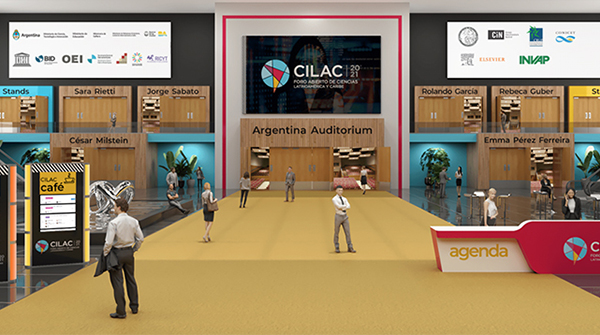
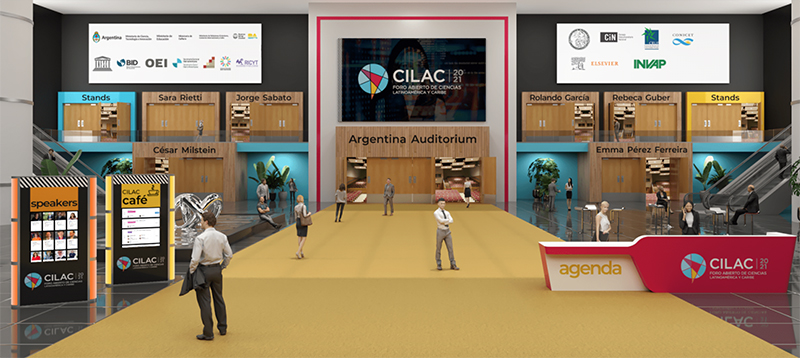
From April 26 to 28, the third edition of the Latin American and Caribbean Open Science Forum, CILAC, and the Second Latin American Forum on Scientific Evaluation (FOLEC) will take place, jointly organized by CLACSO and CONICET of Argentina.
This is the largest scientific knowledge event in the region and an opportunity to discuss, plan and monitor the role of science in the face of the new normal.
CLACSO at the CILAC2021 Forum
@ForoCILAC
CLACSO will participate with various activities in the III Latin America and Caribbean Open Science Forum-CILAC 2021 to be held in virtual format, from April 26 to 28.
CLACSO in the Program of Activities
Gender inequalities in science: an epistemic/methodological approach to equity
Wednesday, April 28, 14 PM ARG/URU
Coordinated by Karina Batthyány, Executive Secretary of CLACSO
Moderation: Laura Rovelli (FOLEC-CLACSO)
Speakers: Elizabeth Jelin (IDES, Argentina) and Guadalupe Valencia (UNAM, Mexico)
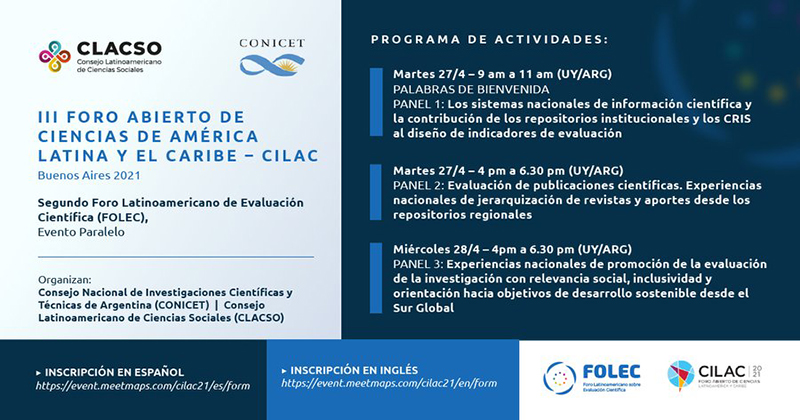
Parallel Event: Second Latin American Forum on Scientific Evaluation (FOLEC) , co-organized by CONICET of Argentina and CLACSO.
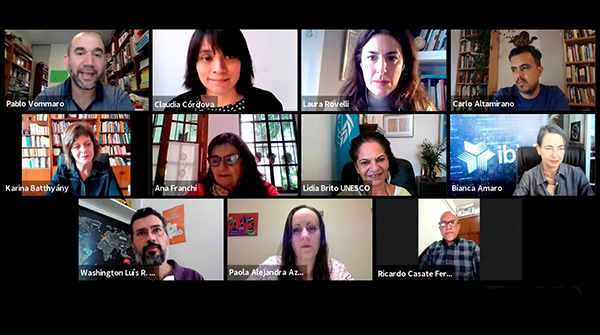
On April 27, the Ana Franchi (CONICET), Karina Batthyány (CLACSO), and Lidia Brito (UNESCO) Forum was opened in a meeting coordinated by Pablo Vommaro (CLACSO), who explained that "the Scientific Evaluation forum that we are inaugurating today is a collaborative, cooperative, and participatory work, based on the principles of open knowledge, open science, public science, open, free, and democratic access to knowledge, science as a public good, as a common good, and as a right."
Ana Franchi, speaking on behalf of CONICET, celebrated “the realization of this Second Latin American Forum on Scientific Evaluation as a continuation of the First Forum held in Mexico in 2019, which was organized with our Latin American partner, CONACYT, and by CLACSO. (…) Latin American countries face diverse socioeconomic demands, even more so in the current context, where the world is experiencing a pandemic with high costs in terms of health, especially human lives, and the economy. Many of the responses to these demands are, and must be, provided by the scientific and technological field. Therefore, the definition, application, and consensus on evaluation indicators that reflect the interaction of science and technology with social development becomes a primary necessity for the countries of the region. Clearly, the cooperation and participation of scientists has provided important answers in this unprecedented pandemic in which we are still unfortunately immersed, and which teaches us the importance of cooperation among our countries and the importance of scientific communities in helping to confront it.”
In turn, Karina Batthyány added that “scientific evaluation is an absolute priority for CLACSO, one that we have been promoting from day one with the intention of making progress. Progress not only in terms of diagnoses, but also in transforming scientific evaluation, modifying the criteria that have been imposed in most Latin American and Caribbean countries, perhaps uncritically. (…) We are interested in advancing the promotion of alternative science policies, rigorous of course, and based on what each of us who work in science believes to be the public responsibility in the exercise of knowledge production, incorporating, of course, the principles of pluralism, solidarity, open science, and knowledge as a public good. CLACSO has always championed these principles and will continue to do so, and hopefully contribute to making them not just principles, but realities and concrete transformations in the scientific systems of our countries.”
Then, the Executive Secretary of CLACSO added that “the idea of knowledge as a public good takes on particular relevance within the context of this health, social, and economic crisis, this pandemic, and with a very specific issue that we must not fail to mention today, and to which CLACSO has also actively contributed: the demand that open science also extend to patents for vaccines and medicines, and particularly to the vaccine against Covid-19, which is affecting the world. This is a very clear demonstration of the difference that can occur between science guided by market criteria, by profit motives, and science oriented toward the public good and the common good.”
Lidia Brito closed the opening session , stating that “without a doubt, when we talk about open science, we still have much to achieve, much to change, much to do together. (…) We are driven by the same goals: to have more accessible, transparent, high-quality science that benefits all people and future generations. To have more open and fair research evaluation criteria that understand science as a public good. (…) Karina spoke about the importance of opening up patents for Covid-19 vaccines, and the President of Peru, Dr. Francisco Sagasti, said that the biggest gap we have in the world is the scientific gap, and that this gap also guarantees the continuation of other gaps we have—economic, social, and environmental gaps—and that if the region doesn't truly address the issues of science, technology, and innovation for social transformation, then we have no chance.”
Panel 1: Research evaluation: National scientific information systems and the contribution of institutional repositories and CRIS to the design of evaluation indicators.
April 27 at 9.30 PM ARG/UY
They present:
Bianca Amaro and Washington Luís R. de Carvalho Segundo (IBICT, Brazil)
Carlo Altamirano (CONACYT, Mexico)
Juan Pablo Paz (MINCyT, Argentina)
Patricia Muñoz Palma (ANID, Chile)
Ricardo Casate Fernández (IDICT, Cuba)
Andrés Melgar Sasieta (CONCyTEC, Peru)
Commentary by: Pablo de Castro (EuroCris, Netherlands/Glasgow, Scotland)
Coordinator: Paola Alejandra Azrilevich (MINCYT, Argentina)
Panel 2: Research Evaluation: The evaluation of scientific publications. National experiences in journal ranking and contributions from regional repositories
April 27 at 16 PM ARG/UY
They present:
Hebe Vessuri (Independent Researcher, Argentina)
Mario Pecheny (Conicet, Argentina)
Liliana Castro/Clara Beatriz Ocampo Durán (Minciencias, Colombia)
Fernanda Beigel (UNCUYO, Argentina)
Arianna Becerril García (REDALYC, Mexico)
Abel Packer (SciELO, Brazil)
Ana María Cetto (Latindex, Mexico)
Ismael Rafols (Leiden University, Netherlands/Spain)
Comment: Jean Claude Guédon (University of Montreal, Canada)
Coordinator: Dominique Babini (CLACSO)
Panel 3: Research Evaluation: National experiences in promoting research evaluation with social relevance, inclusivity and orientation towards sustainable development goals from the Global South
April 28 at 16 PM ARG/UY
They present:
Judith Sutz (CSIC, Uruguay)
Ángel Moreno Fuentes (CONACYT, Mexico)
Fernando Peirano. (R&D&I Agency, Argentina)
Cynthia Jeppesen (CONICET, Argentina)
Matthew Wallace (IDRC, Canada)
Mario Albornoz (RICYT, Argentina)
Commentary by: Gabriel Vélez Cuartas (University of Antioquia-COLAV, Colombia)
Coordinator: Laura Rovelli (FOLEC,CLACSO)
We invite those who wish to follow the activities to register on the #CILAC2021 platform through the following institutional links:
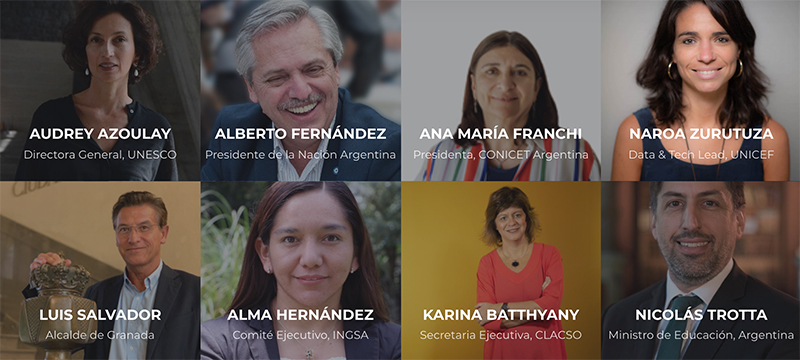
Considered the regional hub for science, technology, and innovation to achieve the Sustainable Development Goals of the 2030 Agenda, CILAC 2021 is adapting to the current context by launching a hybrid edition, seeking to best combine virtual and in-person events—as much as the pandemic allows. In both formats, the event will strengthen networks and promote exchanges.
Maintaining its spirit of bringing together a diverse range of speakers from around the world and offering thematic sessions on inclusive science, the ethics of artificial intelligence, open science, and the challenges and opportunities of the digital economy—contextualized within the context of the COVID-19 pandemic—the new edition of the Forum will feature more than 70 thematic sessions, roundtables with ministers and regional authorities, and parallel events including workshops and demonstrations. A large central virtual stage, led by the government of the Republic of Argentina—host of this edition of CILAC—will serve as the platform for showcasing the Forum's key meetings and announcements.
“The pandemic, which forced us to reschedule the biennial meeting, highlighted the need and urgency for spaces for dialogue and cooperation such as the Open Forum to unite efforts and visions of sustainable development based on scientific knowledge at all levels of our societies: international, governmental, the private sector, social organizations and the scientific community,” said Guillermo Anlló, Coordinator of the CILAC Forum.
Throughout 2020, CILAC developed various activities and initiatives through its digital platforms to highlight the vital role of science in our lives. This year was marked by a surge in efforts from the scientific community in the region and around the world, underscoring the critical need for each country to have a skilled workforce of scientists. More than 10 people participated in virtual events focused on open science, science diplomacy, entrepreneurship, bioeconomy, and science education, among other topics.
The new edition of the Forum, #CILAC2021, will take place from April 26 to 28, entirely online. Pre-registration is now open at forocilac.org/cilac2021 and is free of charge.
For inquiries regarding the organization of the CILAC Forum, press inquiries, or other comments, please contact [email protected]
If you would like to receive more information about CLACSO's training programs:
[widget id=”custom_html-57″]
to our email lists.

