
The coup and democracy in Bolivia
The battles of plurality and Western rationality
Pilar Lizárraga Aranibar
Researcher, JAINA Studies Community
Member of the CLACSO Steering Committee
…the strength that ideas give, that truth gives, and that a just cause gives
It's that the people become invincible.
Excerpt from Fidel's speech in Buenos Aires in 2003
Narrating events is a challenge because, from our own perspective, we have the power to name or silence history. Trouillot (2017), in his analysis of Haiti, reveals how power operates in the production of history—power associated with empire and the control and production of subjectivities. In the history that needs to be told in the Bolivia that emerged after October 20th, the power to produce subjectivities and narratives is under the control of the upper middle classes, academic circles that wield the power of discourse, and the media that distort and tell the story of the powerful.
The Empire has implemented a right-wing advance strategy in Latin America, focusing on Cuba, which is resisting, Venezuela, Brazil, and now Bolivia. The Empire, in alliance with the fascist civic bloc, as defined by the Santa Cruz Departmental Workers' Union, has established a strategy to remove the "Indian" from power, just as they did with the soft coup in Brazil. They have called for a "civic strike" under the slogan of "defending the vote and democracy," promoting electoral fraud and the annulment of the elections. This has been accompanied by a process of upheaval and the paralysis of cities to justify the coup d'état.
The weeks leading up to October 20th were marked by violent actions against peasant women, attacks on MAS campaign headquarters, and the burning of these acts. These violence intensified after election day, with the takeover and burning of public institutions and the destruction of electoral materials (ballots and ballot boxes). These violent actions escalated during the "seizure of the cities" through civic blockades, where strategies were employed to intimidate, instill fear, and restrict the movement and expression of dissent.
Narratives were established that silence the senses and distort the history of the power struggle that is taking place, delegitimizing the ways of narrating that Indigenous Peoples have when they name this process as a COUP D'ÉTAT, imposing a subjectivity that conveniently legitimizes the origin of the social upheaval as a result of the Indian's disrespect for DEMOCRACY, a lack of knowledge of the will and the de facto power of the white man and a violence that they attribute to the response and mobilization that has developed from the Indigenous Peasant Peoples.
These narratives are silencing the construction of history from the perspective of Indigenous, peasant, and working-class communities, who argue that there is a return to the invisibility of collective and territorial rights, and to the ways of shaping and constructing political spaces. It is argued that CONADE and candidate Carlos Mesa, with the call to action dubbed the “mother of battles” and the threat of installing Mesa as President, have instigated a cycle of violence to ensure the votes of the middle and political classes who are leading the occupation of cities and the establishment of blockades. They make it clear that the objective of this movement is to annul the general elections in order to hand over the people's gains to transnational interests, thus constituting an attack on democratic institutions (CONALCAM 2019). The rejection of the electoral audit demonstrates the clear objective of the civic-political coup d'état, which is being built on civil disobedience and the instigation of violence.
The colonial narrative constructs the idea that historical responsibility for the violence lies with Evo Morales and the Indigenous Peoples of the Andes (PIOC) who do not accept the decision to "respect the vote" of the blank ballot, citing the argument of "disrespect for the February 21st referendum, the Plurinational Constitutional Court's (TCP) ruling on candidacy, the approval of the law for primary elections, and the characteristics of the 2019 electoral campaign" (Solón, 2019). These narratives fail to address, in their analysis of democracy, the construction of subjectivity, the control of political thought (Chomsky, 2017), or emancipatory constitutionalism (De Sousa Santos, 2006), as factors that contribute to understanding social emancipation (De Sousa Santos, 2006). This clearly breaks with what is imaginable and thinkable (Trouillot, 2017) in the construction of bourgeois democracy.
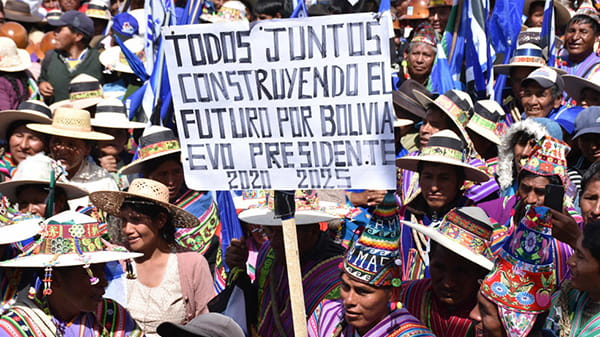
This narrative exalts and legitimizes the town hall meetings held in cities as representative spaces of the popular will, while rendering invisible the assembly spaces and the collective decision-making that renewed Evo Morales's extended mandate as President. It privileges the vote of the urban middle class, attributing the power of decision to the will of the white population as the means to resolve the social upheaval. This contrasts sharply with the self-affirmation of rural and working-class people, whose vote constituted the majority and defined the victory and the continuity of the process. This was evidenced by the arrival of people from rural areas and cities throughout the country, highlighting their tangible presence.
The central tenet of these conservative narratives is the apology for democracy, the defense of the VOTE and the slogan of Fraud which is constituted to question the legitimacy and the final results that give the victory to Evo Morales with 2.889.359 votes (47,08%) over 2.240.920 votes (36,51%), narratives that discursively correspond in the discursive handling of candidates of Citizen Community and CONADE, to name a few. Solón reaffirms the claims of fraud, irregularities, and disregard for the popular vote. His argument is based on the suspension of the Preliminary Electoral Results Transmission (TREP) by the Electoral Body at 83% of the vote counted. At that time, Mesa declared he would go to a second round, while Evo stated he was confident of winning with the 17% of the vote coming from rural areas that still needed to be counted. It is this interruption of the TREP transmission and its subsequent resumption that Solón attributes to the emergence of suspicion and indignation among the population. During this period, the voting trend supposedly changed, Carlos Mesa's assertion that there would be a second round vanished, and Evo's victory in the first round was evident. These conditions led to a hardening of the call for open assemblies to demand respect for democracy and the people's vote, moving from a call for a second round on October 20th to the resignation and now, on the 29th, to the expulsion of the incumbent President. as will be proposed by the Southern bloc that is meeting in La Paz on October 29.
In contrast, CONALCAM and the parent organizations of peasant, mining, and urban groups argue that the FRAUD allegation is unfounded and that after nine days Carlos Mesa has not presented any evidence. This narrative is echoed in Ritcher's (2019) argument, which further posits that the "allegation of massive fraud" is a historical irresponsibility that arose during a period of heightened tension. Ritcher attributes to the TREP (Preliminary Results Transmission System) a binding character it does not possess, generating social upheaval through the manipulation of political subjectivity, ultimately leading to confrontation and division within Bolivian society.
Through the civic strike, cities have been "taken over," rules for peaceful coexistence have been imposed, and fear has been instilled. In Santa Cruz, the blockade, now in its eighth day, is seen as a movement that seeks to destroy democracy and usher in a dictatorship. Their strategy is to create a siege and criminally block roundabouts and streets… they beat any citizen who doesn't pay tolls at their blockades, recruit criminals to set fire to homes and institutions, and have established these points as spaces for parties and takeovers (COD Santa Cruz). In Cochabamba, motorcycle brigades have been formed to force citizens to stay home. Tarija has been surrounded by students and public employees from the mayor's office and the governor's office, who have established their blockade points at roundabouts using ropes, chairs, and vehicles. In La Paz, miners have arrived to defend democracy from the fascist civic coup and have begun to contest the territory taken over by the civic movement.
People feel their rights are being violated and that violence is being perpetrated against those who are simply trying to go about their lives normally. This violence is being fueled by the occupation of cities under the guise of democratic slogans and by the confrontations resulting from the obstruction of free movement and the infringement of economic rights. Demonstrations and marches have been organized by trade unions, transportation workers, and the self-employed, who have demanded the lifting of the blockade and that people be allowed to work. It has been made clear that the vote of the ayllus, the communities, and the tentas has chosen the MAS candidate and that this vote cannot be disregarded.
Intellectuals and former allies of the MAS party have stated that the departure of these organizations is a provocation to the citizenry, generating conflict and confrontation. They marginalize political demands and the people's right to protest, prioritizing the urban vote over the rural vote. They have promoted a narrative that employs a strategy of evaluating, disqualifying, and classifying anything that is stated but falls outside the realm of what is "thinkable" for this academic establishment, as expressed by Cecilia Salazar (a professor at CIDES-UMSA) and Patricia Alandia (a professor at UMSS) in response to the argument of destabilization by the right wing and a coup d'état orchestrated by the United States. They have positioned this narrative on social media as an ideological and uncritical tool of the post-election process in Bolivia.
The political actions of the opposition and the academy that legitimize its conservative and coup-plotting discourse appeal as a way out of the convulsion that Evo renounce the vote and extended mandate (Solon, 2019) and on the contrary the people appeal for the political rights of the people to be respected (CONALCAM 2019).
We believe that at this moment not only democracy in its liberal sense is at stake, but also the process that has been built through the conquest of the peoples with which an Alternative towards Living Well and life itself as a collective begins.
Bibliography
-De Sousa Santos, Boaventura. Renewing theory and reinventing social emancipation: Encounters in Buenos Aires. Buenos Aires: Clacso, 2006.
-Roffinelli, Gabriela. Noam Chomsky and the control of thought. Madrid: Campo de Ideas SL Chomsky, 2003.
-Trouillot, Michel-Rolph. Silencing the Past. The Power of the Production of History, Madrid: Comares, 2017.
Letters and pronouncements
-Pablo Solon (2019). Letter to the anti-globalization movement on the situation in Bolivia.
https://fundacionsolon.org/2019/10/23/carta-al-movimiento-antiglobalizador-sobre-la-situacion-en-bolivia/?fbclid=IwAR2bmfk_NK3moeCKmO-lF0hTI9SZR4v72KcrGwqR6MPmOmOFScjXv8-zrH4
-CONALCAM (October 2019). Statement –CONALCAM
https://www.facebook.com/AbyaYalaTv/videos/786909378493295/
-Jorge Ritcher (October 2019). Analysis of the post-election situation
https://www.facebook.com/860801303977862/videos/3950237538335541/UzpfSTE3MTkzODYzNDY6MTAyMDY0MjAyMTUxNDA0MDQ/
-Clacso interview with Pilar Lizárraga Aranibar
https://www.facebook.com/206871509410716/posts/2392014727563039/
[+] Latin American and Caribbean Front
in the struggle for democracy and the people
If you would like to receive more information about CLACSO's training programs:
[widget id=”custom_html-57″]
to our email lists.

