
The Colombian genocide, elements for analysis
Jesús Antonio Reyes Benavides[1]
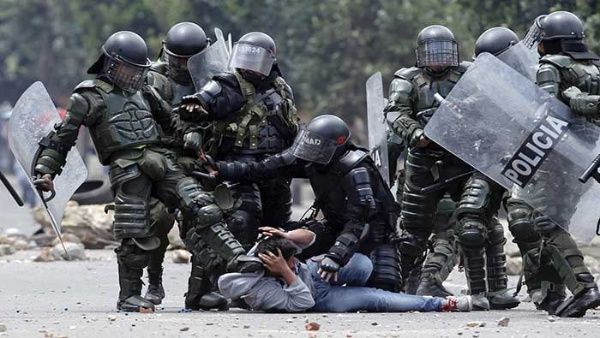
Political genocide is characterized by an ambiguous construction of the figure of the enemy, the one to be annihilated. Annihilation seeks to change the identity of the people, as in the last Argentine dictatorship, where the aim is “social reorganization.” It is the instrumentalization of violence as a form of terror, where those who mobilize are considered “vandals, savages, terrorists” and are reduced to an amorphous mass mobilized by a superior threat, be it communism, Castro-Chavismo, Judaism, the Tutsis, the Hutus—in our case, a conglomeration of labels that easily differentiate between “good people” and everyone else.
Thus, those who instrumentalize violence, in this case the Colombian government, intend, through terror, to stop the protesters from mobilizing and ultimately force them to identify with the language and rhetoric of those who glorify authority and violence. By destroying the identity of those who mobilize, they seek to impose the identity of the “good people,” the “good guys” represented by the productive, state, and public sectors; and by the economic and political expression of the paramilitary apparatus.
The construction of the vandal is ambiguous, like the doctrine of the terrorist, the internal enemy; this discursive construction seeks to create a generalized distrust that breaks the horizontal social bond that has allowed the mobilization to continue. Like Nazism in its fight against the “Judeo-Bolshevik,” Uribismo conjures the specter of “Castro-Chavismo”; the core of its ideology is that anyone who behaves like a Castro-Chavista can be eliminated, and their annihilation is justified.
For this reason, Paola Holguín and María Fernanda Cabal are calling on “good people,” on “citizens,” to arm themselves to defend the security forces. It is a crusade that draws a line between what they consider vandals and citizens, and according to the instigation of the Democratic Center party, not everyone who demonstrates against the government is a citizen, and therefore, they are dehumanized to justify their murder, disappearance, or torture.
As the Argentine dictator Videla put it, for Uribismo, the subversive, the Castro-Chavista, and the terrorist is "whoever challenges the values of Western Christian society." For the party that carries out terror through its civilian armed wing and the military forces, anyone who isn't a vandal but supports a vandal is a vandal. The indifferent are vandals because they don't care whether these terrorists exist or not, and the timid are vandals because, although they support them, they don't express themselves with such radicalism. Under this logic, the central movement of Uribista terror is expressed in the "citizen movement," the party, and the leader—that is, "good people"—the Democratic Center and Álvaro Uribe, a specific trinity of fascism and authoritarianism.
The annihilation of protesters is not the objective, but rather the instrument employed through a set of techniques designed to eliminate an identity. These techniques include: control of the media, disinformation, the glorification of heroes and villains, and the justification of terror and annihilation. In short, the perpetrators of genocide understand terror and know that the only way to destroy a social movement is through widespread distrust and ambiguity regarding their target. Within this category are students, Indigenous people, Afro-descendants, or anyone who does not identify with the logic of terror, the party, and the leader. We are facing state crimes and terrorism embodied by the security forces, who thus mask the destruction of life and the murder of civilians defending their property and freedom of enterprise. This freedom is reserved for the visible heads who monopolize the businesses of cattle ranching, palm oil, extractive industries, the financial sector, and so on, for "the good people who only do good and defend themselves."
The Democratic Center decided to do what it projects in the “annihilable enemy”: combine all forms of struggle to establish terror in Colombia.
[1] Colombian. PhD student in Sociology. UNSAM/IDAES, Argentina. Researcher at CLACSO.
If you would like to receive more information about CLACSO's training programs:
[widget id=”custom_html-57″]
to our email lists.

