
The specter of hunger in Peru
Nicholas Lynch1
Looking the other way is an art that those at the top in Peru not only inherited from their colonial past, but which, in neoliberal times, has allowed them to invent a reality parallel to the world they lived in. This is the case with the precariousness of work, for the overwhelming majority of the population, which even today, a year before the bicentennial, has not yet fully materialized as a right.
Such are the times that it took a moment of extreme crisis for this parallel reality to crack and for a self-evident truth to be acknowledged: the existence of an informal Peru. Except the name is misleading – “informal” – and implies the existence of a formal one against which the former is defined.
Decades ago, Aníbal Quijano pointed out that there was a single, albeit heterogeneous, workforce comprised of a segment without rights, known as the informal sector, representing approximately 75%, and, on the other hand, a segment with rights, barely formal, comprising, at best, a quarter of the economically active population. These figures, which predated the pandemic, have likely worsened, with less formal employment and lower incomes. The difference, in any case, lies in the degree of exploitation and overexploitation of both groups by our dependent capitalism, which needs them both as a single entity, allowing it to maintain its high profit margins and extremely low wages.
This appalling reality of jobless growth (as the specialized literature calls it) has resurfaced with the crisis exacerbated by the coronavirus pandemic. The reasons are starkly obvious: the destruction of much of what little work existed and the disappearance of the precarious income of those in the informal sector. This precariousness didn't simply disappear before; it has been ideologically and politically concealed. The regime's spokespeople have always claimed that there was employment in Peru, and they have done so through their monotonous control of the media. Even a Minister of Foreign Affairs went so far as to say, regarding the massive influx of Venezuelans into Peru, that there was no problem because there were jobs for everyone in the country. This has been the neoliberal ideological hegemony: informal workers don't exist, or they are a small army of failures, and there is work for everyone here.
It's not just a heavy ideological veil that has fallen over the problem, but also a lack of interest in any potential solution. The neoliberal right is only interested in exporting raw materials to the global market, not in realizing profits in the domestic market or producing exportable value-added goods. We thus have businesses with substantial investments, such as mining and gas, generating high profits in a relatively short time for the owners and their associates, and creating very few jobs. The ideological justification for these businesses as a means of development has collapsed with the coronavirus pandemic.
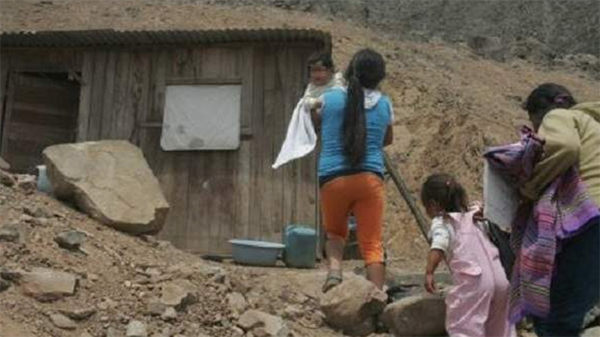
Thus, the resurgence of Peru's informal sector not only reveals the near absence of jobs with full labor rights, but also the precariousness of the income of the majority of the working population, euphemistically called the informal sector. These two elements—lack of work and extremely low incomes—are what haunt us during these days of pandemic. Why does the majority of our country's population "speak with their feet" and go out into the streets or want to walk back to their hometowns, despite the quarantine? Because they are hungry and are less afraid of contracting COVID-19 than of dying of hunger. A friend, a distinguished sociologist, told me that everyone has already failed to convince them to stay home. Even the Armed Forces have failed in their attempt, which speaks to the erosion of one of the reverential fears of oligarchic Peru and the tremendous ineffectiveness of the State, which has even lost the capacity to instill fear.
But returning to the collapse of neoliberal hegemony: if the corruption scandals of recent years had a profoundly corrosive effect, the revelation of the near-total absence of decent work and its resulting hunger is having a second, dissolving effect on this hegemony. However, unlike the corruption scandals that reveal we have been governed by crooks, the widespread presence of hunger is an immediate certainty, affecting every individual and their family. Hunger, therefore, is a powerful solvent, one that not only exposes the emperor but also lacerates him.
Therefore, hunger becomes a specter haunting the countryside and cities of our country. It provokes outrage and mobilizes us, despite the "total lockdown" imposed upon us. It sends the wealthy into a panic, as they fear the hunger of the majority, a hunger no longer concealed by ideological veils. Furthermore, hunger is an urgent problem because it represents the very essence of daily survival. It is a source of revelation and rebellion, calling us to action, from our immediate efforts to ensure our fellow citizens do not go hungry, to the necessity of a different kind of organization, as several have already stated, including from this very publication, in this critical juncture.
Aid from above, however limited, is proving ineffective. Therefore, it is necessary to mobilize social organizations, especially those closest to the people. This is not the best of times for grassroots organizations, given the direction society has taken in recent decades, pressured by an individualistic and market-driven logic, but they are one of the few resources with the potential to be effective. This will be the moment to see if the memory of past decades is awakened and if today's urgency compels new generations to take up the mantle. There seems to be no other alternative, and that could be the decisive impetus.
However, corruption scandals and hunger, as solvents of ideological hegemony, have another pending effect: the reconstitution of political will, though this does not happen automatically. The virus may have played its part, but it cannot become a political party, much less a political project. Today, we must start from these immediate problems, which are also structural, and point out the need to put Peru on a different path, since the course of the April 5th coup has run its course.
The specter of hunger can thus be transformed from a search for solutions to everyday anguish into an incentive to envision a country and a world that, while taming the virus, allows us to write our own emancipatory script.
1- National University of San Marcos, Peru
If you would like to receive more information about CLACSO's training programs:
[widget id=”custom_html-57″]
to our email lists.

