
The social challenge in times of pandemic
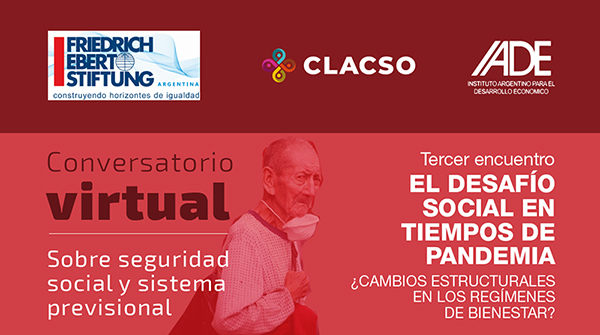
On Tuesday, August 4, the Latin American Council of Social Sciences, the Friedrich Ebert Foundation, IADE, and the CLACSO Working Group on Social Security and Pension Systems are organizing the Third Meeting: “The social challenge in times of pandemic. Structural changes in welfare regimes?”
Speakers: Fernanda Raverta, Executive Director of ANSES. Simone Cecchini, Officer in Charge of the Social Development Division of ECLAC. Karina Batthyány, Executive Secretary of CLACSO. Svenja Blanke, FES Representative for Argentina and Director of the journal "Nueva Sociedad". Moderator: Nicolás Dvoskin, Argentine Institute for Economic Development.
In this activity, representatives from large and influential institutions, whose work focuses on one or more dimensions of the so-called social question, will address these critical issues. What lessons can we learn from the current crisis? How can we counteract the recurring uncertainty of socio-economic crises? What impact has the health crisis had on gender inequalities? What role are women playing in social protection? What role do women play in sustaining life in contexts of multidimensional crisis? What challenges must nation-states face to strengthen social cohesion? Is it necessary to broaden the scope of the so-called "common goods" for the benefit of society as a whole?

To a long history of successive economic crises, financial crises, migration crises—among others—is now added a pandemic crisis. These have placed high levels of uncertainty, volatility in material production, and regressive impulses in income distribution on the shoulders of our societies. The ongoing pandemic crisis is putting healthcare systems under immense strain while simultaneously causing a significant drop in economic activity and personal income. Increased poverty and greater inequality are two key consequences of the current crisis, exacerbating factors of social disintegration and challenging democratic development.
Furthermore, the crisis, more than ever before, contrasts superfluous activities with essential or truly useful ones. The inability of markets to allocate sufficient resources to a significant portion of the latter becomes evident. Thus, while the detrimental effects on the well-being of our societies continue to grow, the response organized by nation-states seems to require a new institutional framework, a new hierarchy in the consideration of the public sphere, and a new conception of the instruments that existing welfare systems can potentially deploy.
If you would like to receive more information about CLACSO's training programs:
[widget id=”custom_html-57″]
to our email lists.

