
“The challenge is knowing how to measure inequality”
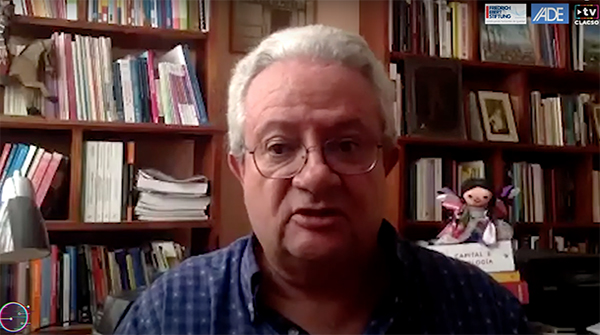
Pablo Yanes Rizo, Research Coordinator at the ECLAC subregional headquarters in Mexico, participated in the second meeting of the Virtual Conversation Series on Social Security and Pension Systems, organized by CLACSO, the Friedrich Ebert Foundation, IADE, and the CLACSO Working Group on Social Security and Pension Systems. Afterward, he spoke with CLACSOTV.
Interviewed by Gustavo Lema
Pablo Yanes Rizo believes that in Latin America and the Caribbean, “we are talking about a region with a long-standing, chronic inequality, where there are sometimes small improvements, but essentially the trend is toward an ever-increasing concentration of wealth and income. Furthermore, I think there is a challenge in knowing how to measure inequality. We have really been very focused on measurement and often on a meticulous debate about poverty, but regarding inequality, the lag in terms of conceptual reflection and methodological development is remarkable. This in itself indicates that we have not given the measurement of inequality, or rather inequalities, the relevance and importance it deserves. And we must also take note—and I think the pandemic has starkly exposed this—that this is not simply an inequality where there is greater concentration in a small sector of the population and a lack of protection and deprivation in another sector, but rather a very profound precarity. There is an inability to survive from day to day without working in even low-productivity activities, under very unfavorable conditions.” There is a lack of certainty regarding access to fundamental social rights, and this has been very clear in the area of health: implementing physical distancing measures is very difficult in small homes, where access to water is often very limited, and where people are unable to work and have to rely on unsafe, overcrowded public transportation. It has forced us to confront the magnitude of our precariousness, our insecurities, and our vulnerability. And I believe that if we truly take seriously the fact that the world cannot be the same as it was before the pandemic, this is an issue that must be put on the agenda.
If you would like to receive more information about CLACSO's training programs:
[widget id=”custom_html-57″]
to our email lists.

