
"Care is part of the public sphere and is a human right."
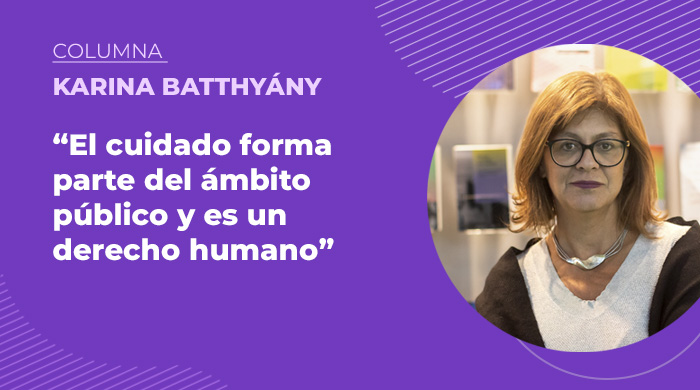
Transcript of Karina Batthyány's column
in InfoCLACSO – September 11, 2024
In Mexico, I participated in the first Academic Forum “Territories of Care: Contributions from Academia to the XVI Regional Conference on Women in Latin America and the Caribbean” jointly organized by ECLAC, UN Women and the National Institute of Women of Mexico, within the framework of this articulation of organizations towards what will be the next Regional Conference for Women, which took place in Buenos Aires, Argentina.
The issue of care has occupied and continues to occupy an absolutely central place in the agenda and the construction of the necessary elements to move towards care societies in the Latin American and Caribbean region.
Is care a human right? Absolutely. In our region, the conceptualization, definition, and implementation of policies toward care societies have advanced in recent times. One example of this is the formation of the Global Care Alliance, spearheaded by Latin America and the Caribbean. This alliance has also designated October 29th as International Care Day. CLACSO will be supporting communication and outreach initiatives related to this issue.
The regional distinction lies in the idea of conceptualizing and recognizing care as a human right, and therefore as a public good, not as a private or behind-closed-doors responsibility. Care must be understood as a collective issue, part of the public sphere, and a human right. I'm referring to the concept of a right as we do when we talk about the right to education, work, or housing.
Caregiving has direct consequences for states and public policies, because states become responsible for guaranteeing access to and the exercise of this right to care. This also means ensuring that everyone has access to quality services throughout their life cycle and that caregiving is no longer solely the responsibility of families and women.
Furthermore, significant progress has been made in understanding the life cycle perspective and the concept of interdependence. This understanding of care recognizes two central elements. First, it is a relational activity: there is a relationship between at least two people, the caregiver and the person being cared for. Second, throughout our life cycle, we will occupy different roles: we will be cared for, we will be caregivers, and we will provide care again at different times in our lives.
Regarding the notion of interdependence, human beings are interdependent. We need care to exist, to develop as individuals, and for that care to cover all stages of life. It is often thought that care is only needed in childhood, but we also need it when we are occasionally or chronically ill, or when we reach old age.
In the Latin American and Caribbean region, there has been progress in defining care systems and care policies, which can address these care needs. Indeed, we are talking about policies and systems that must be coordinated and comprehensive, encompassing a diverse range of services to address the various dimensions of care and the diverse populations that require it.
Furthermore, care systems and policies have proven central to our region and the world for discussing or advancing gender equality. In other words, care has been shown to be one of the critical issues in gender inequalities and also in terms of social well-being.
How can we talk about social well-being if we don't place care at the center? In the last 25 years, gender perspectives have been incorporated into the discussion of care in the region, which is the origin of this topic and the reason we are talking about care today. This has made unpaid care work visible and highlighted how it falls disproportionately on women.
Furthermore, progress was made in the discussion about the role of the different actors or agents providing well-being and care, such as the State, the market, families and communities, placing the discussion around gender equality at the center.
The remaining challenges for the region are related to persistent gender inequality, despite conceptual advances and the implementation of some gender policies. Much of this gender inequality is explained by the unequal distribution of care work between men and women. Challenges also persist regarding investment and sustainable financing for these policies and systems.
Uruguay and other countries in the region started with a very good pace and progress in care and gender perspective, but then, faced with ideological shifts and changes in government orientation and due to a lack of investment and sustainable financing, these policies are quickly cut, reduced or even eliminated, as in Argentina.
In Latin America and the Caribbean, we face another challenge in terms of policy integration and coordination. What we see in the regional experience is that the care policies being implemented are not sufficiently integrated to guarantee their continuity within government regulatory frameworks. There is an urgent need to link care policies with other key areas of social policy.
Care policies must be universal and equitable, meaning they must be for everyone, not just targeted at certain population groups or specific locations. If we understand care as a right, then that right belongs to everyone, not just a select few.
We must guarantee citizen participation in the formulation and implementation of care and gender policies in governance. Through our Platforms for Social Dialogue (PDS), we promote and connect the knowledge generated by academia, social movements and organizations, and public policy regarding citizen participation and governance on issues that are critical to overcoming inequalities.
Furthermore, challenges arise related to technology in the area of care, challenges to the new forms of work that are being established in our Latin American societies.
Today, CLACSO is part of the global alliance for care, as we are committed to promoting its progress, because this is where one of the knots of inequalities in care societies in Latin America and the Caribbean is located.
– The debate is whether care work falls under the umbrella of a basic human right, both the right to receive care and the recognition of those who provide it. In that context, when there are attempts to dismantle or defund these programs, it becomes a violation that extends far beyond individual states or countries, wouldn't it?
– Of course, that's why recognizing care as a right is so important. Several Latin American countries have done so at different levels through their constitutions or specific laws to give legal status to the issue of care. A case was brought from the region to the Inter-American Court of Human Rights, which in its initial ruling recognized care as a legally binding right, making it enforceable. This is a fundamental step in asserting that everyone has the right to receive the care they need at different stages of their lives, as well as the right to provide care.
Full program – Is care a human right?
If you would like to receive more information about CLACSO's training programs:
[widget id=”custom_html-57″]
to our email lists.

