
"Care should be an alternative for building new social contracts"
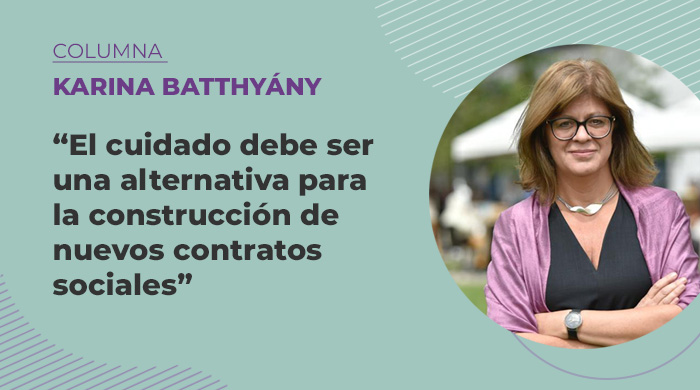
Transcript of Karina Batthyány's column
in InfoCLACSO – November 13, 2024
We are concluding the 34th ALAS Congress in the Dominican Republic with a strong participation of CLACSO researchers and students in the various working groups. We also held book presentations and launched a new Graduate School with 30 students from 11 countries in Latin America and the Caribbean.
In addition, we participated in a Care Forum to present various research advancements on the topic, particularly regarding our agreements with UN Women. This forum had two parts: the first day featured presentations of these agreements with commentators from the fields of public policy, social movements, and organizations; the second day included the participation of women leaders from social movements, focusing on developing alternatives to gender inequality and addressing care work in the Dominican Republic.
Continuing with the issue of care, I had the privilege and honor of giving a lecture within the framework of ALAS to reflect on the challenges that this care society poses for Latin America and the Caribbean in terms of theoretical contributions in recent years at the international level and those that come from our region.
Our book, "Latin American Perspectives on Care," delves deeper into this topic with multiple and collective authors. Therefore, this reflection on care must be positioned as an alternative for building new contracts and agreements for a care society.
In addition to the activities mentioned, we also worked hard on the proposals of FOLEC and SILEU CLACSO, where we discussed the meaning of research evaluation, both for personal and professional trajectories, as well as institutional ones.
In turn, through the collaboration between CLACSO, ALAS, and ISA (International Sociological Association), we conducted an academic writing workshop. There, we explored how to write scientific articles or papers for scientific journals, promoting greater participation of Latin Americans, which are often heavily dominated by the European sphere or other non-Latin American spheres.
– The academic writing workshop is very interesting because it proposes a new step towards the practical and concrete with a critical thinking perspective regarding publication in scientific journals and everything that FOLEC brings, right?
– Of course. From that critical Latin American perspective, we also consider how to value these instruments and how to participate in them in conjunction with ISA, focusing on practical tools. It is necessary to encourage academic participation for graduate students and young researchers.
– In terms of definitions, what role do you think sociology should play in the face of a strong attack by conservatives on the social sciences in particular?
If we mention Bolsonaro in Brazil and Milei in Argentina, we must also mention Donald Trump's recent second victory in the United States, which undoubtedly jeopardizes the democratic principles and agreements upon which our societies are structured based on social pacts and contracts. In addition to understanding knowledge as a public good, public higher education is absolutely essential so that everyone can exercise their right to education.
It is one thing to proclaim the right to education, and quite another to create the conditions for effective access to education for all. Undoubtedly, these guarantees are being challenged, along with another agenda related to new rights and academic freedom, which is currently threatened by extreme conservative governments and the new right wing.
If you would like to receive more information about CLACSO's training programs:
[widget id=”custom_html-57″]
to our email lists.

