
The “Trump Corollary” to the Monroe Doctrine: a global approach
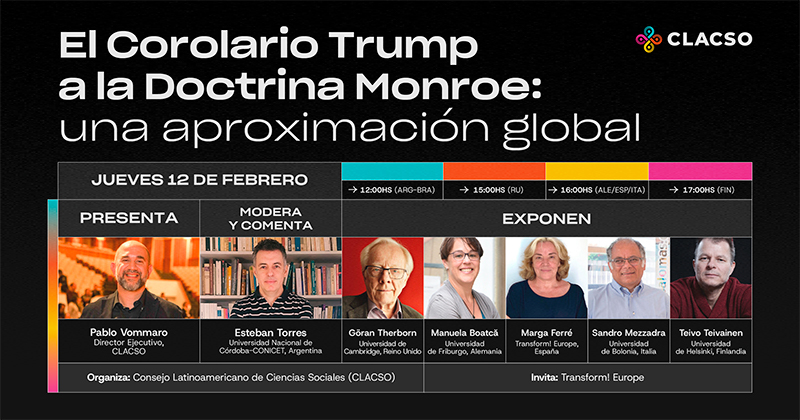
On Thursday, February 12, the Latin American Council of Social Sciences organized the virtual dialogue “ The 'Trump Corollary' to the Monroe Doctrine: a global approach”; Transform! Europe invited.
Presented by: Pablo Vommaro (Executive Director, CLACSO).
They stated:
Göran Therborn (University of Cambridge, United Kingdom)
Manuela Boatcă (University of Freiburg, Germany)
Marga Ferre (Transform! Europe, Spain)
Sandro Mezzadra (University of Bologna, Italy)
Teivo Teivainen (University of Helsinki, Finland)
Moderated and commented by: Esteban Torres (National University of Córdoba-CONICET, Argentina)
On January 3, the United States government bombed Venezuela and kidnapped its president. While this event is part of a broader escalation against the region within the context of current geopolitical conflicts, it marks a turning point in U.S. policy toward Latin America and the Caribbean, sweeping the surface of the global agenda of liberal democracy that the U.S. Empire had been promoting in the region since the 80s. The “Trump Corollary to the Monroe Doctrine”—published in late 2025—is underway, and the impact of this strategic policy is being felt on all five continents.
Based on the Venezuelan and regional situation, this international dialogue aims to contribute to a global understanding of how the Trump Administration's policies are altering the course of action in Latin America, the Caribbean, and the world as a whole, while remaining mindful of the structural dynamics at play in this geopolitical context. This event brings together renowned European intellectuals who maintain active ties with our region, with the purpose of fostering an internationalist political culture within academia, enabling them to respond to the major challenges ahead. Through the discussion of European perspectives, CLACSO seeks to broaden the understanding of these issues globally, engaging with the critical and transformative perspectives that the Network produces from and for Latin America and the Caribbean.
“Are we facing the end of the international order as we knew it?” asked Pablo Vommaro during his participation in the debate. He then analyzed: “The recent escalation of intervention in Latin America and the Caribbean, along with global tensions, compels us to rethink our position. We are at a moment of intertwined crises, a contested process of geopolitical reconfiguration. From the attack on Venezuela to the pressures exerted on Panama, Colombia, Brazil, and Mexico, and the attempt to strangle Cuba, we see a resurgent imperialism that no longer even bothers to disguise itself. The fiction of international democratic consensus seems to have shattered into a thousand pieces. The result? A world at open war and democracies under constant threat. But this is not just a problem for Latin America and the Caribbean. Europe also faces its own tensions and shares urgent challenges with the Global South: the rise of the far right, hate speech, and the need for new political proposals that can once again captivate the majority. In the midst of this geopolitical mutation, critical and transformative thinking cannot remain merely at the level of diagnosis. We need political imagination and interpretive tools to transform this reality,” he concluded.

