
The Greater Buenos Aires area in quarantine

National University of General Sarmiento - Argentina
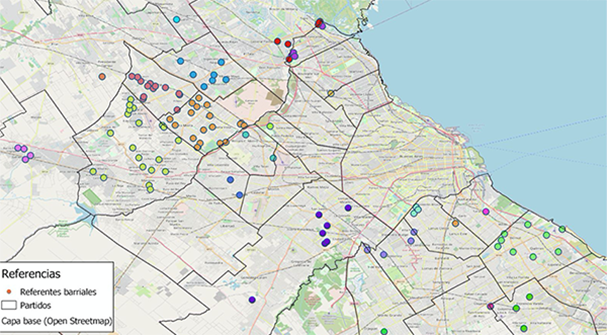
The Report of the second survey of leaders of the popular neighborhoods of Greater Buenos Aires in the context of mandatory social isolation, carried out by the Institute of Greater Buenos Aires of the National University of General Sarmiento, communicates the result of the collaborative survey carried out in the popular neighborhoods of Greater Buenos Aires between April 22 and 26, aimed at describing the conditions in which mandatory social isolation is taking place in that territory.
The survey explored a set of interconnected topics: a) compliance with social distancing measures; b) perceptions of the main problems that arose or worsened in neighborhoods during the second phase of the quarantine; c) work and income generation in households and in units of the popular, social, and solidarity economy; d) household strategies for coping with the economic impact; e) evaluation of the impact of the first phase of implementation of the Emergency Family Income program; and f) the conditions under which food supply and assistance are being provided. Additionally, the survey focused on three relevant problems in the neighborhoods within this context: g) domestic gender-based violence; h) restrictions on access to healthcare; and i) relationships with the security forces responsible for enforcing the quarantine in the area.
The survey is based on 165 records made by researchers and teachers from the Instituto del Conurbano, colleagues from other institutes and other universities, non-teaching workers, students and graduates of the University, in collaboration with territorial organizations and networks.
The analysis was carried out by Verónica Maceira, with the participation of Gonzalo Vázquez (food provision and social and solidarity economy representatives), María Crojethovic, Carlos Jiménez and Ana Ariovich (health providers), Nicolás Caloni and Soledad Castillo (georeferencing and cartography), Cecilia Anigstein (union representatives) and Bárbara Couto and Emanuel López Méndez (emerging demands).
The survey was coordinated by Gonzalo Vázquez and Verónica Maceira, and includes interviews conducted by Alejandra Potocko, Ana Ariovich, Ana Luz Abramovich, Anabella Zamora, Bárbara Couto, Betina Plaza, Carlos Jimenez, Carolina Barnes, Cecilia Anigstein, Eduardo Reese, Emanuel López Méndez, Fernando Momo, Flavia Cáceres, Florencia Neira, Gonzalo Fernández, Gonzalo González, Gonzalo Vázquez, Jesús Ebis, Leandro Rodríguez, Lorena Putero, Marcelo Ochoa, María Cristina Cravino, María Crojethovic, María Eugenia Jaime, Marian Sola Alvarez, Mariana Amil, Mariana Jaruz, Mariana Rossi, Marina Toledo, Martín Mangas, Mónica Santiago, Sandra Hoyos, Sandra Nicolaiczuk, Silvia Barraza, Silvia Ebis, Verónica Maceira and Viviana Colella.
If you would like to receive more information about CLACSO's training programs:
[widget id=”custom_html-57″]
to our email lists.

