
"The knowledge produced in the university setting should be available to everyone."
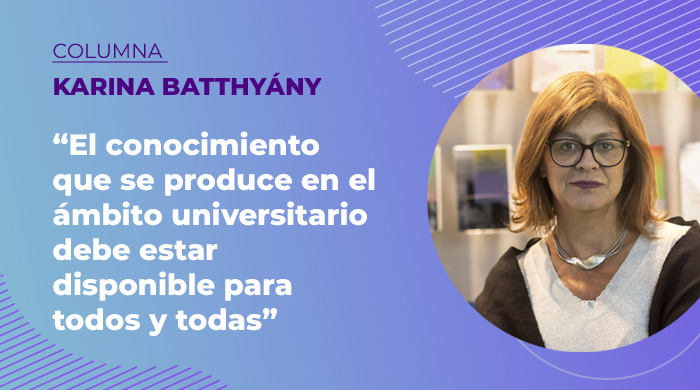
Transcript of Karina Batthyány's column
in InfoCLACSO – August 28, 2024
We are at the sixth edition of the International Book Fair for University Students, FLUNI 2024, in the same venue at the National Autonomous University of Mexico (UNAM), where in June 2022 we held our Assembly and Conference #CLACSO2022. FLUNI champions publications that aim to disseminate knowledge across all disciplines, where CLACSO always plays a prominent role in the field of social sciences and humanities.
We have set up our CLACSO stand at UNAM, resuming the practices we promote in person and at the main book fairs with one motto: the idea of disseminating open knowledge without any barriers, a policy that CLACSO has practiced since its origins and has become one of our main banners.
The knowledge produced in universities, especially public universities funded by public funds, must be available to everyone. We will be discussing this very topic in a panel and a conference on the challenges of Open Science and Evaluation in the social sciences and humanities.
UNAM is an emblematic space for the dissemination of knowledge. Furthermore, CLACSO is present at FILUNI because it has the University of the Republic (Udelar) as its guest of honor—the institution to which I have belonged since 1987 as a student and since 1991 as a professor, and which is part of my identity.
– At the opening of FILUNI, the rector of the University of the Republic (Udelar), Rodrigo Arim, mentioned the importance of Mexico and the National Autonomous University of Mexico (UNAM) during very complex periods of dictatorship in Uruguay, when the dictatorship intervened in the university and in relation to the exiles. What does Udelar's presence at FILUNI mean, given all its significance for Uruguayan identity?
– It means a great deal. In 2024, the University of the Republic (Udelar) is celebrating its 175th anniversary, and being the guest of honor at FILUNI is one of the central events of this university celebration because, as Rodrigo Arim said, Mexico played a crucial role during the hardest, darkest, and most critical years of our country's recent history. I'm referring to the Uruguayan civic-military dictatorship, which began in the 70s.
The Mexican embassy in Uruguay was a refuge for many, a place of escape from the clutches of the dictatorship, but also a place of exile for colleagues who had to leave the country and found their second home in Mexico. In Uruguay, we always say there are “Urumex”—a whole generation of Uruguayans who completed their studies at the National Autonomous University of Mexico (UNAM) and then returned to Uruguay after the return to democracy, including Samuel Lichtensztejn, who was rector of the University of the Republic (Udelar) during the dictatorship's intervention and who finished his doctorate at UNAM and taught there. Mexico undoubtedly holds a special place in the hearts of those of us who are part of the University of the Republic.
– What is the value of all these years of work in publishing?
– We are here at this beautiful CLACSO stand to showcase all our publications in the fields of social sciences, humanities, and arts. Many CLACSO teams, especially the editorial team, have made a tremendous effort, dedicating themselves with great professionalism to making the publications produced by our CLACSO network available in open access, without any restrictions, in our Latin American and Caribbean library and bookstore.
We also have books in print format for wide circulation throughout Latin America and the Caribbean, and beyond regional borders. CLACSO has earned a privileged and prestigious place in the field of social sciences and humanities publishing. That is why we are here, at the sixth edition of the International Book Fair for University Students.
– These are days packed with activities covering a wide range of interconnected topics and content. You'll also be participating in a meeting of the Economic Commission for Latin America and the Caribbean (ECLAC) in Mexico City.
Yes, I've been invited by UNAM to participate in these events associated with FILUNI, speaking on various panels and at conferences. It also coincides with ECLAC inviting us to participate in an Academic Forum on "Territories of Care." This Thursday afternoon, I'll be discussing the region's progress in this area, focusing on the academic aspects of care and the critical issues for gender equality. CLACSO is also committed to this topic.
– On Thursday and Friday, other activities will be taking place within the framework of an international forum, "Socio-environmental Conflicts and Human Mobility: Challenges from Policies and Activism." What are the expectations for this meeting?
– From CLACSO, we also decided to organize together with our Member Centers in Mexico a new instance of the Platforms for Social Dialogue (PDS), this time on the platforms linked to environmental issues and migrations and human mobility.
These are two issues of crucial importance for the Latin American and Caribbean region, but particularly for this area, Central America and the Caribbean. We want to advance in the articulation of knowledge, public policies, and social movements and organizations, to discuss and build alternatives around environmental issues and migration.
If you would like to receive more information about CLACSO's training programs:
[widget id=”custom_html-57″]
to our email lists.

