
"Knowledge must be appropriated by society to fight against disinformation."
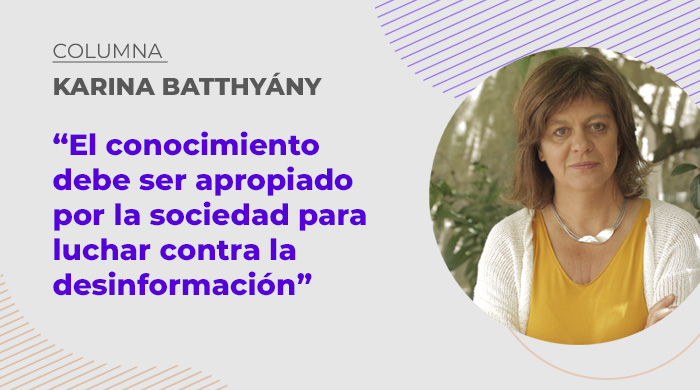
Transcript of Karina Batthyány's column
in InfoCLACSO – September 4, 2024
We are at El Colegio de México (COLMEX), one of the leading institutions in the field of social sciences and humanities, with a humanist spirit and a commitment to critical thinking. We have launched the new CLACSO-COLMEX Open Access Library, which joins the other 25 libraries that CLACSO already operates in partnership with its Member Centers or other academic institutions. The aim of these libraries is to make the reproduction of knowledge—such as books, journals, and academic publications in general—available to everyone without any barriers or restrictions.
At CLACSO, we have always championed open access. It is one of the fundamental pillars for the practice of open science and for defending access to knowledge as a public good for everyone.
Undoubtedly, the addition of this new publication to the library ensures that those who wish to learn about the significant contributions El Colegio de México has made to the development of the social sciences in Latin America and the Caribbean can also find them in the CLACSO Virtual Library. The new CLACSO-COLMEX Library further solidifies this library's position as the largest repository of social sciences and humanities resources, not only in terms of quantity but also in terms of the quality and types of materials we hold.
The CLACSO Library's materials repository generally has more than two and a half million downloads per year; what a way to democratize open access to knowledge!
– We live in a complex world with fake news and certain political sectors that promote climate change denial and stifle feminist struggles. How does the importance of initiatives that provide open access to materials of this kind fit into this complex world?
– Precisely, that is the role of knowledge. It must be appropriated by society for the search for information and its dissemination in order to combat the policies of disinformation and fake news that are circulating widely. We invite everyone to consult our Latin American and Caribbean Library and Bookstore to access these materials and then discuss them within the scientific field of social sciences and humanities.
– There were sessions within the framework of the Platforms for Social Dialogue, including forums between the Center for Interdisciplinary Research in Sciences and Humanities (UNAM) and the National Human Rights Commission of Mexico. What is your assessment of those two meetings?
– We returned to the National Autonomous University of Mexico, in this case to the Center for Interdisciplinary Research in Sciences and Humanities (CEIICH), where our Latin American and Caribbean Conference #CLACSO2022 was held. It was a great thrill to return to these spaces like the Humanities Tower.
We held two forums on “Migration and Human Mobility” and “Environment and Climate Change,” with two days of intense discussions and collaboration among those working in academia, social movements and organizations, and public policy implementation. These are undoubtedly two central issues for Latin America and the Caribbean, both in terms of environmental matters and climate change, and migration and human mobility. We continue to build upon this framework of platforms to promote social dialogue.
– In that sense, we spoke with some researchers, and it was very interesting to see the intersections between climate change and feminism, and especially how gender inequalities are reflected even in climate change issues. Women are disproportionately impacted by caregiving responsibilities due to human mobility in some cases, and these inequalities persist in all areas.
– This is the perspective we always propose, I'm referring to intersectionality, where the different dimensions of inequality are interconnected and, in many cases, reinforced. Of course, one of these dimensions is gender. When addressing environmental issues or migration and human mobility, we have a very important dimension in terms of gender inequalities.
In addition, we recently discussed within the topic of Migration and Human Mobility specifically the global care chains, migrant women who move geographically between different continents or even within Latin America itself to work as caregivers and what happens to their dependents or care situations in their countries of origin.
We also participated in a forum organized jointly by ECLAC, UN Women, and the National Institute for Women of Mexico on “Territories of Care,” where we addressed the intersections between many dimensions, such as care and the environment. In addition, I participated in the International Dialogue on this topic, sharing reflections and experiences, and considering the progress made in terms of concepts and public policy in Latin America and the Caribbean.
– In Mexico we have an unprecedented context with a very strong governmental transition and very high popularity at the departure of one government, to give way to the first female president of that country, something that marks a historic event, right?
– Absolutely. It marks a historic event because she is the first woman to assume the presidency of Mexico, due to the levels of votes she received, which are even higher than those of her predecessor, López Obrador.
Claudia Sheinbaum's victory presents a significant challenge. First, in terms of the continuity of the political cycle, it will allow for the advancement or deepening of the reforms being implemented in Mexico. And second, for our region. It will ensure the continuation of a progressive-oriented government, which is good news for Latin America and the Caribbean.
Full program – How do socio-environmental conflicts affect human mobility?
If you would like to receive more information about CLACSO's training programs:
[widget id=”custom_html-57″]
to our email lists.

