
“Scientific knowledge must be a public, social, collective and strategic good”
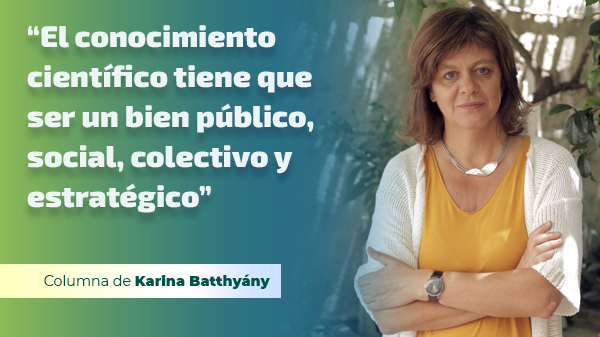
(Transcription of Karina Batthyány's Column)
(In InfoCLACSO – October 12, 2022)
-First, I'd like to ask you to explain to people what the International Science Council is. We've talked about the ISC on several occasions, especially since your election as our representative in this important organization.
Indeed, the International Science Council (ICSC) arose from the merger of two former organizations: one dedicated to the sciences and the other to the social sciences. About five years ago, they merged into a single institution that now works to strengthen science without distinction worldwide. Its main mission is to ensure that science is truly a public good, and therefore, that scientific knowledge is a public good accessible to everyone. This organization brings together many science academies from countries around the world, as well as organizations dedicated to scientific work. CLACSO has been a member of the ICSC for several years, having previously been part of the International Council of Social Sciences. Exactly one year ago (October 2021), I had the privilege of being elected to serve on the ICSC's Board of Directors for a three-year term, to participate in discussions with two main objectives, in addition, of course, to supporting the institution's development:
1.-To highlight the role of the social sciences in scientific knowledge and especially in these post-pandemic societies.
2.-To bring the contributions of Latin America into this discussion, because it is a region that is poorly represented on the Board of Directors of the International Council for Science.
So, we ask ourselves what we have to say about these issues and what we have to contribute to the debate on scientific knowledge as a public good in our Latin American and Caribbean region.
In this column, I propose revisiting the discussion of scientific knowledge as a public good. Why? Because recent years have clearly been marked by the increasing penetration of technology into almost every aspect of our daily lives, by the technological race between the United States and China, and, especially, by the dispute surrounding COVID-19 vaccines during the pandemic. This demonstrates the importance of access to scientific and technical knowledge, which has become both an absolutely central element and a central source of inequality.
Given this situation, CLACSO maintains that access to, use of, and democratization of scientific knowledge must be a public, social, collective, and strategic good to guarantee the human rights of all people.
It is necessary to make a diagnosis on this issue, since it forces us to critically analyze the way in which scientific knowledge is distributed today, and the framework in which the exercise of scientific activity takes place, as well as the training of researchers.
Talking about the challenges surrounding the democratization of scientific knowledge implies, first of all, strongly questioning the predominant way in which scientific practice is carried out, questioning the current parameters of relevance and scientific evaluation, of the distinction of research agendas that are closely associated, among other elements, with the famous rankings of scientific journals, many of which carry out their editorial practice with a clearly commercial purpose of profit and are hyper-giant transnational publishing houses.
For example, if we look at the data from the Science and Technology Indicators Network (RICYT), in the last decade the scientific population of Latin America increased from 410 in 2010 to 660 researchers in 2019, rising from 1.48% to 2.07% of the Economically Active Population of our region during the same period. In other words, we have indeed made progress in the number of people dedicated to research in the scientific fields.
The activity model centered on journal publication metrics and the promoted profile of the researcher—one who publishes articles in journals indexed within the mainstream scientific knowledge dissemination circuit—dictates what kind of publications are required, what writing style or language is necessary for publication, and also the choice of research methodologies and topics deemed more feasible or appealing to these publishing industries. Therefore, there is direct interference in defining research topics, which are often far removed from the realities of Latin America and the Caribbean, leading to a disconnect between research and its communities of origin and its environment.
In that regard, CLACSO has always strongly advocated for changing these practices. And since 2019, we have been promoting the Latin American Forum on Scientific Evaluation (FOLEC), which aims to discuss these criteria and propose alternatives to the ways in which scientific knowledge is currently produced, conducted, and evaluated.
And, of course, we are addressing the issue of the training of researchers, which leads us to emphasize academic and university systems, affected since the 80s by an advance towards universalization, but in a context of increasing commodification and privatization of Higher Education in our region.
There, we can use two indicators to better characterize this process. For example, taking UNESCO as a reference, in the last twenty years the Gross Enrollment Rate (which expresses enrollment as the percentage of the population in the age group corresponding to the five years immediately following high school graduation, generally from 19 to 23 years old) increased from 23% in 2000 to 52% in 2018. On the other hand, according to RICYT, the average for private education is 54,83% in Latin America, but in some countries it is quite serious, as in the cases of Chile (84%), Peru (74%), and Brazil (73%).
Therefore, it is increasingly crucial to design academic models that effectively connect all university functions—research, teaching, and outreach—within a framework of regional cooperation open to communities, including non-university communities. This framework should also allow for the recovery and democratization of other forms of knowledge, enriching the much-needed dialogues surrounding higher education and universities, particularly in our region today. In this regard, it is worth highlighting the long and powerful university tradition in Latin America regarding outreach, which has precisely addressed the link between university and society.
And finally, the issue of access to knowledge: it is key to defend knowledge as a public good that is distributed throughout society in an equitable, free, collaborative and above all non-commercial way, because therein lies one of the keys to effectively combat the inequalities and phenomena of poverty that we face today in our region, and to promote and strengthen democratic participation.
That is why open and free access to scientific knowledge was, is, and will be one of CLACSO's most important founding principles, shaping the course of institutional practices such as those we have always had in terms of open access to all the output produced by CLACSO and its more than 800 member centers. We are referring to the Latin American and Caribbean Social Sciences Library, which offers open, free, and unrestricted downloads: today it has more than 3.500 books from different collections and more than 30 million downloads per year; or the Network of Virtual Libraries, CLACSO.tv, CLACSO Radio, or our connection with the Network of Scientific Journals of Latin America and the Caribbean (REDALYC), which are some examples of this line of action. These are very important elements for ensuring that higher education and science are a human right and are not subject to these kinds of restrictions resulting from commercialization.
Scientific knowledge and academia today are called upon to play a central role in promoting democracy, solidarity, interdependence, responsibility and, of course, critical thinking, which, as we always say, is a type of thinking that also promotes or implies the idea of the social transformation of our Latin American and Caribbean societies.
If you would like to receive more information about CLACSO's training programs:
[widget id=”custom_html-57″]
to our email lists.

