
“The conflict in Eastern Europe undermines living conditions in emerging countries”
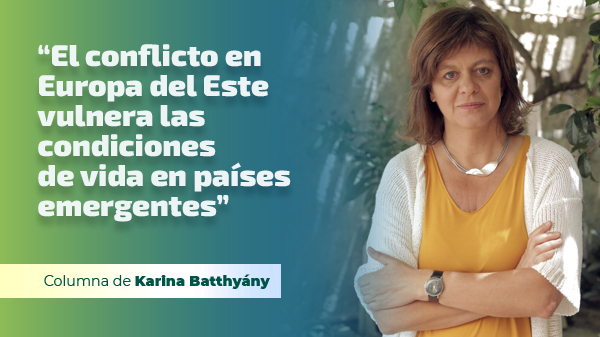
(Transcription of Karina Batthyány's Column)
(In InfoCLACSO – April 13, 2022)
We've already surpassed 6 participants for the #CLACSO2022 Conference, the major event taking place from June 7-10 at the National Autonomous University of Mexico (UNAM). It's no surprise to CLACSO that its conferences are always well-attended, but in this post-pandemic scenario, we were unsure how many people would be able to participate. We've already exceeded 6 registered attendees, and we're sure to have many more, as registration is still open for anyone who wants to join, free of charge, on our website: https://conferenciaclacso.org/
The #CLACSO2022 Conference will be an in-person gathering within the framework of the Social Sciences and Humanities. It will undoubtedly be a celebration to reunite in June.
-Turning to the topic you have planned for this column, we live in a complex and interconnected world where the globalizing logic of the economy poses new challenges. For example, an armed conflict in one place, with a shift in the prices of certain raw materials, can generate instability or economic activity elsewhere in the world.
One of our participants who will be at the #CLACSO2022 Conference, economist Jayati Ghosh, has just published a very recent article on the risk of a global food crisis. I will draw on elements of this article to address the topic of this new column. The economist from the international network IDEAS (International Development Economics Associates) argues that the conflict we are witnessing in Eastern Europe will not only affect Ukraine and Russia, but will also undermine the living conditions of everyone in emerging countries. She shows us how the economic impact of this armed conflict is already being felt worldwide: in Latin American countries like Argentina and Uruguay; in the United States, the year-on-year inflation rate for March has already been reported at 6%, and the same is happening in our countries. This is because, since the start of this escalating conflict at the beginning of the year, commodity prices like energy and food have been on a rollercoaster ride, meaning an uncontrolled rise. Global energy prices were, of course, already rising after the collapse they experienced during the 2020 lockdown. Let's briefly recap: in April 2020, Brent crude oil reached just over $9 a barrel. Since then, prices have increased steadily, and so far in 2022, this increase has accelerated. If we compare the price to April 2021, that is, from $9 in April 2020 to April 2021, crude oil has increased by 60 percent. And at the beginning of March 2022, it reached $120. Today, it's around $110. These are the highest prices since 2014. As we know, hydrocarbons are a strategic input that is part of the cost of almost all goods produced, and an increase in hydrocarbon prices is passed on to the rest of the economy. For example, in the span of a year, natural gas, a key input for electricity generation and heating, doubled in price by 116 percent. Another input that also doubled in price in the last year was gas, which is now also widely used in agricultural production. The increase in prices is, of course, partly explained by Russia's position in the global energy market. Russia is the leading exporter of natural gas and the third-largest producer of crude oil. It is also due to the economic sanctions imposed by the United States and the European Union, which call into question the ban on Russian gas and oil (and thus drive up prices).
According to economist Jayati Ghosh's analysis, this situation is amplified by the behavior of financial capital operating in the futures markets for these and other commodities, naturally seeking maximum monetary returns. This upward spiral in futures markets is particularly affecting grains, with the social and humanitarian implications that such price increases entail. As with hydrocarbons, the rise in grain prices is also driven by the risk that this armed and economic conflict will prevent both Russia and Ukraine from supplying their production to the global market. It's worth recalling that a United Nations FAO report stated that Russia and Ukraine are among the world's five largest grain producers. Russia and Ukraine hold the top two positions in the global sunflower oil market and together account for 60 percent of the world's supply of this essential commodity. Russia is also the leading wheat producer, and Ukraine is the fifth largest; together they contribute more than a third of global wheat exports. These two nations also account for almost a third of the global supply of other grains such as barley, and Ukraine is the world's third largest producer of corn.
These figures demonstrate the significant economic and social impact of the current crisis from a production standpoint. This has led, among other things, to a 60 percent increase in wheat prices over the past year, reaching levels that surpass the previous all-time high of 2007. These prices are now at $1.200 per ton. So far in 2022, corn (such a basic commodity) has increased by almost 30 percent. This rise in food prices was already a concern before the outbreak of this armed conflict. According to the FAO Food Price Index, a composite indicator that compiles international prices for a basket of food products, a year-on-year increase of 21 percent had already been recorded in February 2022, reaching a new all-time high that surpasses the previous record of 2011.
The FAO, also concerned about this armed conflict, published a report this past week on the risks this war in Ukraine poses to global food security. It warns that the military operation launched by Russia against Ukraine coincided with the summer crop planting season, which also raises questions about future stock levels and the impact on commodity prices. The report reveals a little-known fact: Russia's role as a leading fertilizer producer, supplying almost a fifth of the world's fertilizers, a crucial input for agricultural production. Adding the rising costs of hydrocarbons, fertilizers, and all the other factors mentioned, we can see the food security risks we face.
After two years of the pandemic, the baseline situation upon which we are building this scenario is obviously complicated. Let's remember that at the end of 2021, the FAO warned us in its annual report on the state of global food and nutritional security that, due to the international crisis caused by the COVID-19 pandemic, malnutrition had increased worldwide, affecting between 720 and 811 million people, of whom almost 60 million were from our region: Latin America and the Caribbean. In this report from last week, the FAO updates the estimate and warns that if this armed and geopolitical conflict continues, rising food prices could increase the global malnourished population by another 7 to 13 million, in addition to the 811 million I mentioned earlier. All these figures are worrying and alarming. We don't have to look far back in time to find precedents for a global food crisis. The most recent one occurred between 2007 and 2009, triggered by the rise in international grain prices that accompanied the global financial crisis. Nor do we have to look far back, to the French Revolution for example, to truly grasp the importance of food prices, the political significance of wheat, which was at the heart of the French Revolution. Consider what happened during the Arab Spring due to the price of bread, or the examples in Latin America directly linked to food prices. So, of course, this will be one of the topics on the program of the #CLACSO2022 Conference at UNAM, and we will also have economist Jayati Ghosh representing IDEAS, an international network of economists.
-If the free market "solves everything," if leaving everything in the hands of businesses and the world's wealthiest sectors "solves everything," what you're describing is what happens when nothing is regulated...
-It resolves everything in this direction, that is, by causing these kinds of consequences. And that is why, once again, we insist, as CLACSO generally does, on the commitment to working on the articulation of progressive public policies, on the need to return to this idea of the Welfare State and the intervention of the State to guarantee the basic well-being of everyone. The issue of food is one of the essential aspects of well-being. It is clear that the market does not resolve these things in the interest of everyone, but rather in the interest of profit and other market rules, not the rules of well-being.
If you would like to receive more information about CLACSO's training programs:
[widget id=”custom_html-57″]
to our email lists.

