
"The beginning of a new progressive cycle in Uruguay generates hope and joy."
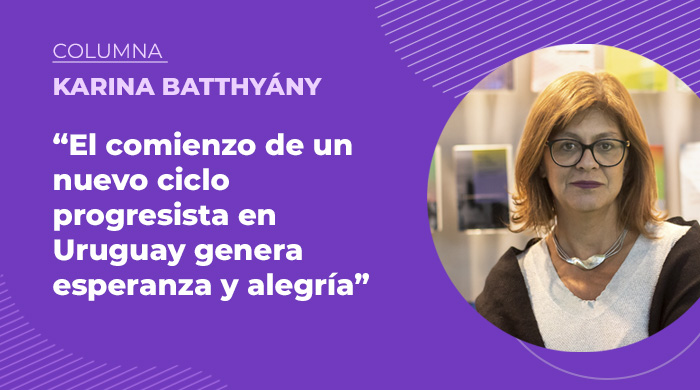
Transcript of Karina Batthyány's column
in InfoCLACSO – February 26, 2025
On Saturday, March 1st, the new Broad Front government takes office in Uruguay, led by Yamandú Orsi and Carolina Cosse, ending a five-year cycle of neoliberalism under Luis Lacalle Pou. Nearly 100 days will have passed since the Broad Front's electoral victory in the second round, where the majority of Uruguayans chose to contribute to a new era.
2025 is a very significant year because it marks 40 years of uninterrupted democracy after the terrible and fateful dictatorship that Uruguay faced in the period 1973-1985. Also, twenty years after Tabaré Vázquez's first victory, the Broad Front returns to government with a mandate until 2030.
Among others, the presidents of Latin America and the Caribbean will be present at the transfer of power, including Luiz Inácio Lula da Silva of Brazil, Santiago Peña of Paraguay, Gabriel Boric of Chile, Luis Arce of Bolivia, Gustavo Petro of Colombia, José Raúl Mulino of Panama, Bernardo Arévalo of Guatemala, Xiomara Castro of Honduras, and Luis Abinader of the Dominican Republic.
It is important to highlight this beginning of a new progressive cycle in Uruguay because there is a sense of renewed hope and joy placed in the government plan that this political force brings to power after winning the elections. Furthermore, the presence of a significantly greater number of women in the new cabinet, who will head ministries and take office on Friday, March 7, on the eve of International Women's Day, is noteworthy: Cristina Lustemberg as Minister of Health, Sandra Lazo in Defense, Cecilia Cairo in Housing, Lucía Etcheverry in Transportation, and Fernanda Cardona in Industry.
Regarding the issue of care, Uruguay was a pioneer and a beacon for Latin America with the creation of its National Care System, and this central theme is returning to the national public agenda with the new government of Yamandú Orsi. In this regard, I would like to highlight Valentina Perrotta, a collaborator with CLACSO, a woman with extensive experience in care at the national and regional levels, who will be heading the National Care Directorate.
Less than 56 hours remain until the inauguration of Orsi and Cosse, and the mobilized people are finalizing the last details of a vigil that began on Friday, February 28, accompanied by the vibrant rhythm of the Montevideo carnival being celebrated in various parts of the city.
Unfortunately, the transition was not without friction between the incoming and outgoing authorities. The outgoing government has taken some highly questionable measures in its final days in office regarding natural resources and public companies.
New right-wing movements around the world
Today, we are witnessing a worrying rise of right-wing parties around the world. Last Sunday, the advance of the far-right Alternative for Germany (AfD) party was confirmed, achieving its best result since the end of World War II in 1945. It became the second most voted political force with 20% of the vote, doubling its 2021 results, and this was met with delight by other global right-wing leaders such as Donald Trump and Elon Musk, who were very active in the election campaign supporting AfD leader Alice Weidel.
The gains do not allow them to form a government, which will be led by the conservative Christian Democratic Union (CDU), which came in first on Sunday with almost 29% of the vote. But the truth is that Germany, with a declining economy, is poised for a rightward shift that threatens to erode many social rights won in recent times.
The political program of the far-right Alternative for Germany (AfD) party focused on immigration. Among its proposals, it called for the closure of what it described as Germany's "asylum haven" and placed great emphasis on the concept of "remigration," understood as the mandatory repatriation of foreigners who must leave the country. Furthermore, the party advocated for reversing what it called "mass immigration" and establishing stricter requirements for obtaining German citizenship.
There is no shortage within the ranks of the AFD of those nostalgic for Nazi Germany and proponents of the so-called "great replacement" theory, according to which the European, white, and Christian population will eventually be displaced and replaced by Muslims.
It was also confirmed that Germany is not exempt from the phenomenon sweeping across various regions of the world: the growing support of young people, especially young men, for far-right parties. It is there that the AfD draws a significant portion of its electoral base.
Undoubtedly, this raises questions about the phenomenon of the (re)masculinization of politics, which is closely linked to the crisis of traditional models of masculinity, especially among working-class communities. In the context of precarious employment, unemployment, and the weakening of unions, some men have seen antifeminism as a way to reaffirm their identity in a world they perceive as hostile, and this impact has contributed to the far right capitalizing on male discontent through misogynistic rhetoric.
Added to this is the discontent of the population with the stagnation of the economy of the largest member of the eurozone, which has an impact both within and outside its borders.
This advance of the AFD accompanies Europe's shift towards different variants of the right wing that govern or are part of governments in Hungary, Italy, Belgium, the Netherlands, and are increasingly gaining ground in Austria, the Czech Republic, Romania, France and now in Germany, which have found common ground in building alliances with the United States of Donald Trump and Elon Musk.
Finally, I ask myself: What is happening to liberal democracy?
If you would like to receive more information about CLACSO's training programs:
[widget id=”custom_html-57″]
to our email lists.

