
“Climate change disproportionately affects the poorest communities”
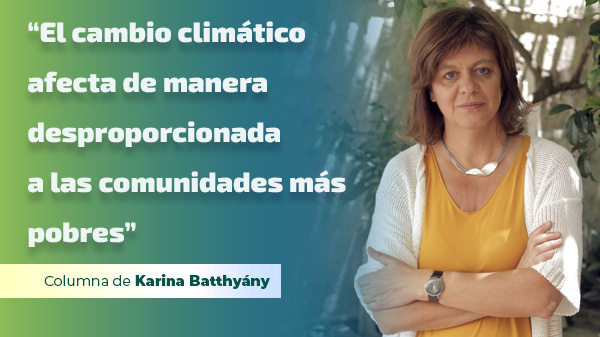
Transcript of the column by Karina Batthyány
in InfoCLACSO – June 7, 2023
Today, we will address the issue of climate justice in Latin America and the Caribbean, which is of growing importance due to the challenges and inequalities that our region faces in relation to climate change.
Latin America is one of the regions most vulnerable to climate change for many reasons, linked to its biological diversity, its geographical diversity along its extensive coastline, and the high dependence that is still observed on natural resources.
When we talk about climate justice, we're talking about the need to address the impacts of climate change equitably, as well as its underlying causes and associated responsibilities. Therefore, it means ensuring that all people, particularly the most vulnerable, have access to resources and opportunities to cope with this situation and participate in decision-making related to it.
In Montevideo, Uruguay, we have always been known for our abundant freshwater supply and for having some of the highest quality drinking water in the region and the world. However, for the past month, Montevideo and its metropolitan area, home to more than half of Uruguay's population, have been without potable water. That is to say, we have water that government authorities have deemed "drinkable," but it is not necessarily potable, because the levels of sodium and chlorine in the water supplied to the population through the sanitation and drinking water networks in Montevideo have been increased.
This is a consequence of a deep drought that is currently affecting the waterways that supply Montevideo and its metropolitan area.
Of course, we are also talking about climate justice in this matter, insofar as those most impacted today in Montevideo are clearly those people with fewer resources, who cannot buy bottled water to drink or for whom doing so represents a very significant percentage of their income.
The latest report from the Intergovernmental Panel on Climate Change (IPCC) essentially concluded with six key points. First, that climate-related impacts are worse than previously predicted and projected. Second, that the short-term effects of climate change will continue to worsen; they will not improve. Third, that risks will increase rapidly with the rising temperatures being recorded, leading to irreversible climate change effects. Fourth, that inequality, conflict, and development problems increase with vulnerability to climate risks. Fifth, that there is an adaptation issue: some viable solutions already exist, but more support is needed to reach the most vulnerable communities. And finally, that some effects of climate change are already too severe to adapt to, and that urgent measures are needed to address loss, damage, and the impact on specific populations.
A primary issue is that Latin America faces several challenges regarding climate justice, as we defined it earlier. Clearly, one of these challenges is social and economic inequality. As we've stated, our region has extremely high levels of inequality, meaning that the impacts of climate change will disproportionately affect the poorest and most marginalized communities. These communities also have fewer resources to adapt to climate change and are more vulnerable to the extreme weather events we are witnessing daily in our region, such as droughts, floods, and storms.
There is a second issue: deforestation and biodiversity loss. The region has a great deal of biodiversity, but also tropical forests, whose deforestation, along with the ongoing degradation of ecosystems in many countries, increases vulnerability to climate change and again affects local communities, which depend on these resources for their livelihoods.
A third issue of concern in Latin America and the Caribbean is extractivism and the exploitation of natural resources. We are aware of our region's wealth in natural resources. Perhaps this same wealth has served as a poor inspiration for the intense exploitation of these mineral resources, oil, and gas. This extraction often occurs without regard for environmental and social impacts, generating conflicts with local communities and, of course, contributing to climate change.
In our region, we face the problem of forced displacement and migration. Extreme weather events and the impacts of climate change can cause forced displacement and migration of entire communities. We have seen it, and we continue to see it, in different regions, perhaps more frequently in Central America and the Caribbean, but it is a reality that affects all of Latin America. People are forced to abandon their homes due to floods, droughts, rising sea levels, or other effects of climate change.
How do we address these challenges? We must work at the policy level, particularly on public policies at the national, regional, and international levels. We must also implement actions that promote diverse adaptations to climate change and protect the rights of the most affected and vulnerable communities. We must guarantee the meaningful participation of affected communities in decision-making related to the environment and climate change, and ensure the equitable distribution of the benefits of any resulting actions.
We must consider that our region, to move forward in this direction, has a unique instrument to improve environmental decision-making and protect everyone's right to a healthy, clean, and sustainable environment. This is the renowned regional agreement on access to information, public participation, and access to justice in environmental matters in Latin America and the Caribbean, known as the Escazú Agreement, which is pioneering and unique in the world.
We have a concrete instrument, a clear platform that promotes solutions and fosters alliances between different countries and between national, local, and municipal governments with the private sector, the scientific community, and civil society to encourage an equitable distribution of economic benefits and environmental impacts across the region. This agreement also raises the need to safeguard the fundamental rights of all people, with a particular focus on those voices that are not being heard.
So, we have this challenge, but we also have this tool to work at a regional level. We must incorporate climate change as one of the central dimensions today in terms of development, well-being, and ultimately, in terms of the future that awaits us.
CLACSO has always been committed to the issue of climate change, but in recent years it has been focusing its work on combining elements such as knowledge, public policies, movements and social organizations that work on environmental issues.
We are doing this on one of our Platforms for Social Dialogue. From there, we invite everyone to join the work on the Sustainable Development Plan for Environment, Climate Change and Development.
– In Montevideo, Uruguay, the water is becoming drinkable but not potable. That is, it's a perfect example of how certain changes in climate change can have very direct consequences, isn't it?
Absolutely. The problem was already being predicted months ago. Specifically, about six weeks ago. In Montevideo, the water is no longer potable due to increased sodium and chlorine levels. While it's claimed to be drinkable, it's not recommended. Health authorities have even stated that the water issue poses serious problems for people with hypertension, as well as for children.
What's happening is that, practically overnight, everyone now needs to buy bottled water, something that wasn't a regular occurrence in this country, and other inequalities are surfacing. It's not just about the renewed commodification of water, nor is it simply about having the money to buy it; the distribution networks are also quite different in different areas of Montevideo. Furthermore, there's a problem with distribution itself, and we hear stories from people living in Montevideo's poorest neighborhoods expressing a certain level of anxiety about not being able to access the product, even if they have the money.
There are no government-level measures in place for subsidies, beyond specific initiatives to assist hospitals with water distribution or to provide potable water to a very small, vulnerable segment of the population. Rates remain the same. Ultimately, it's once again: "solve your problem however you can." And that "however you can" is contingent on the resources available to each individual.
If you would like to receive more information about CLACSO's training programs:
[widget id=”custom_html-57″]
to our email lists.

