
“Access to knowledge has become one of the central issues of inequality.”
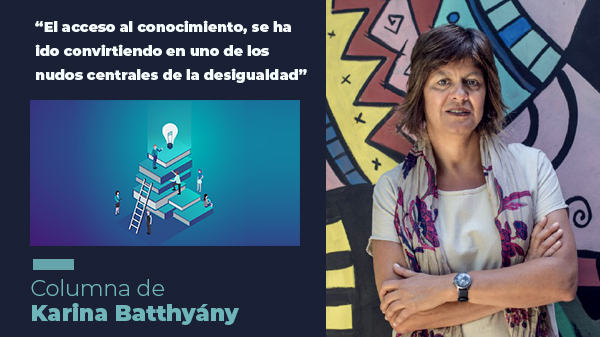
(Transcription of Karina Batthyány's Column)
(In InfoCLACSO – October 27, 2021)
During this week, CLACSO, together with many institutions and agencies with which we work dedicated to training, research and the promotion of Science and Technology, celebrates International Open Access Week.
These days CLACSO will have a very important presence, organizing, sponsoring or participating, through different references in the subject, in events of different types: seminars, colloquiums, open classes, symposia, and in the launch of books and podcasts, among other activities.
Why all this? Because open and free access to scientific knowledge was, is, and will be one of the most important principles of our institution, and that is why we are participating in the organization of Open Access Week.
We must remember that promoting open access to Latin American and Caribbean academic production is a way to democratize knowledge—this is one of CLACSO's founding objectives. And we believe that in recent years this issue has become even more important. This is because, as never before, access to knowledge has become a central issue of inequality. Therefore, this topic will be very prominent at our Conference, "The Web of Inequalities," in June of next year (2022).
We believe that defending knowledge as a public good that is distributed throughout society in an equitable, free, collaborative and non-commercial manner is also a way to combat poverty and inequality and promote or strengthen democratic participation.
In this fight to which we are committed, CLACSO has many actions underway this week, as well as ongoing actions within our strategic guidelines. For example:
-The Latin American Social Sciences Bookstore, which offers more than 3.500 books from different collections for free download.
-The Virtual Libraries Network, which has more than 100 texts from the network of associated centers and CLACSO Working Groups.
-The joint portal with the Network of Scientific Journals of Latin America and the Caribbean (REDALYC), which offers open access to almost 300 articles from 650 social sciences and humanities journals in the region.
-And also CLACSO TV, which in these last years of pandemic and quarantines is playing a more than prominent role, with many documentaries, interviews, virtual classes and talks.
Therefore, our publications program has been one of the channels through which our researchers, intellectuals, academics and scholars can disseminate the results of their work, their reflections and research, in the different areas of knowledge.
It is worth pausing to consider the case of the Latin American Social Sciences Library: it has had more than 30 million downloads during the last year, its collection has been built, improved, and multiplied with the Member Centers, but also in agreements with other institutions, such as the Ayacucho Library of Venezuela; the National University of General Sarmiento of Argentina; or the María Sibylla Merian Center for Advanced Latin American Studies in Humanities and Social Sciences (CALAS); also co-editions with commercial publishing houses such as Siglo XXI of Mexico and Argentina, or, signed just a few days ago, Blossom Press of China, among others.
At the beginning of this column, I mentioned that we are engaged in this struggle. Why do we call it a struggle? Because CLACSO and other training and research institutions are deeply committed to promoting the democratization of knowledge. This effort takes place within a context of increasing commodification of the educational and academic systems.
We want to emphasize that this defense of open access and of the repositories of our Latin American Library of Knowledge as a public good is, ultimately, also going against this trend towards the commodification of knowledge and also of the results of research.
The data you've shared is truly striking, because it speaks to an open access policy that is bearing fruit in terms of the impact of knowledge access materials and is trying to avoid the commodification logic you mentioned. But what's happening globally regarding this issue? Are we really able to challenge these market forces when it comes to knowledge? How much longer will this struggle continue as we address these issues?
I would love to tell you that we're almost there and that we're winning this fight, but unfortunately, that's not the case. We're in the midst of a debate and a full-blown challenge to democratize knowledge and, above all, to counter these commodifying trends. Progress has been made… Latin America and the Caribbean are an example in this regard, as is the work CLACSO is doing, particularly in relation to the data I presented from the Latin American Library. But much remains to be done. We have other lines of work that we're promoting, which go hand in hand with knowledge assessment and academic evaluation, where sometimes one of the requirements is precisely publication not in open access, but in those large journal publishers that are ultimately commodifying the results of research.
If you would like to receive more information about CLACSO's training programs:
[widget id=”custom_html-57″]
to our email lists.

