
The abandonment of strategic universities in Ecuador
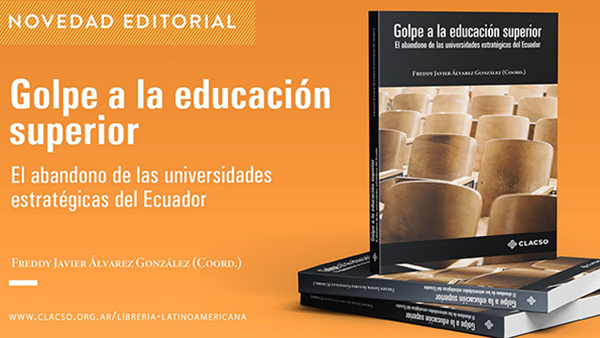
On Monday, January 25, the book “A Blow to Higher Education: The Neglect of Ecuador’s Strategic Universities” was presented. Organized by CLACSO, with the participation of various Working Groups, the virtual meeting included: Axel Didriksson – UNAM; Karina Batthyány – Executive Secretary of CLACSO; Andrés Arauz – Progressive candidate for President of Ecuador; Jesús Ramos – Former Rector of IKIAM; Ramiro Noriega – Former Rector of UARTES; and Freddy Álvarez – Former Rector of UNAE.
| This book is both a testament to, and an assessment of, the creation of three universities during Rafael Correa's presidency in Ecuador—IKIAM, U-Artes, and UNAE—through the voices of those involved. All three were products of technical and institutional innovations, under the guidance of intellectuals who understood the importance of building alternatives in science, knowledge, and higher education. However, with the transition to a neoliberal government, their strategic projects suffered political setbacks that led to their abandonment. The volume also includes reflections from prominent figures in higher education in the region, aiming to examine the dilemmas and conflicts currently facing the field. |


The meeting was coordinated by Axel Didriksson of UNAM in Mexico, who explained that “the main objective is to give a presentation and discuss the efforts of three founding rectors of the emblematic universities—as they were known in their time in Ecuador—so that we can analyze their trajectories and what has happened in recent years with a truly repressive campaign of ignorance, a campaign of attacks against these universities and, in general, against education, higher education, and universities in Ecuador by the current government. It is a very courageous, honest, and truly compelling testimonial text from the perspective of what the former rectors presented at the time when the aim was simply to remove them from office through an absolutely irrational political decision.”
Then, Karina Batthyány affirmed that “for CLACSO, it is very important to be present today at the presentation of this book, which is part of the ongoing struggle for higher education as a public good and a human right, a struggle that CLACSO has always championed and strategically supported in all processes that aim to establish higher education as a common good, a public good, a human right, and linked to popular movements, sovereign processes, and regional integration processes. Today, more than ever, it is probably necessary to discuss the role of knowledge, the role of innovation in higher education, and the importance of these universities and public universities. In that sense, the book we are presenting today is a contribution in this direction and, in particular, a contribution to the understanding of these emblematic universities created in Ecuador. I want to highlight what has driven these universities in terms of knowledge, the integration of knowledge, and the inclusion of those who are generally excluded from higher education processes. I also want to emphasize this central idea in these processes of emblematic universities: knowledge as a central element, as Knowledge is a foundation for public policy, but not just any public policy; precisely the kind of public policies we need in Latin America and the Caribbean to overcome the inequality and social injustice that, unfortunately, still characterize our region. Knowledge is also the foundation for democracy, but again, not just any democracy, but a popular, inclusive democracy that defends—as the book aptly puts it—the concept of "good living." Higher education is under attack throughout our region, and has clearly suffered significant blows in recent years in Ecuador with the processes of commodification that deeply concern us, the attempt to turn higher education into a commodity, and the expectation that all of us who work within higher education must accept this commodification, which is absolutely unacceptable. They ultimately want to turn us into consumers of that commodity.
For Andrés Arauz, economist and progressive candidate for the presidency of Ecuador, “we cannot forget what it means to build flagship universities. It was a legacy of the clear, visionary leadership we had in Ecuador, like that of Rafael Correa, which allowed this dream to receive the full political support in terms of laws, infrastructure, and public resources so that these dreams could become a reality. (…) And we must start from the fact that here we have, for the first time in the history of Ecuador and probably of many Latin American countries, a Constitution of the Republic that expressly addressed the importance of higher education, the rights related to higher education, science, technology, the arts, and culture, with entire chapters dedicated to this topic. This reflects the strategic importance that the Ecuadorian State gave it, based on a social consensus, that development and well-being could not be separate from or divorced from the importance of higher education. This contrasts with the neoliberal creed that for many decades prevailed in Latin America.” This was reflected in the publications of multilateral lending institutions, which, in their studies on macroeconomic trends and public policies in our countries, expressly recommended defunding higher education and directing it exclusively to basic education. They argued that the market could take care of higher education and that, as compensation for the social emergency following the neoliberal disasters, it was necessary to provide public education. I repeat: always from this perspective of emergency, of providing a lifeline, and not from the perspective of building rights and—worse still—of building a future, dreams, and aspirations for our people in Latin America.”
Then the three co-authors of the book took the floor. First, Freddy Alvarez, philosopher and former Rector of UNAE (National University of Education), stated that “we are here to present this book as a recognition of the transformation of education; it's not about ideas but about facts. (…) We come to declare the importance, for Ecuador, the network, and the region, of the creation of flagship and strategic universities, a project that was brutally attacked by right-wing media, by some private university enthusiasts, and by the government of Lenin Moreno. And, consequently, we must also affirm today that in this small country of volcanoes, coasts, and Amazon rainforest, we have been able to do something that no other country in the world has been able to achieve, and even then, with great difficulty: the flagship universities. (…) A project we built with great dedication, a project with heart and intelligence; we turned a dream into a reality.”
In turn, Jesús Ramos, former Rector of the IKIAM Amazonian Regional University, referred to a “somewhat personal account of our vision of the University. Although the book presents three very specific examples from Ecuador, I believe the lessons that can be drawn are perfectly applicable to any territory, especially in Latin America. (…) I am Spanish, and in Spain, for many years during the dictatorship, the saying was 'let them invent, we'll just copy'; that is the logic of neoliberalism, leaving the capacity for action to the market and others. For us, these universities were clearly created from the beginning to break with that logic of letting others do the research or generate knowledge. No, no, knowledge had to be generated here, it had to be generated in each place, and it had to help change the country, and that is why these universities were created.”
Finally, Ramiro Noriega, former rector of the University of the Arts (UARTES), acknowledged: “I am thrilled to see that history continues in these complex contexts we have been experiencing, not only because of Covid but especially because of what has been happening in our specific case of universities: it has been an extremely difficult and complex year, because we had been working with a vision, a vision dictated by the law, and the law mandated achieving university autonomy, that is, realizing an institutional project and attaining that transcendence. (…) I see this book as a starting point that will hopefully generate a substantial, in-depth debate not only regarding the strategic, emblematic universities, as we call them here, but also at the level of public higher education, which has been—as Karina mentioned—severely affected throughout Latin America and particularly in countries like ours, in a very critical way, even to the point of calling into question the very purpose of public education.”
If you would like to receive more information about CLACSO's training programs:
[widget id=”custom_html-57″]
to our email lists.

