
“97% of women of reproductive age live in countries where abortion is not permitted”
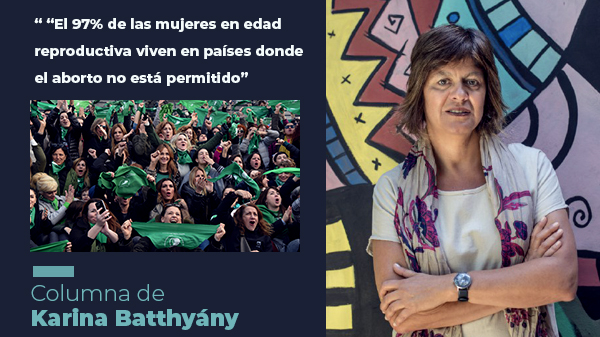
(Transcription of Karina Batthyány's Column)
in InfoCLACSO – 16 December 2020)
Last Wednesday, towards the end of our column, we referred to this issue, which was being debated in the Argentine Chamber of Deputies and which was ultimately approved: the Voluntary Interruption of Pregnancy has passed its first reading in Argentina. And I think it's important to dedicate some time today to examining the situation of sexual and reproductive rights, and particularly the Voluntary Interruption of Pregnancy (or abortion), in Latin America and the Caribbean.
If we were to quickly draw a map—in fact, one is available; several organizations have posted it online—we would say that the situation regarding abortion in the region today is, generally speaking, that it is either prohibited or highly restricted in some cases, and only partially decriminalized. That is the situation.
Let's look at the example: only three countries in this region, and four if we include Guyana, allow voluntary termination of pregnancy within certain established timeframes, generally around week 12 or 14. These are, in addition to Guyana, Cuba, Puerto Rico, and Uruguay. Then we have Mexico City and Oaxaca, also in Mexico, as cities that permit this voluntary termination of pregnancy.
The fact that there are so few countries, which therefore represents an exception to the rule that extends throughout the region, implies very important risks to women's health and results that concern us in all these countries.
We must also mention that there are five countries that prohibit abortion under any circumstances. This means, for example, when the mother's health is at risk, when it is the result of rape, or in cases of incest. These countries are the Dominican Republic, Haiti, Honduras, Nicaragua, and El Salvador. If we want to continue with examples, let's remember that El Salvador also stands out as perhaps one of the countries that most aggressively and severely prosecutes women accused of abortion. Today, we have more than a dozen women in prison for having abortions, some with sentences of up to 40 years. And when we look at who these women are, in many cases we find that they are poor, young women, victims of rape. Furthermore, in that country, medical personnel believed to have participated in an abortion are also punished. This is the result of the prohibition of abortion under any circumstances, as I just mentioned. Furthermore, we must be clear that this situation generally coexists with high rates of sexual violence against women, and that the prison sentences imposed for abortion—and this is a paradox—are often double the sentences for rape. In other words, in these countries, the situation of a woman who has an abortion is considered more serious than that of a male rapist in terms of the penalties imposed.
This situation, when we travel through Latin America and the Caribbean, reveals that practically 97% of Latin American and Caribbean women of reproductive age live in countries where abortion is illegal. It is estimated that approximately 5 to 10 women die each year from unsafe abortions in this region—the numbers are complex because the figures are unclear in most countries. Therefore, it is a public health problem.
But we also have to understand that the Voluntary Interruption of Pregnancy is a political issue, since women cannot decide about their own bodies and this generally perpetuates and aggravates situations of poverty and violence that women experience.
Let's not fool ourselves into thinking that "the fact that abortion is prohibited means that abortion doesn't exist." I just gave the figures: despite being prohibited, despite not being legalized, abortion exists; it has always existed in all our countries. What we do, in any case, is define who can have one, who has the resources and connections to terminate their pregnancy safely, and who has to end up risking their life by resorting to clandestine methods or, in many cases, ending up in jail.
We mustn't forget here (although we don't have time in today's column to elaborate on it) the role that religions in general, and particularly the Catholic Church, have played in this whole issue, but also the rise of evangelicalism in Latin America and the Caribbean, which, as we know, has been gaining ground and hindering, in many cases, the progress of the Feminist Movement in demanding rights related to the Voluntary Interruption of Pregnancy and other basic reproductive rights. Brazil is the prime example, even before Bolsonaro, in terms of the impact of the evangelical bloc, which systematically thwarted various legislative actions in favor of women and the LGBTI population.
Now, to conclude this overview of Latin America and the Caribbean without mentioning the hopeful situation in Argentina, where, as I mentioned, the bill has already passed one house of Congress, and we hope that this time it will indeed be passed and not repeat the mistakes of 2018, when it passed one house but ultimately failed to be approved. Undoubtedly, Argentine women have been at the forefront of the fight for these rights and the unprecedented social mobilization throughout 2019, which spread the green scarf movement across the continent. Ultimately, what we are proposing, as we concluded in our column last Wednesday, is a vision of a democratic society where women truly have the right to decide about their bodies and their life plans, where these decisions are respected, and where states guarantee and create the conditions necessary to ensure the exercise of these rights.
Legal and safe abortion is a reproductive right, a human right that must be exercised within a context of state secularism, social justice, and gender equality. Let me conclude by recalling the slogan of the Latin American campaign for abortion rights: “Sex education to decide, contraception to prevent abortion, legal abortion to prevent death.”
We hope to have the good news before the end of the year that Argentina will join the countries that have legalized the Voluntary Interruption of Pregnancy.
If you would like to receive more information about CLACSO's training programs:
[widget id=”custom_html-57″]
to our email lists.

