
“The 25N movement emerged from the Latin American Feminist Movement against violence against women.”
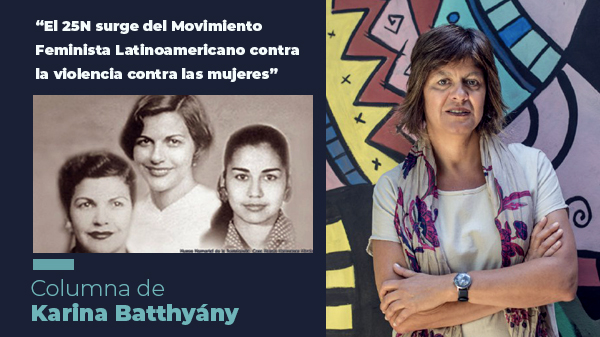
(Transcription of Karina Batthyány's Column)
(in InfoCLACSO – November 24, 2021)
It's a pleasure to participate in this InfoCLACSO, the day before November 25th, where we'll dedicate the entire program to the topic of gender-based violence, violence against women. A very important issue. Of course, our Latin American and Caribbean region will be one of the key focuses of our upcoming Regional #Conference2022 in June (Mexico), as we've been discussing here week by week, exploring the different areas of work.
First of all, if you'd like, let's remember how November 25th came about, because it has a unique Latin American and Caribbean significance. The first call to commemorate November 25th was made by the Latin American Feminist Movement. That is to say, this date, which is now internationally recognized and has been adopted by organizations such as the United Nations, originated in one of the Latin American feminist gatherings to remember the date in 1960 when the three Mirabal sisters were assassinated in the Dominican Republic, establishing that day as a day of struggle against violence against women, against gender-based violence. As I said: Today it is recognized internationally by all countries and by different communities around the world at the suggestion of the United Nations. But its origin is here, in Latin America and the Caribbean.
Gender violence is a manifestation of gender-related inequalities, perhaps the most dramatic, the most extreme, violence that is imposed on women and girls because of the position of domination and subordination that women and girls have in society and that this violence is expressed in different dimensions: physical, sexual, emotional, economic, institutional, among others.
Furthermore, this phenomenon of gender-based violence is widespread throughout our societies, disregarding all geographical, social, and cultural boundaries. It is, we might say, a form of globalized violence, without distinction of class, race, ethnicity, or group affiliation. Nor is there a specific profile of victims of gender-based violence. The main risk factor for becoming a victim of this type of violence is simply being a woman. That is to say, merely by virtue of being a woman, we are already at risk of experiencing these situations of violence.
Looking at the statistics or records from the United Nations Office on Drugs and Crime (UNODC), we see that in Latin America, 14 of the 25 countries have some of the highest rates of crimes against women in the world. Furthermore, our region is the second most dangerous (from this perspective for women), surpassed only by Africa.
According to the ECLAC Gender Equality Observatory for Latin America and the Caribbean, the ten countries with the highest rates of femicide per 100 women are headed in our region by Honduras, followed by the Dominican Republic, El Salvador, Bolivia, Brazil, Panama, Mexico, Guatemala, Uruguay and Argentina.
The record of femicides is perhaps the most serious and extreme form of gender-based violence (though not the only one), but it demonstrates how, in times of crisis, the numbers increase, as seen recently during the COVID-19 pandemic and also during recent humanitarian crises, conflicts, and climate disasters. All these factors contribute to increased violence against women.
A new UN Women report, also for Latin America and the Caribbean based on data from 13 countries since the pandemic, shows that 2 out of 3 women suffered some form of violence or knew a woman who suffered some form of violence.
Let us also remember that back in 2013, the World Health Organization (WHO) stated that “physical or sexual violence is a public health problem affecting more than a third of all women worldwide.” However, during the pandemic, gender-based violence, despite these warnings, remained invisible in our region. So much so that the measures taken in the early stages of the pandemic, such as lockdowns, exacerbated violence like never before. This factor was not taken into account when the lockdown measures were implemented.
These very lockdown measures triggered an escalation of gender-based violence. According to ECLAC, two out of every three femicides in Latin America occur in the context of current or former intimate partner relationships. And according to a UN Women survey conducted during the pandemic, 12% of women and girls (adolescents) between the ages of 15 and 49, approximately 19,2 million, were victims of physical or sexual violence by a current or former intimate partner in the 12 months prior to the survey.
We know all too well that, in times of economic hardship and social instability, gender-based violence erupts in the domestic sphere. And it became very clear—as I said—during the pandemic that for many women and children, home was not a safe place to shelter from COVID-19, but rather a trap and a deadly threat.
Femicide is the most extreme expression of the inequalities that affect women's human rights, but it is not the only form of violence. Let's take another case: The general situation of prohibition and persecution against abortion, for example, is also a form of violence that violates women's physical autonomy. As we have stated here at InfoCLACSO in other columns: 97% of Latin American and Caribbean women of reproductive age live in countries where abortion is not permitted. And it is estimated that approximately 5 to 10 women die each year from clandestine abortions in this region.
So, once again, we at CLACSO say with great force: Enough is enough, Not One Less!
That's why there are different dimensions to violence: physical, certainly, but also emotional, psychological, and economic, and of course, the different spheres in which this violence occurs. Now, in any case, let's always remember that for women, the most dangerous place is not the street, nor is it the workplace. The most dangerous place for women in Latin America and the Caribbean continues to be their own homes.
-I was thinking about this context and the day's events. There was a significant effort, at least in some countries, to get the media to start talking about femicide and not other terms that tried to hide the brutal violence against women. How do you see this situation?
-Absolutely. It's a step forward in that regard, where things are called by their name, for what they truly are, and not like a few years ago when we were used to seeing newspaper headlines that spoke of "crimes of passion," for example. They weren't crimes of passion; they were femicides. Now we've made progress in that area, we've also made progress at the regulatory level in Latin America and the Caribbean with the recognition of gender-based violence and femicides, and also with policies to prevent these kinds of problems, but there's still a lot to be done… Because there's a reason for the figures I shared. The issue remains very serious in Latin America, and we have to continue redoubling our efforts. And I think that the slogan "Not One Less" is a good slogan to remember today, the day before November 25th, and of course, every day.
-Karina, there's something about the analysis that I find generally complex. I say this based on observing certain things, especially listening to what you said about how sometimes only one or two lines of analysis are used to understand the situation of violence against women. For example, the need to change educational approaches to prevent sexism from early childhood, and possibly other issues that arise in adolescence related to education. But I also understand that this is happening without public measures, without laws to prevent these situations. So, the multitude of situations that need to be addressed simultaneously makes this type of work, which is entirely multidisciplinary and involves different perspectives, quite complex... How does that approach work?
-Yes, absolutely. First of all, I want to reaffirm the importance of public policies in this area, public policies in the broadest sense, and clearly, given the topic at hand, of an absolutely intersectoral nature. It's not just one sector of public policy—like health, for example—that's involved, but rather multiple sectors that have something to contribute. And we have to work to eradicate all forms of violence, and that implies broad public and cultural policies to highlight, to denounce this issue, to raise awareness about it, and, of course, to change everyone's practices, because this violence is ingrained in everything from small, everyday practices to the larger-scale practices of states that still perpetuate forms of violence against us women.
If you would like to receive more information about CLACSO's training programs:
[widget id=”custom_html-57″]
to our email lists.

