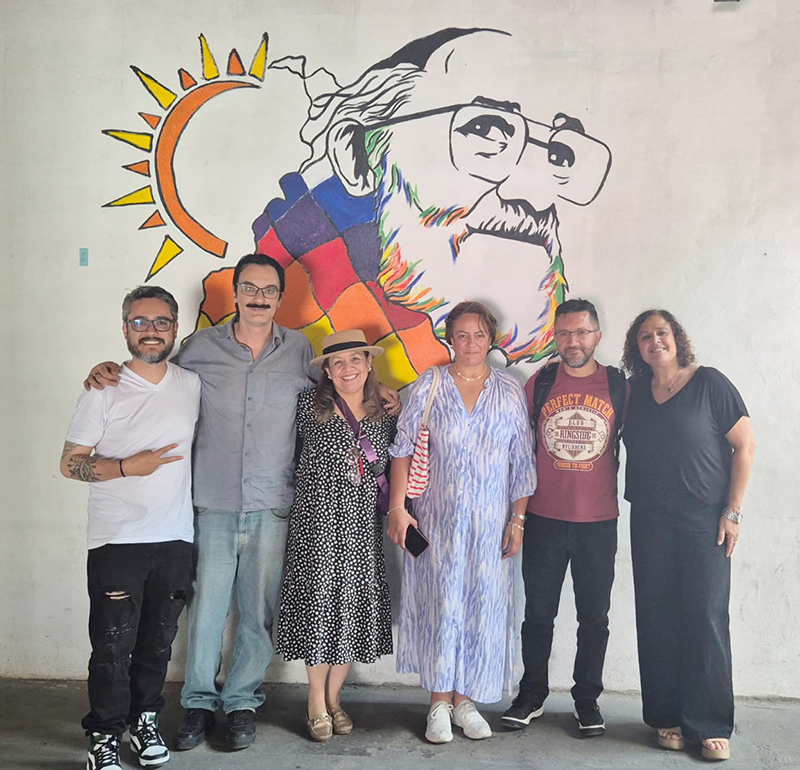
“We will educate despite everything, striving for a better world.”
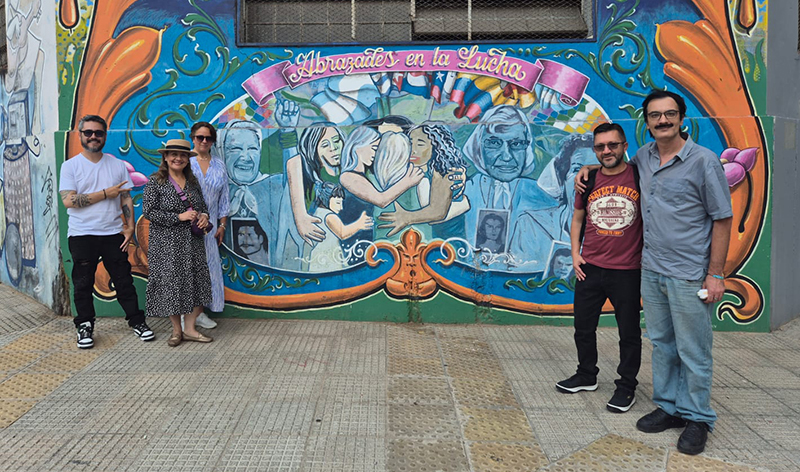
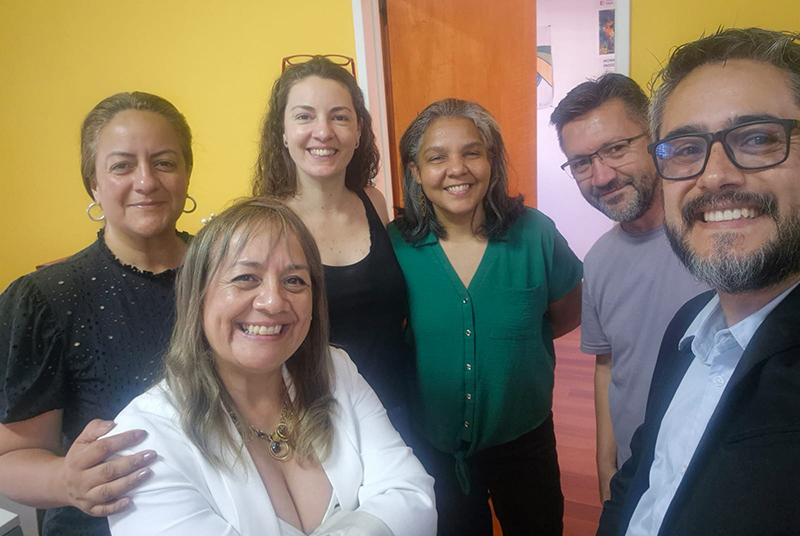
Four Colombian doctoral interns from the CLACSO Network spent several weeks in Buenos Aires, the capital of Argentina, where the executive headquarters of the Latin American Council of Social Sciences is located.
Is about:
• Franklin Arévalo Flórez . Teacher, Bogotá SED. Doctoral student in Social Sciences, Childhood and Youth. CINDE / University of Manizales.
• Liliana Castro Cruz . Liaison Teacher, Bogotá SED. Doctoral student in Social Sciences, Childhood and Youth. CINDE / University of Manizales.
• Milton Eduardo Solórzano Peñuela . Teacher, Bogotá Department of Education. Doctoral student in Social Sciences, Childhood and Youth. CINDE / University of Manizales.
• Claudia Liliana Rincón Valdiri . Early Childhood Teacher, Bogotá Education Secretariat. Doctoral Student in Social Sciences, Childhood and Youth. CINDE / University of Manizales.
Among their many activities, they visited the Cooperative of Popular Educators and Researchers (CEIPH) in Buenos Aires, a social, political, and educational organization that promotes education as a tool for social transformation. There, they were received by its president, Fernando Santana . The IMPA (Argentine Metallurgical and Plastics Industry) Popular High School for Youth and Adults operates there.
Franklin, Liliana, Milton and Claudia gave their testimony in front of the cameras of CLACSO TV and their written accounts about their experience in the city of Buenos Aires and at the CLACSO headquarters.
Mate and tinto, conversation rituals between Argentine and Colombian teachers
Franklin Arévalo Flórez
In Colombia, we drink coffee and talk. In Argentina, they prepare mate and talk. We've spent twelve days in Buenos Aires trying to understand how to teach when the education system fails, and we've learned that the best conversations about education don't happen in academic conferences but around these rituals: the coffee prepared early in the morning, the mate circulating in the afternoon.
But this December afternoon, in the multipurpose office of the Popular High School for Youth and Adults IMPA, there is no mate.
"Is there any weed?" a boy asks, poking his head out.
Fernando looks at Natalia, another teacher. She shakes her head.
-There is no.
Fernando offers us coffee, with an apology and a half-smile:
—He's not Colombian, but oh well…
The absence of yerba mate is no accident. In present-day Argentina, even the smallest rituals are becoming difficult to sustain. But Fernando Santana, tall and with a Groucho Marx-esque mustache, runs this high school as if he had everything: willpower, creativity, stubbornness. What he lacks is state funding.
This meeting takes place after a tour, with Fernando, of the worker-recuperated factory IMPA. There, in the late 1990s, the workers realized that the plant was being slowly dismantled by its owners and managers, who were trying to salvage their investment even at the cost of abandoning them. Faced with this prospect of closure, they decided to occupy the factory and keep it running, guided by an ideal of solidarity and self-management.
Popular high schools emerged in Argentina as a response to a long-neglected need: millions of adults who had not been able to finish secondary school or were at risk of not doing so. They arose from social organizations and community processes and, like worker-recuperated factories, are organized around self-management and solidarity.
The IMPA community high school was born from a teachers' cooperative, a social movement that took up the unmet educational need. Its pedagogical approach is rooted in the history of the worker-recuperated factory, art, body awareness, and comprehensive sex education, all aimed at challenging the relationship between labor and capital, inequalities, and everyday exploitation.
At the high school —as teachers and students call it—two philosophies coexist. The first, Fernando's own, I photographed on a board covered in notes: "We leave the doors open because they are an invitation to enter." The second: we solve the problems that affect us as a community, as when, faced with the difficulty of caring for young children, they created the Mariela Muñoz Popular Preschool so that the students wouldn't drop out.
The way these community-run high schools operate is unique. Through social activism and years of struggle, they achieved state recognition, which includes salaries and social benefits for the teachers. However, the project remains autonomous in its curriculum, work methods, and teacher hiring practices. Faced with difficulties, it allocates a percentage of those salaries to a common fund for materials, maintenance, and even food, all based on a principle of solidarity.
My childhood friends had a saying when a shared drink ran out: "Well, that's the end of the friendship ." Not here. Even though there's no more yerba mate and the coffee runs out, friendship is born, nurtured by our shared paths in teaching and Latin America. Fueled by the commitment to raising awareness of IMPA in our communities, we remain convinced that, thousands of miles away, we will educate despite everything, striving for a better world.
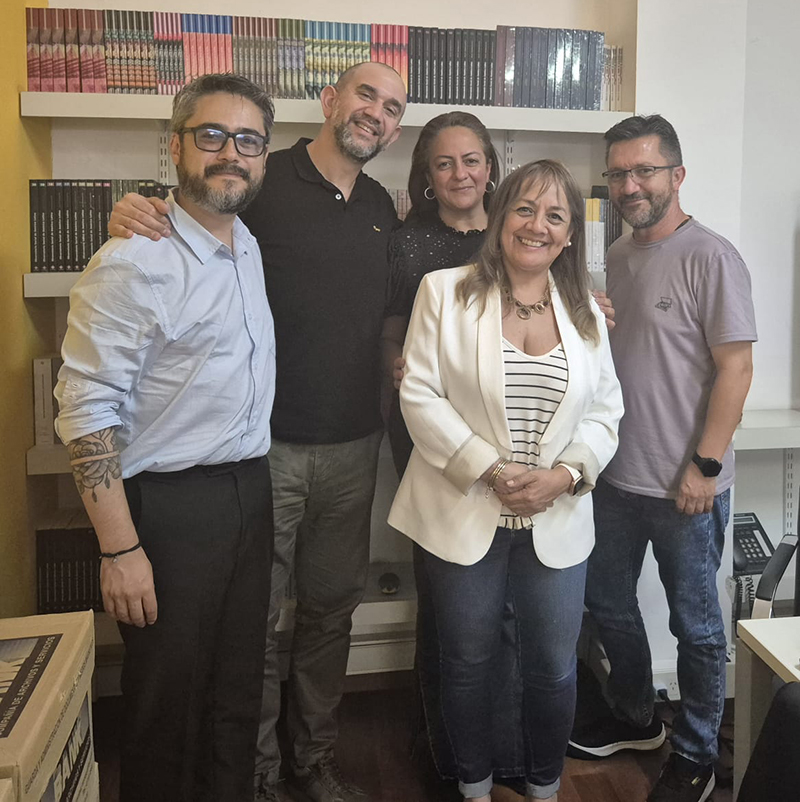
A Journey Between Memory and Reality
Liliana Castro Cruz
Walking through the streets of Buenos Aires during my stay, I found myself immersed in a sea of conversations that, almost inevitably, touched on the topic of education. It wasn't in classrooms or school hallways where I encountered profound reflections, but rather in everyday chats with Uber drivers, men and women who, although outside the professional educational sphere, were deeply concerned about the direction their children's education was taking.
“How has secondary education changed?” was the question that arose spontaneously in every conversation. And it was fascinating to see how a topic so close to their lives could evoke such palpable melancholy in their voices. In Argentina, where education—and particularly in the later grades—is seen as the gateway to a more promising future, the answers were not simple. In every word, one could perceive a mixture of nostalgia and bewilderment: memories of an educational system that demanded more, that forged character, that seemed to hold the key to unlocking the doors to a better future.
“Education used to be tougher, more demanding,” Juan, a 45-year-old driver, told me as we drove along 9 de Julio Avenue, with the Obelisk looming in the background . “The teachers were always on top of us, making us study seriously and instilling values. Today everything is more relaxed, more easygoing. Kids aren’t afraid of making mistakes or failing anymore, and they stand up to their teachers without any problem.”
That phrase, uttered almost in passing, yet brimming with common sense and experience, left me pondering. What changed in schools that makes this feeling so common in everyday conversation? At what point did high standards begin to be seen as excessive and commitment as something negotiable? It's a question that resurfaces time and again, amidst traffic lights and memories, whenever someone talks about what school used to be and what it is today.
What some see as nostalgia, others see as a clear sign that something fundamental has stopped working. And that "something" has repercussions not only for young people's present but also for their future, their transition to higher education or working life. As in every country where secondary education is crucial for accessing better opportunities, the challenges are numerous and the answers scarce. And as I delved into these parents' stories, I realized that the questions they raise about education are not just academic but profoundly social and cultural.
Their words weren't just a critique of today's youth, but a lament for what they saw as a loss of education as a space for discipline, challenge, and personal development. A space that, according to them, allowed them to forge skills that today seem beyond the reach of young people. And it was the most nostalgic conversation, when I asked myself: Why does the perception of a "more rigid education" generate so much melancholy, but at the same time, doesn't seem to be the solution to today's problems?
Carlos, another of the drivers, remained silent for a while before speaking, as if rewinding the tape of his memory. Then she launched into a monologue, with a mixture of nostalgia and pride: “In my day, we were much more immersed in our studies. School was a different beast. I vividly remember my math teacher, Esther. She was a very unusual woman, like something out of another era, you know. Always with her hair pulled back tightly in an impeccable bun, not a hair out of place, as if the order she demanded in class began with herself. But if there was one thing she couldn't let you get away from, it was her gaze. A fixed, deep gaze that pierced you through her glasses, you know, thick glasses, with those old-fashioned frames and that almost invisible line that divided each lens in two—her bifocals—which she would barely shift to look you straight in the eyes, you know, as if she were reading your mind. She didn't even need to raise her voice. Just by looking at you, you knew there was no room for distraction. She kept us all on a tight leash, but not out of fear. It was respect, you understand? A strange mix of admiration and tension that forced you to pay attention.” You see, when math got tough, he didn't yell or challenge us. A simple gesture of his hand was enough; he'd extend it firmly and in one swift motion suspend one of his fingers as a warning, you know, or that look of his—"Wow…!"—and the classroom would fall into absolute silence, waiting for his next instruction.
She wasn't one to act cool or like she was friends with her students. She taught with the conviction that what she was teaching was worthwhile, that you had to put in a little effort to learn. And the incredible thing is that, without saying it, she made you understand that the effort had meaning, that every calculation, every formula, served a purpose, you know.
The teacher always carried a worn cloth bag containing chalk, an eraser, and a skein of yarn. And that's when the chaos began. Out of nowhere, bam!, she'd throw the skein at you or anyone else, and the interrogation would start: multiplication tables, mental calculations in the middle of class, without warning. It was incredibly stressful, total madness. But thanks to that, we came prepared, because we knew it could be your turn at any moment. That's how I learned my times tables, through sheer nerves and practice.
Today you look at kids and it's a different story, you know, it seems like nothing matters to them. They stand up to the teacher and say without hesitation that they don't know, while they're on their phones, more focused on social media and likes than on what's happening in the classroom. And that's when you realize how much everything has changed.”
Continuing to reflect on Juan and Carlos's comments, a fundamental question arises: Is the school solely to blame for young people's disengagement from the educational process? Or have all of us, as social actors, in some way been complicit in a transformation that, while undesirable, has left its mark on us? It's easy to point the finger at teachers, institutions, evaluation systems, or even educational policy, but what if the responsibility also lies with other factors that, while less visible, are equally decisive?
Continuing the conversation, I asked him curiously, "So, who do we blame?"
“Look, as a parent, I feel it’s wrong to put all the blame on the school or the teachers. It’s easy to say that teaching used to be better and that kids aren’t interested anymore, but it’s not that simple. Education doesn’t just happen in the classroom; it starts much earlier, at home, in how we raise our children, in the values we transmit, and in the actual time we dedicate to them.”
We adults also have to take responsibility when we look the other way, when we let our cell phones take over, or when we expect the school to solve a problem that belongs to everyone. The school has changed, yes, but we have also changed as families and as a community, you understand? So, rather than looking for someone to blame, I think we need to assume shared responsibility. If we want children to engage with learning, we first have to commit ourselves: setting limits, providing more support, and giving education back the place it deserves.”
At the end of each conversation, as the car moves through traffic lights and honking horns, the same feeling lingers: no one is entirely right, and yet, no one is completely blameless. As parents, many of us quietly acknowledge that something has slipped out of our control: shared time, clear boundaries, authority constantly under scrutiny. As a society, we've relegated schools to a secondary role, demanding more and more from them while supporting them less and less.
And that's where I come in, a Colombian teacher, listening from the back seat, taking note of those recurring nostalgic memories—the strict teacher, the respect, the fear that wasn't fear but commitment—and contrasting them with this present of tired, distracted, often listless kids. Not to judge, but to ask questions. To understand at what point we stopped seeing school as a collective project and started seeing it as a service that "someone else" has to provide.
Perhaps the first step to reversing this apathy lies not in grand reforms or bombastic speeches, but in that minimal, almost invisible gesture of taking responsibility again. Of listening more, of truly supporting, of setting boundaries without guilt, and of restoring education to the place it should never have lost. Because schools can't sustain themselves, and neither can the kids. And if these Uber conversations, amidst memories and frustrations, make one thing clear, it's that we still have time to do our part before the journey completely spirals out of control.
The answer doesn't lie in just one direction. If we want secondary education to fulfill its purpose of preparing young people to face the challenges of the future, we must build a new educational pact together, one in which all stakeholders understand their role and work together toward a common goal: that school be a place of opportunity, growth, and connection with the world around them.
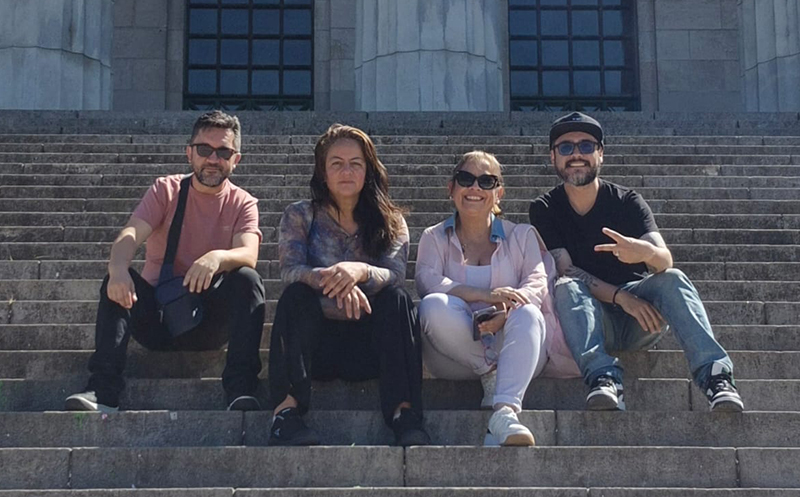
“Buenos Aires, the city that resists: Notes on a society in crisis”
Milton Eduardo Solórzano Peñuela
With a very smooth landing, the plane I had come in from Colombia slid the giant wheels of its landing gear across the ground of Buenos Aires, the capital of the Argentine Republic. Upon entering the airport, my tired eyes wanted to close, but stoically resisted in order to remain open, amidst the heat and humidity of the morning. I took a taxi that would take me to the place where I was going to stay. I'm going to Rincón and the United States. "San Telmo?" the driver asked me; and as I tried to check the address and appeal to my memory to be sure if that was the destination, I answered with an uncertain yes. The driver very kindly asked me, "Where are you from?" While looking to the left in his rearview mirror, he used his right hand to turn down the volume of the Rolling Stones song "Satisfaction" that was playing on the radio. "I'm from Colombia," I replied, with the cordiality and shyness typical of someone unfamiliar with the space and place they have just arrived at. From Cali? He asked me again. "No, no, from Bogotá, I'm from Bogotá," I told him, to which he jokingly replied, "You're from Bogotá," and while smiling, he slowly turned the radio volume back up. As we moved towards San Telmo, with Jagger's voice in the background, the Buenos Aires landscape generated more and more anticipation in me, due to its wide contrast. On one side was the imposing Río de la Plata, which looked more like the Atlantic Ocean, and on the other side were some colorful residential complexes, with their air conditioners turned on, suitable for dealing with the high temperatures generated by the strong summer that is experienced at this time of year. As you cross the city, its architecture manifests an impressive mix between the past that refuses to disappear, facing the new constructions of spacious apartments and offices, whose height covers with imposing shadows the classic bars and cafes where people barely arrive to read the newspaper, smoke a cigarette or have a coffee with a couple of croissants. Upon arriving at the place where I was to stay, I could see several people sleeping on the platforms or on the initial step that leads to the entrances of some houses. At that moment I thought that, apparently, Argentina is indeed experiencing a severe socio-economic crisis, as has been warned by various local and regional media outlets. Once settled at my destination, I rested a bit to regain my energy and then explore the city to try to understand what is really happening in Argentine society. In the following days, as I walked around and shared a few words with various people in the city, I was struck by how they expressed their ideas about the high cost of living that Argentina is experiencing today. "Inflation is through the roof here and money really doesn't stretch far enough. Transportation costs go up very often, food is very expensive, and rent is almost impossible to pay. You can't imagine how difficult it is to make ends meet," says Laura, a saleswoman at a sporting goods store. It is also interesting to see how many establishments in the city offer different promotions on food, clothing, and services. Likewise, it is striking to see how, despite the situation, people continue to work with enthusiasm and tenacity to cope with this difficult situation. Somehow, the people of Buenos Aires have found themselves immersed in this problem, which they have faced with the fortitude and resilience that has always characterized Argentine society. Here there are no distinctions of nationality or language; the great city of Buenos Aires has historically sheltered millions of migrants and immigrants from different countries around the world. In this cosmopolitan space that the city offers, and in this diverse setting, social problems become more evident in two large sectors of the population: children and the elderly. This is reflected in the significant cuts to public education, as well as the cuts to pensions received by retirees. In the case of education, in the report prepared by the organization Argentinos por la Educación, Curcio, Alzú and Sáenz Guillén (2024) present an interesting analysis of the education budget, which shows that public education experienced a significant budget cut of a little over 40% compared to the year 2023. This has had a strong impact on public educational institutions, on the quality of education for students, and on the deterioration of teachers' working conditions. However, despite the circumstances, the desire and drive of many teachers who lead educational processes continue their advance to transform the social reality of dozens of children and young people, such as IMPA (Argentine Metallurgical and Plastic Industry), which functions as a recovered factory, as a self-managed cooperative and at the same time as a cultural and educational center, with a popular high school model, located within the framework of studies on popular movements. These are scenarios where resilience and tenacity face the daily challenges imposed by the neoliberal model, based on the individualization of subjects and the eradication of community integration processes. "It's not easy to accept this situation, even more so with this political model promoted by the government; however, we have a great social, cooperative, and community commitment that drives us to move forward," says Fernando Santana, its director. IMPA is just a reflection of the difficult circumstances that hundreds of educational institutions must overcome as they try to overcome the privatization and banking of education. The commitment to these scenarios and their survival is clear evidence of the socio-political character that has characterized the Argentine people. Despite the circumstances, Argentine society is a reflection of a people who do not give up, who are always willing to fall and get back up, to continue being a paradigm of resistance in Latin America.
Evening falls in Buenos Aires. The combination of heat and humidity makes staying hydrated nearly impossible. Around six o'clock, the city's wide streets witness the flow of hundreds of workers heading for the subway or buses, trying to get home. Many of them live in the suburbs, enduring commutes of up to two or three hours. Some may have had a good day, while others haven't yet earned enough to pay rent or buy groceries. Nevertheless, with the hope that things will improve, millions of Argentinians continue their daily lives in Buenos Aires, persevering despite the hardships.
My time in Buenos Aires has come to an end. I must pack my things and return to my country, but not before trying to understand how the policies governments implement for their citizens have a profound impact on the lives of millions. Public policies and budget adjustment programs must consider criteria that truly address the needs and requirements of the people. Furthermore, I will maintain my commitment and social responsibility from within academia to continue uncovering these realities, highlighting alternative, community-based, and grassroots projects, and fostering unity and solidarity. Long live Argentina!
Highlighted
Curcio, J., Alzú, MS, & Sáenz Guillén, L. (2024). *National Education Budget 2025*. Observatory of Argentinians for Education.
Desserts as an expression of collective memory, migrations and cultural mixing in two Latin American capitals
Claudia Liliana Rincón Valdiri
“Cooking is a bridge that connects cultures and traditions.”
Auguste Escoffier
Introductory note
This reflection emerges from my experience as a doctoral intern at CLACSO in Buenos Aires, and puts into context the situated research that the institution promotes: producing knowledge from lived experience, valuing local knowledge transmitted from generation to generation and democratizing access to academic knowledge.
Desserts, as everyday cultural objects, reveal profound historical processes of migration, cultural mixing, and Latin American identity. This analysis is primarily situated within the framework of Epistemologies of the South, feminist and decolonial perspectives, by reclaiming popular knowledge as cultural heritage. It also connects with the theme of Migration, Borders, and Human Mobility, as desserts narrate how different migratory patterns shaped distinct gastronomic identities in Argentina and Colombia. Desserts are not trivial. They are memory made food, they are identity that can be touched and tasted; in conclusion, they are a subject worthy of rigorous academic study.
The beginning
I've always believed that desserts are much more than just the end of a meal, and that there's always room for them. Besides, they're one of my personal weaknesses. Desserts are memory, tradition, and identity transformed into flavor. When I arrived in Buenos Aires (which I was visiting for the first time), one of the first things that caught my eye was alfajores—they were everywhere! Before coming, I had researched Buenos Aires, and food was one of my interests. Among other things, I learned that the city was recognized as the gastronomic capital of Latin America, with eight restaurants on the list of the 50 best in the region. This piqued my curiosity even more: what was its pastry tradition like? What desserts defined this city that the world celebrates for its gastronomy?
As a Bogota native, I carried with me the memory of other flavors: Christmas custard, guava paste with cheese, rice pudding that I learned to make by watching my maternal grandmother, to name a few. My hometown has also strengthened its gastronomic identity with programs like Sabor Bogotá , which invests significant resources in recognizing its culinary talent. But here I was, in the south of the continent, tasting a variety of alfajores and discovering that a simple dessert could tell entire stories of immigration, cultural fusion, and identity.
What unites us
The first conclusion I reached was that some desserts connect us. Flan , for example, exists in both cities with the same basic recipe: eggs, milk, sugar, that dark, shiny caramel. The difference lies in how we serve it. In Bogotá, we generally eat it plain. In Buenos Aires, it's unthinkable without a generous portion of dulce de leche. That small difference reveals a lot: dulce de leche here isn't just an ingredient, it's a national symbol that's in absolutely everything.
Rice pudding also brings us together. It's my favorite dessert, the one I make best, the one that connects me with my family. Here in Buenos Aires, I find it on restaurant menus and in pastry shop windows. The recipe is practically the same: rice cooked slowly in milk, with cinnamon and that sweet aroma that perfumes the kitchen. It's a democratic dessert that transcends social classes and that many of us learn to make as our first foray into baking.
And gelatin . That simple dessert that many might consider insignificant, but which holds a special place in my heart. I remember arriving at my paternal grandparents' house and opening the refrigerator, searching for those colorful gelatin molds. Here in Argentina, it's there too, waiting in family refrigerators, a part of birthday celebrations and a dessert after lunch . It's curious how something so modern and mass-produced has become traditional in both countries.
What makes us different
The differences are equally fascinating. When I tasted the Argentinian vigilante (fresh cheese with quince paste), I immediately thought of our cheese with guava paste from Vélez. The logic is the same: the saltiness of the cheese versus the sweetness of the fruit. But the ingredients tell different stories. The quince paste speaks of Asian fruit trees that thrived in Argentina's temperate climate. Guava paste, on the other hand, is pure Colombia: tropical fruit, sugar or panela (in some cases), and centuries of Santander tradition.
The alfajores completely surprised me. In Colombia, we have wafers, which are similar in concept (two layers joined by dulce de leche), but with a completely different texture: crispy and ultra-thin, compared to the softness of the Argentinian alfajor. They are two cookies joined by dulce de leche, often covered in either white or dark chocolate.
But what impressed me most was the variety: cornstarch, chocolate, coconut, pistachio, mousse, artisanal, industrial. Every Argentine province has its own version; the alfajor isn't just a sweet treat, it's a cultural artifact, a souvenir, a form of identity that you can eat.
Pastries (sweet baked goods including croissants, cannoli, churros, snails, etc.) represent the strong Italian, German, and French heritage in Argentina. 'Going to look for pastries' is a weekend ritual, something done to share at teatime with mate or coffee. It is a social practice that has no exact equivalent in Bogotá, although we have our own traditions of what we call "onces" [2].
But what I miss most, what truly marks my absence from home, is natilla. That Christmas dessert made with corn, milk, panela (unrefined cane sugar), and raisins. Now there are a variety of flavors, but the one I like best is the traditional one. Here in Argentina, from what I've been able to gather from the people I've met, it doesn't exist. During December, when families in Colombia gather to prepare natilla, I feel its absence as a cultural void. Natilla is usually served with buñuelos (fritters), and they're not just a dessert: they're December transformed into texture and flavor, they're family gatherings, they're a tradition passed down from generation to generation, although I must admit, sadly, less and less frequently.
The wheat we share
Something I noticed in both Argentinian and Colombian cuisine is the constant presence of wheat. In Argentina, it's in pastries, alfajores, and breads. In Colombia, we also use it in our confectionery and breadmaking. This European grain, foreign to our pre-Columbian cultures, arrived with colonization and stayed. But it didn't replace our original ingredients (corn, cassava, plantains); rather, it coexisted with them, creating mestizo cuisines where European and American influences merged.
Memory in every bite
Desserts are part of our cultural heritage. When my grandmother taught me how to make rice pudding, she didn't just give me a recipe: she transmitted memories, connected me to previous generations, and gave me a piece of our identity that I could recreate with my own hands. Desserts travel with us, represent us, and define us.
The differences between the desserts of Buenos Aires and Bogotá reflect distinct migration histories. Argentina received millions of European immigrants who brought their techniques and flavors. These flavors became Argentinian: dulce de leche, alfajores, and facturas are now entirely Argentinian, even though they have European roots.
Colombia underwent different processes. We retained more pre-Columbian ingredients and preserved techniques that blend Indigenous, African, and Spanish influences in unique ways. Our desserts evoke tropical rainforests, slowly simmered panela, and fruits that thrive only in our climate. But we also share so much: that flan found on both sides of the border, that gelatin in both refrigerators, that rice pudding we prepare with the same love.
We share the Spanish legacy, Latin American family structures, and the importance of after-dinner conversation and dessert as a time for gathering.
Identity in sweetness: a shared closure.
Each alfajor tells the story of Italy in Argentina. Each natilla evokes Colombian Christmases. The vigilante and the bocadillo, so similar yet so different, show how two sister cultures satisfy the same desire: to combine cheese and sweetness with the ingredients their land offers.
Desserts are not trivial. They are memory made into food, identity that can be touched and tasted. When I savor an alfajor, I am tasting Argentine history. When I miss natilla, I am feeling my Colombian roots. When I prepare arroz con leche or gelatin here in Buenos Aires, I am creating a bridge between my origins and my present.
In every bite of a traditional dessert, we taste history, incorporate culture, and reaffirm our sense of belonging. Pastry reveals who we are: Latin Americans who have inherited multiple traditions, who have built our own identities, and who constantly navigate between what we share and what makes us unique. Between the flan that unites us and the custard that sets us apart, between the alfajor and the bocadillo veleño, lies all the beautiful complexity of our cultural identities, ready to be savored.
[1] In Colombia, sobremesa refers mainly to the lunch drink (juice, lemonade, panela water, soda), while in Argentina it refers to the space for conversation that prolongs the meal.
[2] In Colombia, " onces" are known as an afternoon family gathering where a beverage, usually hot (coffee, hot chocolate, or tea), is shared along with bread, arepa, or almojábana. This tradition has cultural roots in the Andean region.