
Education, public health, and epidemic management: What lessons are we learning?
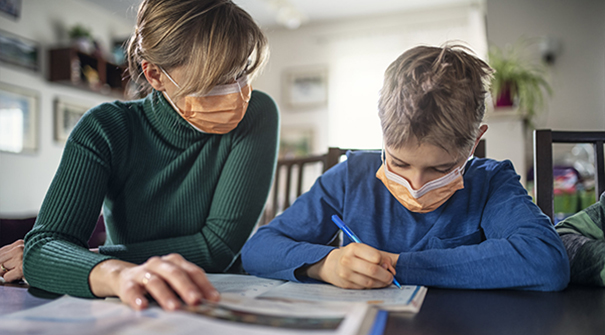
Mother and little boy wearing face masks. The mother is homeschooling her son during a virus outbreak. Nikon D850
Alessio Surian 1
“War” is the key slogan in the official discourse of countries like France and Italy regarding the spread of COVID-19. It seems that 2020 is delivering the story of those who devoured themselves. European countries finally have the context to declare any pretense of tolerance for diversity in the public sphere superfluous.
Forty years ago, Susan Sontag explained why it's so easy to treat a health emergency as if it were a war, instead of addressing it as an ecological, social, and cultural problem. According to Sontag, war is one of the few human activities we don't view realistically, or by evaluating costs and outcomes. In war, resources are spent without any precautions. In war, no sacrifice is considered excessive. Thus, treating illness as if it were war makes us obedient, docile, and, in retrospect, resigned victims. The sick become the inevitable civilian casualties of a conflict; they lose their right to citizenship.
Today, European governments use fear as a means to suppress diversity and as a strategy for social organization, simultaneously promoting social distancing, digital hyperconnectivity, and the suppression of diversity. Ninety years ago, Simone Veil warned us that when concepts like nation, security, order, and authority dominate, and when these concepts become universal, it is no longer a matter of responding to particular circumstances, but of disseminating the ideals that construct a culture of war. COVID-19 offers neoliberal governments the opportunity to actively cultivate public amnesia regarding the policies of violence perpetrated against migrants—in the Mediterranean and the Balkans—and the cuts made in recent decades to essential resources for education, social work, and healthcare.
In Italy, over the past 10 years, within a fragmented healthcare system divided into 21 regions, public funding for healthcare has decreased by approximately €37.000 billion. This is a factor to consider when looking at the COVID-19 mortality rate: 0,3% in Germany, while Italy's reaches 9%. In Italy, 359 wards have closed, and small hospitals have been abandoned, resulting in a reduction of around 70.000 beds. Of the 1.000 hospitals currently operating nationwide, 482 are privately run: beds for general hospitalization are divided into 151.646 in public facilities and 40.458 in private facilities. The number of intensive care beds (essential in the fight against COVID-19) is 5.090, 30% less than in 2001. In the face of COVID-19, ethical problems related to the use of health services are becoming more acute, including selection for access to intensive care.
In southern regions like Campania and Sicily, private sector laboratories and clinics account for over 80% of the workforce. According to healthcare unions, there is currently a shortage of more than 30.000 nurses. The nurse-to-patient ratio can range from 1:9 in northern Italy to 1:17 in southern Italian hospitals.
In the fight against COVID-19, the help of Chinese, Cuban, and Russian doctors and paramedics – many of them with experience fighting viruses in Africa and Asia – has been fundamental, especially in assisting health services where the highest number of deaths are recorded, particularly in the Lombardy region, the most affected by the new coronavirus.
Such a policy of cuts is affecting the public education budget, which, at the end of 2018, had been reduced once again by about 4.000 billion euros.
In the time of COVID-19, we find ourselves with empty schools, libraries, and bookstores, and overflowing hospitals. In this void, there is a risk of forgetting how, in March 2020, more than 860 million children and young people worldwide had to stay away from schools and universities due to closures. What about the more than 300 million students in low- and middle-income countries who eat their meals at school every day? Educators, teachers, and parents are discovering online classes, the lack of public policies in this sector, and the challenge of trying to create some form of routine and structure in this new way of living in lockdown. What space can be offered through these digital means to continue facilitating the collective dimension of education? It is striking that UNESCO itself, in the section of its website dedicated to “Solutions for distance learning” ( https://es.unesco.org/node/320226 ), has forgotten to identify radio (which played a key role in relation to the Ebola containment season), open access technologies and the dimension of technology interaction which, instead of opposing smartphones , makes them an interactive and potentially fun teaching and learning tool.
Private spaces vs. public spaces
In the emerging contrast between different models for containing the spread of the virus, the paradox of a public authority that prioritizes the discourse of “territorialization” and a state of siege seems evident. The objective disseminated by the Italian government is “stay at home.” This is a symbolic logic that identifies “private” spaces as “safe” and “public” spaces as infected. It is summarized in the slogan: “#iostoacasa” (#Istayhome). This leads to translating the precautionary measure of “keeping your distance from each other”—instead of a deep understanding of individual and collective responsibilities in daily interactions—into policing of public spaces. In particular, this is noticeable in the growing impatience—sometimes open hatred, even stone-throwing—towards those who go for walks and jogs, people who are taking care of their own health, who are letting the fresh air and sunshine of public spaces help their immune systems. The problem is that there's now a symbolic communication that establishes a complete divide between public (illegitimate) and private (legitimate and recommended) space. The message "stay home!" dominates.
Thus, the measures implemented by governments to contain the spread of COVID-19 in February and March 2020 created a situation of “modified sociability” with a drastic limitation of individual freedoms: never before had such a socio-anthropological experiment occurred in recent European history. The prohibition of all meetings and gatherings accelerated the shift to virtual communication and educational activities (as well as some work).
So, another serious, longer-term problem concerns surveillance, the “territorialization” of existence, and hysteresis—the phenomenon by which a body, under pressure, maintains a deformation even when the tension is released or ends. Are we at risk of “social and political hysteresis” at the end of the COVID-19 pandemic? Among the dangers of COVID-19-related measures is the justification of extreme control strategies that will pit privacy against health. In particular, two issues are already visible: georeferencing and the control of people's mobility through cell phone monitoring and biometric recognition. Both are justified as means to address the emergency. But even after the emergency, this idea of control may persist. This is a system of continuous monitoring of an entire population, presumably with biometric characteristics, to protect people from future epidemics, something that may contribute to forming the basis of a totalitarian regime based on a surveillance system that already dominates digital policies: continuing with the logic that people have no privacy in the name of their protection against the spread of epidemics.
Within this framework, three key themes stand out: mental health, open access to data and open-source medical resources, democracy, and critical thinking. The biopolitical dimension, which state intervention has assumed in the context of the COVID-19 emergency, seems to favor authoritarian interventions. But democracy is either inclusive or it is not. Taking measures focused on walls, barriers, and closures highlights a dimension intrinsically contradictory to democracy. In this context, a primary testing ground is the issue of open and shared knowledge, which is key to building responses to the emergence and spread of viruses like COVID-19. Its global spread illustrates the interconnected nature of today's society and indicates how, faced with a systemic challenge, the response also stems from collective efforts. On the one hand, it is crucial to protect the privacy and security of those affected (we are thinking of georeferenced data and personal information); On the other hand, open data is essential so that it can be used to generate tools, maps, and applications that, along with documentation on the analyses, facilitate the strengthening of the technical community and informed access for citizens. Information policies have a strong relationship with the mental health dimension. According to Peng Kaiping, director of the Institute of Psychology at Tsinghua University in China, one of the effects of the COVID-19 containment measures has been having to handle calls from people experiencing severe depression and anxiety symptoms typically associated with PTSD (post-traumatic stress disorder). On February 2, 2020, China opened more than 600 dedicated helplines across the country and was immediately inundated with calls. At that time, people were primarily concerned about contracting the virus and about their loved ones from whom they had been isolated. As the days and weeks passed, the stress and tension extended to family relationships and financial worries. In many cases, wages went unpaid, jobs were lost, and businesses went under. Dealing with all of this while confined at home, under the threat of a new and potentially deadly virus, put people under immense psychological strain. With schools closed, parents also had to take on the role of teachers. For those with babies and toddlers, it has been a challenge to entertain them while also protecting them by trying to minimize the developmental disruption caused by not being able to go to the park, take a walk, or interact with other children.
These crises show how profoundly neoliberalism affects our existence and invite us to reflect, opening up a concrete vision of other possible worlds. In Italy, there are 231 companies that produce weapons and ammunition and only one company that produces ventilators. The paradox is even more evident when we consider that weapons are not a basic necessity (and only a small portion is destined for law enforcement and security forces), while ventilators are an item of fundamental importance for public health, for the survival of the sick.
Will there be a reduction in neoliberal policies?
In July 2012, Jim Robbins wrote in the New York Times that diseases emerge from forests and wildlife, finding their way into and within human populations. This contagion leads us to question the link between their origin and spread and contemporary models of development and lifestyle: the link between emerging infections and the destruction of environmental systems. A shock has occurred that can be exploited to once again support the companies that already harm the environment: the transportation industry, the fossil fuel sector, and the junk food industry . Conversely, a more sustainable future, including for environmental, health, and education policies, requires a new economy that is not necessarily measured by GDP. What would be the point of rebuilding everything as before? We have the opportunity to shift paradigms. To re-establish socioeconomic relationships that are more respectful of territories and communities, we can begin with food policies, the social construction of habitat, and the collective production of knowledge.
1- University of Padua, CLACSO Working Group on Popular Education and Critical Pedagogies
If you would like to receive more information about CLACSO's training programs:
[widget id=”custom_html-57″]
to our email lists.

