
Academic publishing and open access in Latin America
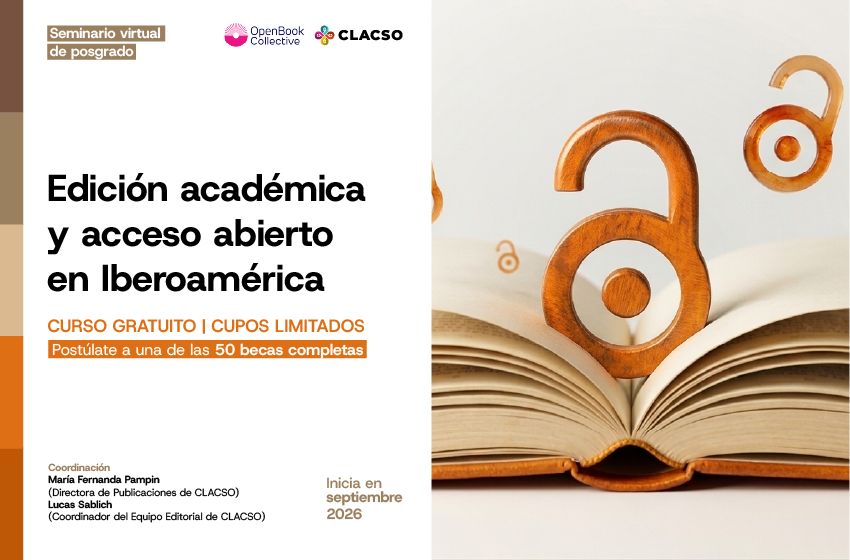
The Latin American Council of Social Sciences (CLACSO) and Open Book Collective invite you to participate in the Virtual Seminar Academic Publishing and Open Access in Ibero-America
Coordination: María Fernanda Pampin (Director of Publications at CLACSO) and Lucas Sablich (Coordinator of the CLACSO Editorial Team)
Start date : 07/09/2026 | Scholarship applications: 23/07/2026 to 23/08/2026
Fifty full tuition scholarships will be awarded to professionals involved in the management of content and digital infrastructure related to academic publishing, editors and professionals in academic publishing and related fields, academics, researchers and university teachers in general.
RESULTS
We appreciate the overwhelming response to this call for applications. We received over 100 applications , all of which were carefully reviewed. Following this process, the following individuals have been selected to participate in the course:
| Name | Surnames | Country |
| Alexandra | Castro Conceicao | Brazil |
| Ana Virginia Menezes Torga | Ana Virginia | Brazil |
| Andrea Patricia | Morales Méndez | Costa Rica |
| Andrea Stepany | Reyes Lozano | Mexico |
| Arnaldo | Espindola Artola | Cuba |
| Bruno | Moda | Brazil |
| Cesar | Gutierrez | Paraguay |
| Claudia | Chau | Chile |
| Claudia Pilar | Lizarraga Aranibar | Bolivia |
| David | Do you sleep | Honduras |
| Diana Janeth | Gradiz Baca | Honduras |
| Elita Luisa | Castle Corner | Venezuela |
| Fabian | Gallardo Ferreira | Chile |
| Fernando Gabriel | Vicente | Argentina |
| Gerardo | Suarez | Cuba |
| Hebe Mariel | Date | Argentina |
| Hector Ramiro | Estigarribia Barreto | Paraguay |
| Jania E | Cabrera Gato | Cuba |
| Jennifer | Soler | Venezuela |
| Jorge Luis | Roman Yauri | Peru |
| Juan Carlos | Álvarez García Cano | Mexico |
| Juan Manuel | Gutiérrez Rodríguez | Colombia |
| Karina | Barreto | Paraguay |
| Karla Gabriela | Pérez Cordova | Mexico |
| Kelly | Gouveia Andrade | Brazil |
| Laura | Miklos | Hungary |
| Laura | López Argoytia | Mexico |
| Leinen De La Caridad | cartaya | Cuba |
| Lucas | Grimson | Argentina |
| Lucilla | Canepa | Argentina |
| Manuel Alejandro | Echeverría Oyarce | Chile |
| Mary Clare | Serna Montoya | Colombia |
| Maria Laura | Romano | Argentina |
| Mariano Exequiel | Moreno | Argentina |
| Mariela Alejandra | gemstone | Argentina |
| Matias | Vlahusic | Argentina |
| Militza Blanca | Angulo Flores | Peru |
| Nadesha | Montalvo | Ecuador |
| Nancy Anael Nuit | Valdivia Pillars | Peru |
| Oscar Alberto | Chacón Gómez | Colombia |
| Pablo | Díaz González | Costa Rica |
| Patricia Gabriela | Pastor | Argentina |
| Penelope | Hernández | Venezuela |
| Very pure | Centeno-Alayón | Puerto Rico |
| René Alexis | Rodríguez Joaquín | Mexico |
| Rigel | Rocha Lopez | Bolivia |
| Rodrigo | Santoyo Rodríguez | Colombia |
| Rodrigo | Galvez | El Salvador |
| Roelvis | Ortiz Núñez | Cuba |
| Rolan Eduardo | Soto López | Honduras |
| Ruben | Zavala | Ecuador |
| Stephanie | Columbo | Uruguay |
| Yurima | Hernández De La Rosa | Cuba |
Latin America has been a pioneer in the field of Open Access since the late 90s. In a region where the main funders of scientific research are the state, the Open Access movement has been radical, collaborative, and democratizing from its inception. In the current international context of shrinking public policies and increasing concentration of knowledge, Open Access presents itself as an ethical and epistemic alternative that conceives of science as an essential common good for the sovereign development of nations.
Through a structured course divided into four modules and eight virtual classes, the program introduces the global and historical foundations of the movement—such as the Budapest, Berlin, and Bethesda Declarations—and delves into the “diamond path” model, focusing on the publication of scholarly books as an object of study with its own distinct circuits, actors, and challenges, separate from those of periodicals (journals). This model, characterized by publication without subscription fees or article processing fees (APCs), represents the community and public response of our region, a model that safeguards bibliodiversity and inclusive equity.
In the contemporary international arena, the production and circulation of scientific knowledge face a critical crossroads characterized by the concentration of transnational publishing markets and the commodification of knowledge through tariff barriers and processing fees (APCs and BPCs). Faced with this model that exacerbates global inequalities, Latin America stands as a pioneering and leading region in the defense of Open Access. Conceived from its origins in the late 20th century as a radical, collaborative, and democratizing movement, the region's ecosystem has demonstrated that science, funded primarily by public funds, must be safeguarded and managed as a common good essential for the sovereign, just, and equitable development of nations.
In this context of reduced public policies promoting open access, the seminar “Academic Publishing and Open Access in Ibero-America ,” organized by CLACSO and the Open Book Collective, presents itself as a relevant space for theoretical and practical training. Through a multidimensional approach, the program introduces the historical milestones and global declarations that underpin the movement, and strategically delves into the consolidation of the “diamond path,” the public, free, and community-based model characteristic of our region that safeguards bibliodiversity against the commercial logic of paying to publish.
This seminar, with its comprehensive and interdisciplinary approach, connects current political and epistemic debates with the technical and institutional competencies necessary for the sustainability of digital infrastructures. By addressing topics ranging from regional indexing criteria, multilingualism, and the revision of scientific evaluation systems through initiatives such as FOLEC-CLACSO, to the emerging challenges of artificial intelligence and the design of interoperable repositories, the seminar offers robust and coordinated solutions for the professionalization of the publishing field.
GENERAL OBJECTIVES
- Promoting the political-epistemic understanding of Open Access as a common good Analyze the historical evolution, philosophical foundations and main global declarations of the movement, critically contrasting the Anglo-Saxon commercial model based on paying to publish with the identity of the public, free and community model of the Ibero-American "diamond route".
- Strengthen good publishing practices and promote the use of regional indexing platforms To train participants in international standards of ethics, transparency and quality in the publishing industry, delving into the use of indexing tools, metadata assignment and indicators, and leveraging strategic institutional alliances in the region.
- Promoting the transformation of scientific evaluation systems, multilingualism, and bibliodiversity Promote discussion around the crisis of traditional metrics and the design of alternative incentive models, aligned with initiatives such as FOLEC-CLACSO, highlighting linguistic diversity and local approaches as pillars of inclusion and knowledge sovereignty.
- Develop technical skills and address contemporary technological challenges in publishing To provide practical tools for interoperable management and digital preservation in institutional repositories, while critically reflecting on the impact, ethical methodologies and responsible uses of Artificial Intelligence in the face of problems such as scientific fraud.
SPECIFIC OBJECTIVES
- Identify and compare Open Access modelsrecognizing the milestones of international declarations (Budapest, Berlin, Bethesda) and the structural differences between transnational business models and the public and community matrix of the "diamond route" in Latin America.
- Analyze the challenges of sustainability and financing of public academic publishers in contexts of state withdrawal, exploring resources for building collaborative networks.
- Apply the guidelines for good practices and editorial transparencyassimilating the criteria of the Committee on Publication Ethics (COPE), Creative Commons licenses and the quality requirements of regional and national platforms (Latindex, SciELO, Redalyc, CEA-APQ Seal).
- Recognizing the trajectories and strategic alliances of the region's publishing networks (CIEUA, EULAC, UNE and CLACSO) as drivers of professionalization and editorial sovereignty.
- Examine alternative models for evaluating science that prioritize social relevance and open processes over traditional impact metrics and indices, taking as a reference the proposals of FOLEC-CLACSO.
- Designing strategies for linguistic inclusion and open translation to overcome epistemic language barriers, make local voices visible and enhance bibliodiversity.
- To manage the fundamental technical and computer tools for the management of institutional repositories, including harvesting protocols (OAI-PMH), metadata structuring (OpenAIRE, LA Referencia) and long-term digital preservation.
- Critically evaluate the impact of Artificial Intelligence on the academic circuit, developing methodologies for its ethical and responsible use in publishing in the face of threats such as fraud and predatory journals.
- Philosophy and origins of Open Access: Study of the historical motivations of the movement and analysis of the global milestones set in the founding declarations (Budapest, Berlin, Bethesda, among others).
- The Diamond Route and Ibero-American identity: Defense of the regional public, free and community model against Anglo-Saxon commercial logics based on pay-to-publish (APC/BPC).
- Editorial sustainability and networks: Financing strategies, resource management, and building collaborative alliances for public publishers in contexts of state budget reduction.
- Ethics, transparency and good practices: Implementation of the international standards of the Committee on Publication Ethics (COPE) and design of rigorous peer review processes.
- Indexing and regional quality seals: Use of Creative Commons licenses, assignment of metadata (DOI, DOAJ) and quality criteria on platforms such as Latindex, SciELO, Redalyc and the CEA-APQ Seal.
- Strategic institutional alliances: Analysis of the trajectories and regional synergies between key academic publishing networks such as CIEUA, EULAC, UNE and CLACSO.
- Reform of scientific evaluation: Debate on the crisis of traditional business metrics and introduction of alternative models based on social relevance, articulated from FOLEC-CLACSO.
- Multilingualism and bibliodiversity: Open indexing and translation tools to overcome language barriers, promoting the inclusion of local approaches, knowledge, and traditions.
- Technical management of institutional repositories: Use of open source platforms (DSpace, Omeka), metadata guidelines (OpenAIRE, LA Reference) and interoperable harvesting protocols (OAI-PMH).
- Contemporary Challenges (AI and Governance): Ethical analysis of the impact of Artificial Intelligence on publishing, combating scientific fraud (predatory journals) and designing decentralized governance to protect public infrastructures.
The seminar will be held virtually. Over the course of one month, eight synchronous classes will be offered, distributed across two weekly sessions on Mondays and Wednesdays from 14:00 PM to 15:30 PM (Argentina time) . All classes will be live and recorded for later viewing in the virtual classroom. A minimum attendance of 75% is required to complete the course.
The sessions will be held via Zoom, fostering exchange and interaction among participants. Those enrolled in the seminar will also have access to exclusive materials available in the virtual classroom, specially selected to complement and expand upon the topics covered in each session.
The seminar's curriculum design presents the main perspectives of Open Access, a journey through its history, characteristics and development, as well as a multidimensional scope that ranges from technical aspects to contemporary political-institutional debates, with a focus on the publication of academic books.
Since it is a field constituted from interdisciplinarity, it is aimed at a broad group of recipients:
- PrProfessionals involved in the management of content and digital infrastructure related to academic publishing: Aimed at librarians, institutional repository managers, and scientific data administrators (data stewards), indexing technicians and specialists in information technologies applied to academia.
- Academics, researchers and university teachers in general: Aimed at the scientific community from all areas of knowledge that produces, evaluates and reads academic material.
- Editors and professionals in academic and related publishing fields: Editors and directors of university presses and coordinators of institutional publications or civil society organizations with related work.
- Dominique Babini (Advisor on open science and Working Group “Open Science as a common good” CLACSO)
- Lautaro Matas (The Reference)
- Sayri Karp (University of Guadalajara, Mexico / EULAC)
- Maribel Cabrera (University of Granada, Spain / Union of Spanish University Publishers)
- María de los Remedios Pérez García (Polytechnic University of Valencia, Spain / Union of Spanish University Publishers)
- Solange Victory (University of Buenos Aires / CLACSO)
- Amanda Ramalho (Scielo Books, Brazil)
- Daniela Perrotta (Latin American Forum on Scientific Evaluation, University of Buenos Aires / University of the Arts, Buenos Aires)
- Jairo Buitrago Ciro (National Autonomous University of Mexico / Ottawa University, Canada)
Tutor : Luna González (National University of La Plata / CLACSO)
Fifty full scholarships will be awarded to the recipients mentioned in this call who are linked to CLACSO member centers.
Application requirements
Applications will be submitted through the CLACSO website.
Interested parties should:
- Complete the application form with your information.
- Indicate your affiliation with a CLACSO member center.
- Briefly state your interest in participating in the seminar.
The available scholarships will be allocated respecting regional diversity and gender equity, with a proportion destined for priority countries (Bolivia, Peru, Honduras, El Salvador, Haiti, Dominican Republic, Paraguay, as well as peripheral areas of core countries).
This call for applications will remain open until 23/08/2026
Inquiries: [email protected]

