
Emancipatory feminist economics
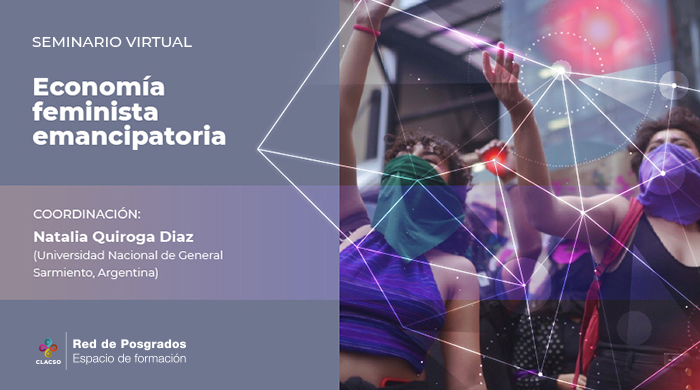
Seminar 2137
Coordination: Natalia Quiroga Diaz (University of General Sarmiento, Argentina)
Start: 25/08/2021 | Registration: 28/05/2021 to 23/08/2021
Workload: 12 weeks – 90 hours.
This seminar aims to present and discuss the main tenets of feminist economics, emphasizing the Latin American perspective on this conceptual framework. This involves presenting the contributions of popular, social, and solidarity economies to the understanding of economics, as well as their points of convergence with feminist economics. It will also reflect, from a decolonial perspective, on the implications of considering economics from the subaltern position historically held by Indigenous, Afro-descendant, and peasant communities, as well as other popular sectors. The emancipatory vision highlights the alternatives for building a different economy, which are rooted in the struggles for the reproduction of life taking place across the continent. Throughout the seminar, participants will be encouraged to engage in exchanges based on their experiences, interests, and knowledge, and to form groups around topics of interest, leveraging the diverse backgrounds and the different countries represented.
Feminist economics, with its conceptualization of the care economy, analyzes the consequences of the androcentric bias common to major economic schools of thought, while simultaneously offering a powerful critique of the neoclassical perspective. It highlights the risks of pursuing profit accumulation without understanding the centrality of reproduction within the economy. This perspective argues that recognizing the importance of reproductive and care work, primarily performed by women, is fundamental to resolving the artificial separation between production and reproduction. In this crucial aspect, it intersects with heterodox perspectives such as the social and solidarity economy, ecofeminism, and community economies, which emphasize reproductive rationality in contrast to the ideal of competition and calculation, while also underscoring the importance of the care dimensions of life in addressing social needs. In this course, we emphasize how Latin America appropriates the theoretical and methodological frameworks produced by feminist economics and propose a way of understanding economics that is termed emancipatory because it accounts for a set of reflections rooted in the variety of struggles unfolding in the region in favor of life, opposing the pernicious effects left in the wake of the advance of neoliberalism. This approach is enriched by a transdisciplinary vocation, which seeks to broaden and deepen the understanding of the economic through a cross-section of readings that integrate feminist perspectives from anthropology, history, sociology, and other social sciences. This intersection of practices and ways of producing knowledge aims to build a common platform for envisioning an economy that places life at its center, with its histories, its places, its emotions, and solidarity with the land and with future generations.
GENERAL OBJECTIVE To develop the theoretical foundations of emancipatory feminist economics by analyzing its main axes and components, motivating critical analysis by the participants of the course.
SPECIFIC OBJECTIVES That students: Identify the main theoretical guidelines that underpin the feminist perspective of economics and the definitions associated with the care economy. Understand the points of intersection and contributions of the popular, social, and solidarity economy in its interaction with feminist economics. Reflect on the implications of a decolonial perspective in understanding economics.
- The emancipatory feminist economy from Mexico to Argentina
- The contribution of feminism to the critical understanding of economics
- The care economy: The challenges of class and race
- Social and popular economies versus neoliberal fundamentalism. The crisis is one of reproduction.
- Racism, economics, and labor. Structural violence: racialized, gendered, and exploited bodies
- Working within the communal/community network: Transformations from subaltern practices to economies for life
- Dynamics in the process of constructing thought and political constructions of Buen Vivir-Ubuntu in black communities
- The perspective of ecofeminism in Latin America
- Depatriarchalize the land. Ruralize feminism
- A Post-Patriarchal Economy
|
|
Discount for payments made before 16/08 |
In one payment from 17/8 to 23/8 |
|
CM Plenos |
$75 |
$150 |
|
CM Associates |
$95 |
$190 |
|
No link |
$95 |
$190 |
FAQ
The basic requirements for taking a seminar are:
- Availability of at least 4 hours per week to dedicate to the seminar course.
- Internet access.
- Reasonable handling of communication and computer tools.
- Language proficiency in the language in which the course will be taught. The official languages are Spanish and Portuguese.
|
|
Discount for payments made before 16/08 |
In one payment from 17/8 to 23/8 |
|
CM Plenos |
$75 |
$150 |
|
CM Associates |
$95 |
$190 |
|
No link |
$95 |
$190 |

