
“During the pandemic there was an obscene increase in inequality in social life”
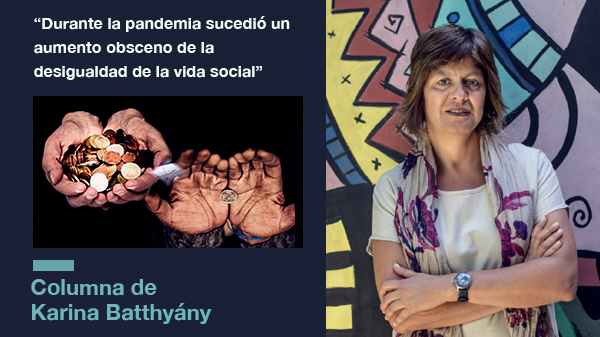
(Transcription of Karina Batthyány's Column)
(In InfoCLACSO – February 9, 2022)
This year, 2022, we will gather in Mexico for “The Web of Inequalities.” And to begin a new 2022 cycle of InfoCLACSO, what better way than to revisit this theme of inequality, specifically in light of a recently released report by OXFAM (with whom we work and collaborate on various issues and who will be present at our #CLACSO2022 Conference in Mexico). This report truly warns of the obscene increase in inequality during the pandemic. They call it the report “Inequalities Kill.”
Every year, on the eve of the World Economic Forum Summit, usually held in Davos, Oxfam publishes its report on the state of inequality. This year, titled "Inequalities Kill," Oxfam denounces that during the pandemic something we've been discussing in these columns has occurred: an increase in inequality, but not just any increase or deepening of inequalities, rather an increase they describe as "obscene," with negative repercussions on all dimensions of social life.
This Oxfam report shows how a tiny minority of humanity (whom they call billionaires) has enjoyed a luxurious pandemic. They explain this by pointing out that this privileged group managed to capitalize on the stock market boom fueled by the massive injections of funds from central banks at various points during the pandemic to mitigate its economic impact and mitigate the pandemic-related restrictions.
Over the past two years, billionaires have increased their fortunes by more than five trillion dollars. This is the largest increase in wealth for this group since records began. This rise in inequality is even more staggering when we consider the changes in the wealth of just ten people: the ten richest people in the world, who, coincidentally (and not coincidentally), are all men.
During the pandemic, the fortunes of these ten individuals doubled, while—let's remember—the incomes of 99% of humanity deteriorated, pushing more than 160 million people worldwide into poverty. Currently, these ten individuals (all men) possess six times more wealth than the three billion people with the lowest incomes.
According to Oxfam, by the end of 2021, the wealth of the world's ten richest men had increased by $821 billion since the beginning of 2020, rising from $700 billion to $1.5 trillion. Even if these ten men were to lose 99.9% of their wealth tomorrow (the Oxfam report states), they would still be richer than 99% of the people on the planet.
This shows us that it is absolutely urgent and crucial to put an end to these obscene and violent inequalities by reclaiming the power and extreme wealth of the elites through fiscal measures, so that we can reintegrate that money into the economy and thus save lives.
There are very specific examples that they also use in their report. According to Oxfam, with the $821 billion in extraordinary profits earned by the ten richest men in the world, enough vaccines could be produced for everyone, universal health and social protection services could be funded, climate adaptation measures and actions to reduce gender-based violence could be financed in more than 80 countries. And yet, those ten men will still have $8 billion more than before the pandemic. This truly demonstrates the obscenity of the situation we are describing.
We must therefore, along with OXFAM, which raises this point in its report, work to recover the profits that billionaires have accumulated by applying, for example, permanent taxes on capital and wealth to tax the enormous wealth they have amassed since the beginning of the pandemic, in order to invest in necessary and universal public services such as health and social protection.
It's not a lack of resources then, but rather a lack of political will regarding how to allocate them. This is one of the points we at CLACSO have also raised about the need to discuss these issues, to discuss universal basic income, universal social services, external debt, and so many other topics we've covered column by column.
Therefore, I leave this obscenity of inequality as the backdrop to our meeting in Mexico to discuss this very topic: The Webs of Inequalities. Knowledge, Struggles and Transformations.
"It's very interesting, Karina, and while I was listening to you, I was thinking that sometimes it's not so difficult to start pulling on the thread to identify where the crucial axes of these webs of inequality lie. Because here we have 10 names, 10 individuals, surely owners of several multinational corporations. So I understand that without public policies and with diminished states, this doesn't change, it doesn't get modified either..."
-It's part of what we've proposed: political will first and foremost; and secondly, that need that we've been exploring and working on from CLACSO to discuss the new State-Society equation precisely, and the role of states and the role of social welfare in these pandemic situations, but in general to guarantee dignified living conditions for everyone.
I propose we continue exploring these themes, and, for example, next week we'll be in Mexico, but we'll make time to discuss another very important report that also emerged recently and that also addresses this topic: the Social Panorama of Latin America and the Caribbean (ECLAC). These two reports provide a framework for CLACSO's work focused on inequalities and for our upcoming meeting to discuss these Networks of Inequalities.
If you would like to receive more information about CLACSO's training programs:
[widget id=”custom_html-57″]
to our email lists.

