
Dominique Babini

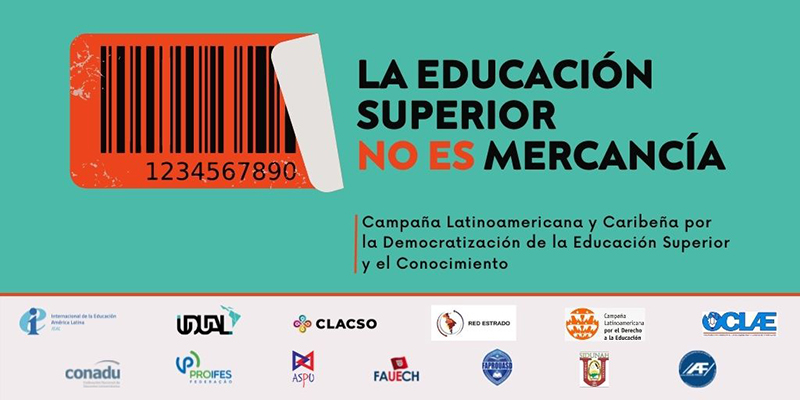
Within the framework of the “Latin American and Caribbean Campaign for the Democratization of Higher Education and Knowledge: Higher Education is Not a Commodity,” which is sponsored by numerous educational institutions for whom higher education is a social public good, a universal human right, and a responsibility of states, Dominique Babini , PhD in Political Science and postgraduate in Scientific Information, was interviewed. She is an advisor on open science and open access academic communications at CLACSO, an institution she represents in various international forums and networks on the subject.
The regional campaign, which is taking place on the road to the World Conference on Higher Education (WHEC2022) to be held in Barcelona, Spain, from May 18 to 20 and organized by UNESCO, was launched with the purpose of defending public higher education as a right and heritage of our peoples.
What trends are being observed worldwide in relation to the communication of scientific and productive knowledge?
What we at CLACSO have observed is that, due to the pandemic, climate change, and the Sustainable Development Goals being promoted, among other emergencies affecting humanity globally, the processes of generating policies requiring that all research funded with public funds be available in open access, free of charge on the internet, have accelerated. In the specific case of the pandemic, international commercial publishers were required to make scientific articles on COVID-19 available and exempt from payment. It worked, but let's not fool ourselves: as soon as the pandemic ends, significant amounts will have to be paid to access that research, even though it is also necessary to address future pandemics. It is not a solution. We can say that the pandemic increased international awareness of the need for a more equitable and participatory system, one that is not so much at the service of the interests of the few international corporations that control the world's leading scientific journals. The pandemic revealed that any health center in the country with COVID-related data contributes to a national database that is shared internationally. This isn't limited to research institutes; it encompasses many more social actors. The experience of the pandemic further prepared us for open science. In this sense, this campaign seemed like an opportunity to strengthen the role of universities in shaping knowledge production policies, disseminating knowledge, and ensuring access for citizens and all interested parties.
What are the mercantilist trends in the circulation of knowledge proposing or trying to impose?
We must always remember that it has historically been the world's universities, along with scientific societies, that have published academic and scientific journals. Only in the last 50 years has the privatization process progressed, primarily in Europe and the US. Universities have outsourced the publication of these academic journals and books to the commercial sector. And this commercial sector has transformed into a conglomerate. Today, five large companies control the vast majority of scientific publications. And there is strong protection of this industry in the countries where it has its headquarters. We are talking mainly about Germany, England, the Netherlands, and the US. It is an industry that exerts a very powerful lobby , and many countries protect it because it provides many jobs and pays significant taxes. This is the tension that exists because, since the advent of the internet, universities have had the capacity to appropriate the dissemination of the knowledge they produce and publish their own journals, books, repositories, analyses of their own output, and indicators to evaluate the performance of researchers and faculty. In other words, they have the full capacity to carry out the entire production, dissemination, and analysis of their knowledge. We have a tension: 70% of open access journals are available online and are not part of a commercial circuit, but there is another 30% that is (incorrectly) called the mainstream , managed by the commercial sector. At CLACSO, we are collaborating with UNESCO to strengthen these open access initiatives in Latin America and around the world, initiatives led by the community, without commercial intervention, and using open infrastructures. Universities play a leading role, with their libraries, digital repositories, and publishing houses that manage journals and books on open, free software platforms. What needs to be done globally is to return to universities what has been outsourced to the commercial sector, which makes a profit of between 30 and 40% annually from money that governments allocate to research.
What advantages does this model offer in terms of advancing and multiplying collective knowledge? How does private management hinder it?
Let's look at an example: when teachers prepare their classes and course bibliographies, when faculty researchers search for literature for their work, or when students look for bibliographies for their studies, it's important that they have access to a diversity of perspectives and experiences. What's in the mainstream, managed by the commercial sector, are journals that prioritize articles in English and on topics of interest on international research agendas. But our faculty researchers, our students, are also concerned with local issues and are interested in hearing local voices on the problems we need to solve in our societies. In that misnamed mainstream circuit, we'll find international literature, but we won't find much important national literature. Therefore, open access policies require that all research results funded with public funds be available, free of charge, online, in full text, to the public that needs it. Commercial management will prioritize what is most profitable, and perhaps publishing full texts of research already published in Spanish, French, and Portuguese, addressing issues in some African countries, for free online is not the most profitable option. But that research also needs to be available online. Commercial systems exclude a portion of the knowledge produced in the rest of the world. And higher education, which is a right, must recognize and organize access to knowledge as a right, one acknowledged by the United Nations. This includes not only access but also participation in the production of knowledge made open access. Currently, publications in Spanish, in quality journals in our region, are not valued the same as publications in English in international scientific journals. That's not right. The important thing is to determine whether a publication is of high quality or not.
When you say it's not valued, do you mean it's not valued in the "First World" or does that bias exist in our countries as well?
Unfortunately, this also exists in our region. In Latin America, there is a strong tendency to follow the career-based evaluation formats used in the Global North. And in the Global North, evaluation is primarily based on indicators generated by the corporations that manage mainstream journals, which exclude most high-quality journals from developing regions, mainly in Latin America, Africa, several Asian countries, and various less developed parts of Europe. Every knowledge network is fundamental. If you look at the Sustainable Development Goals, not one of the 17 is without both local and international knowledge. We have a few exceptions in Latin America: CONICET in Argentina, for example, which, when evaluating researchers in the Social Sciences, also considers publications in high-quality journals in the region. For example, if they have published journals indexed in Redalyc, Scielo, Latindex, and CLACSO, in addition to recognizing journals that have been evaluated in Web of Science and Scopus, which are unfortunately the two tools that predominate in evaluation processes in the region. I say unfortunately because they can still be used, but they need to be complemented with other indicators generated at the regional and local levels regarding quality publications. It's essential to be able to publish in one's own language to maintain conversations with social actors who are not from academia and who don't speak English.
How can open access platforms be strengthened or promoted in Latin America, and how does this contribute to regional integration and equitable and solidarity-based exchange?
This has a lot to do with what has happened in our region: as a result of the last two decades of projects led by public universities and funded with public money, Latin America is now the region in the world with the highest percentage of its academic and scientific journals in open access, freely available online. University libraries are key players in this process of sustaining open access. The full text of knowledge generated by the university community should be free and available. This is a much-discussed case in international debates on open access and an example for other regions to follow, regions that have outsourced the dissemination of knowledge to the commercial sector. It is very gratifying for Latin America that we are an example to follow. What should happen is that this output is properly evaluated because, as I just mentioned, in the national research councils in our countries, evaluation is geared towards rewarding primarily those who publish in English in journals within the international commercial circuit. The Latin American Forum on Scientific Evaluation of CLACSO has been working in this area to review scientific evaluation processes in the region. We invite everyone reading these topics to participate in the debates that will take place at the upcoming Latin American and Caribbean Conference of Social Sciences (CLACSO), to be held at UNAM in Mexico from June 7 to 10. We believe that universities, along with government agencies that fund research and education, should lead the future of open access and open science worldwide, both in terms of strategic policy decisions and implementation. We need to orient knowledge production toward the needs of our societies, and in this regard, the upcoming World Conference on Higher Education could take advantage of the fact that UNESCO launched its recommendation on open science this year, which promotes something very important: the co-production of knowledge with social actors outside academia. What has been happening in Latin America for the past 20 years presents a fantastic opportunity. Now, what's needed is to dedicate more research teams within the university setting to investigating how to reformulate evaluation processes, in order to build new indicators that allow us to strengthen the construction and use of knowledge with other actors outside the university setting as well.
If you would like to receive more information about CLACSO's training programs:
[widget id=”custom_html-57″]
to our email lists.

