
Disputes over the public and the commons in times of pandemic
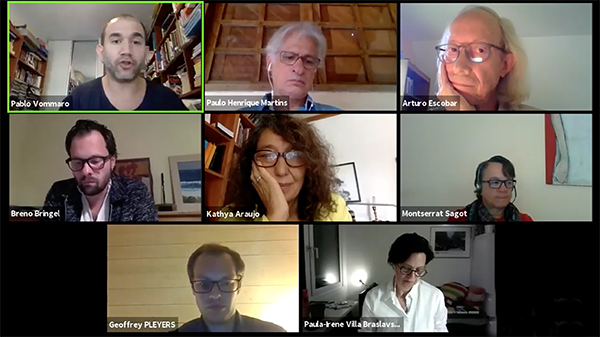
On Wednesday, April 15, the virtual discussion “Disputes over the Public and the Common” was held, co-organized by the Latin American Council of Social Sciences (CLACSO), the Latin American Sociological Association (ALAS), and the International Sociological Association (ISA). Over six hundred people from Latin America, the Caribbean, and several European countries participated in the two-hour event.
Among others, Breno Bringel for ALAS, Geoffrey Pleyers for ISA and Pablo Vommaro representing CLACSO participated, in what was conceived as a space for meeting, exchange, debate and reflection on some dimensions not sufficiently addressed about the COVID-19 pandemic.
Pablo Vommaro opened the debate at the discussion "Disputes over the public and the common," calling for reflection on the public sphere. “In a broad sense. Undoubtedly, this pandemic and the public policies implemented have created tension and debate about what constitutes a public policy, its role, and the State's capacity to intervene and modulate economic, political, and social life. But it also strongly highlights the societal role, the role of communities, the place of working-class neighborhoods, territories, civil society, social organizations, and interpersonal relationships. It calls us to consider what happens to public spaces…”
In turn, the Colombian anthropologist Arturo Escobar summoned “a collective reflection that helps us free ourselves from a dominant way of thinking and living.” He wondered how we got to this situation and how we will move forward. In this regard, he suggested that it is conceivable that a different world will emerge after the pandemic. “How can we contribute now to creating this world?” He wondered, and proposed that “Part of the struggle for the commons and the public in Latin America is to build narratives of other ways of living and other possible futures, and to have them ready so that – when the opportunity arises – we can take advantage of them with the collectives we work with.”
For Costa Rican sociologist Montserrat Sagot, this crisis allows us to see the best and worst of these times. “This crisis, which is not a health crisis but rather has the potential to become a civilizational crisis, allows us to see what I call the murderous phase of capitalism. That phase has always been present; it is one of the characteristics of capitalism, but it is very different when the dead are African migrants in the Mediterranean, or people from Central America.” on their journey to the United States, which “When an ice rink in Madrid is filled with corpses, or 40 military trucks leave Bergamo carrying dead bodies, or a mass grave is opened in a New York park. This murderous phase has even allowed us to redefine what were once public spaces for pleasure and entertainment, now transformed into fields sown with bodies.” And, regarding the current situation, he stated: "I am not against social distancing practices in this time of global crisis, but there must be a social income for all people, a role for the State in redistributive policies."
Also participating in the Conversation were the Brazilian sociologist Paulo Henrique Martins, the Chilean professor Kathya Araujo and the Argentine-German sociologist Paula Irene Villa Braslavsky, with valuable contributions to thinking about the current situation of the pandemic.
[+] Thinking about the pandemic

If you would like to receive more information about CLACSO's training programs:
[widget id=”custom_html-57″]
to our email lists.

