
“Hate speech and the new threats to democracy”
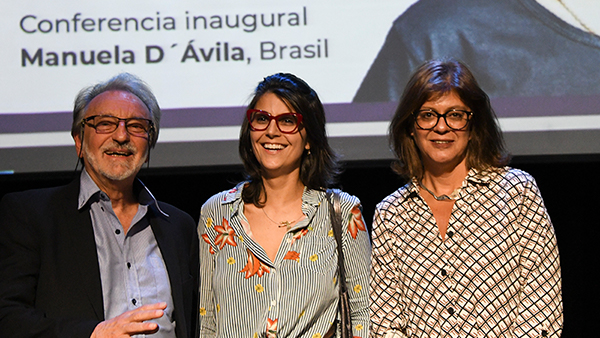

To analyze, debate and remember the 50th anniversary of the civic-military coups in Uruguay and Chile and the 40th anniversary of the return to democracy in Argentina, a series of activities on “Memories, Human Rights and Democracy” began on March 21 and 22, which will take place throughout 2023.
The first meeting, the Forum “Social Dialogues 40 Years After the Restoration of Democracy in Argentina” was organized by CLACSO and the Floreal Gorini Cultural Center of Cooperation (CCC) in Buenos Aires, and featured an opening conference by Brazilian politician and feminist activist Manuela D'Ávila , who spoke about “Hate Speech and the New Threats to Democracy”, accompanied by Juan Carlos Junio , Director of the CCC, and Karina Batthyány , Executive Director of CLACSO.

Karina Batthyány was in charge of introducing Manuela D'Ávila and began "this 40-50-50 dialogue within the framework of a broader project which is the construction of Platforms for social dialogue" promoted by CLACSO to "achieve the production of evidence-based, critical, situated knowledge with a high impact on policy definition, the formation of public opinion and the positive transformation of the living conditions of the most impoverished, oppressed and discriminated populations."

In turn, Juan Carlos Junio offered his views on the past, present, and future, stating that "democracy has always been a topic of discussion within the popular and social sphere," and warning that "popular governments are being harassed by real power."

In her presentation, Manuela D'Ávila emphasized that “we have a responsibility to (re)think the new relationship between human rights and democracies,” understanding that “a democracy with media concentration is only half a democracy.” She also analyzed that “there is a patriarchal perspective in hate speech against women.”

The musical finale was performed by Sofía Viola , an Argentine composer, singer and actress.
40-50-50
–Uruguay: On June 27, 1973, then-President Juan María Bordaberry dissolved Parliament with the support of the military and police forces. That day marked the beginning of the civic-military dictatorship that lasted until March 1, 1985.
–Chile: On September 11, 1973, with the assault on the La Moneda Palace and the death of the constitutional president Salvador Allende, a dictatorship led by General Augusto Pinochet was established, ending the Popular Unity government. In 1990, Patricio Aylwin assumed the presidency, inaugurating the democratic transition.
–Argentina: On December 10, 1983, with the assumption of power by the Radical Raúl Alfonsín, the civic-military dictatorship established on March 24, 1976, with General Jorge Rafael Videla at its head, came to an end.
If you would like to receive more information about CLACSO's training programs:
[widget id=”custom_html-57″]
to our email lists.

