
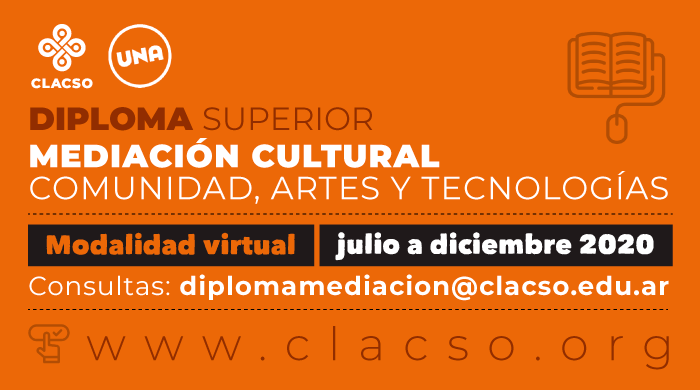
Advanced Diploma in Cultural Mediation: Community, Arts and Technologies
GENERAL COORDINATION: Damián Del Valle (National University of the Arts)
ACADEMIC COORDINATIONRosario Lucesole (National University of the Arts)
ARTISTIC COORDINATION: Marcela Rapallo (National University of the Arts)
Virtual format | July to December 2020
The Diploma in Cultural Mediation: Community, Arts and Technologies is a professionalization and skills training program related to the design and implementation of cultural mediation programs and projects, to be implemented in public and private institutions or organizations, community spaces and artistic, cultural, educational and sociocultural associations.
Cultural mediation can be understood as a dialectical interplay that seeks to create tension between cultural works and expressions through diverse modes of reception, appreciation, appropriation, participation, and enjoyment. The mediator's role consists precisely in recreating the conditions for this interplay to take place. The practice involves the transmission of information, but also engaging with cultural and artistic expressions through the senses, using various dynamics that promote the exchange of knowledge, ideas, opinions, and sensations.
It has acquired its status and function within major European cultural establishments and institutions, and has positioned itself globally, and more recently in our region, as an area of specialization within the field of cultural management. Thus, this practice is demonstrating a body of knowledge that is gaining ground in the realm of cultural work.
Therefore, the diploma program recognizes and reflects on the types and modes of its practice in diverse spaces, enabling the systematization of practices that have been developing in cultural institutions and communities. It proposes an approach that gives significant weight to artistic and technological innovation, understanding them as central factors in the transformation of contemporary cultures and pedagogical practices linked to this discipline.
In this sense, the diploma program is established as a training opportunity to contribute to the improvement of the processes of development, circulation and distribution of cultural goods, and to the use of new technologies to generate projects.
GENERAL PURPOSE
To train cultural mediators by providing the necessary tools to work in traditional and non-traditional areas of the arts and culture field
SPECIFIC OBJECTIVES
- Promote professionalization and improvement strategies that elevate the role of the mediator in the field of arts and cultures
- To address various theoretical and practical aspects that enable the design, management, execution, coordination and supervision of the different aspects involved in cultural mediation
The Diploma program is designed for professionals from diverse fields such as the arts, cultural management, teaching, community cultural work, and activism, among others. It is also intended for individuals working in traditional and specialized arts and culture spaces (museums, theaters, cultural centers, libraries, public cultural departments, etc.), as well as those working in non-traditional spaces (community centers, neighborhood clubs, union spaces, foundations, and civil society organizations focused on social intervention, etc.), or for those who wish to work in these areas.
- João Luiz “Juca” Silva Ferreira - Former Minister of Culture (2008 - 2010 / 2014 - 2016) (Brazil)
- Sandra Torlucci (National University of the Arts, Argentina)
- Victor Miguel Vich Florez (Pontifical Catholic University of Peru)
- Yamila Volnovich (National University of the Arts, Argentina)
- Damián Del Valle (National University of the Arts, Argentina)
- Federico Baeza (National University of the Arts, Argentina)
- François Mairesse (Université Sorbonne Nouvelle Paris 3, France)
- Bruno Nassim Aboudrar (Université Sorbonne Nouvelle Paris 3, France)
- Silvia Susana Alderoqui (Cultural Center of Science, Argentina)
- Renata Cervetto (Berlin Biennial, Germany)
- Alicia Romero (National University of the Arts, Argentina)
- Marcelo Gimenez (National University of the Arts, Argentina)
- Rosario Lucesole (National University of the Arts, Argentina)
- Marcela Rapallo (National University of the Arts, Argentina)
- María Araceli Soto (National University of the Arts, Argentina)
- Bianca Racioppe (National University of La Plata, Argentina)
- Edgardo Gabriel Garzón (Higher Institute of Leisure and Recreation, Argentina)
- Daniel Franco (University of Buenos Aires, Argentina)
- Gabriela Augustowsky (National University of the Arts, Argentina)
The program consists of three interconnected modules taught sequentially, and two additional modules, 4 and 5, which are interspersed with the previous ones. Classes are held weekly, organized into two days of material releases or online work. All classes can be viewed virtually and asynchronously.
Some online meetings will be scheduled that will not be mandatory to attend, but will be recorded and shared for later viewing.
Taking into account the time spent reading, watching classes and working in forums, a total dedication of 128 hours is estimated for the entire course.
Prevailing paradigms surrounding the concept of culture, the origin of cultural mediation as a discipline, and the scope of cultural mediation. The role of the cultural mediator, and the trajectories and particularities that our region contributes to this practice. Strategies for performing a task situated in the territory we inhabit. Community culture and interculturality.
The artist as mediator. Experiences that articulate art, technology, and social transformation. The role of new technologies in these forms of building connections within territorial and virtual communities. Relational art and innovative pedagogical practices in dialogue with new ways of inhabiting the world. Free culture and free software. Creative Commons and licenses.
Cultural mediation as an educational strategy. Culture and the arts as arenas for contesting meaning in educational spaces. Latin American educational experiences related to cultural mediation. Cultural policies and education in museums. The "educational turn" and didactic curatorship. The role of play in mediation, playfulness and aesthetics as forms of knowledge, learning, and exchange. Group work strategies for cultural mediators.
Project design, development of sustainability strategies and financing. Cultural communication, mediation and evaluation of cultural projects.
New roles in the cultural and artistic field. Experiences focused on strategies for building connections and exchanges between cultural and artistic productions and audiences. The mediator as disseminator, facilitator, technician, and activist in the arts and culture field. Documentation and collaboration with agents currently developing mediation strategies in Argentina and the region.
|
JUL AGO |
Module 1: The approach of cultural mediation |
Module 4: Project Design and Management |
Module 5: Experience tables |
|
6 classes / 1 class per week |
12 classes and work meetings / 2 per month |
||
|
AGO SEP OCT |
Module 2: Arts, technologies and mediation |
1 table in September |
|
|
6 classes / 1 class per week |
|||
|
OCT NOV |
Module 3: Education and cultural mediation |
1 table in October |
|
|
7 classes / 1 class per week |
|||
|
DEC |
| Paying until 24/6 | Paying in cash (until 5/7) | Paying in 3 installments (until 5/7) | |
| CM Plenos | $100 | $200 | USD 210 (3 x USD 70) |
| CM Associates | $150 | $300 | USD 330 (3 x USD 110) |
| No link | $150 | $300 | USD 330 (3 x USD 110) |
To participate, you must register using the online form by clicking here. Registration will be open from April 30 to July 1, 2020.
Upon completion of the registration process, you will receive a confirmation in your email.
Classes will begin in July and will conclude in December 2020.
All registered participants will receive the necessary instructions to access the classes, bibliography and discussion forums through the CLACSO Virtual Training Space.
Accessing and navigating the Virtual Learning Environment is very simple and user-friendly. In any case, a technical and academic support team will always be available to you.
| Paying until 14/6 | Paying from 15/6 | Paying in 3 installments (until 1/7) | |
| CM Plenos | $100 | $200 | USD 210 (3 x USD 70) |
| CM Associates | $150 | $300 | USD 330 (3 x USD 110) |
| No link | $150 | $300 | USD 330 (3 x USD 110) |
Payment can be made in one installment by credit card, bank deposit, or bank transfer. We also offer the option of paying in 3 installments.
Yes. There will be discounts for students belonging to CLACSO Member Centers and CLACSO Associated Centers, for CLACSO Associate Researchers, and for all those who pay before June 14, 2020.
Queries: [email protected]

