
Advanced Diploma Map of Wars: The Editorial Catalog as a Production of Political-Militant Knowledge
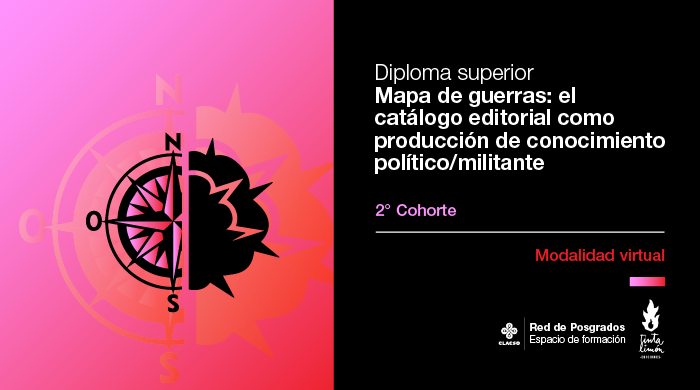
2th Cohort | Virtual Modality
COORDINATION : Diego Picotto (University of Buenos Aires, Argentina), Ezequiel Gatto (National University of San Martín, Argentina), Ignacio Gago (University of Buenos Aires, Argentina)
TEACHING TEAM: Diego Picotto (University of Buenos Aires, Argentina), Ezequiel Gatto (National University of San Martín, Argentina), Ignacio Gago (University of Buenos Aires, Argentina), Andrés Bracony (University of Buenos Aires, Argentina), Veronica Gago (National University of San Martín - CONICET, Argentina), Maurizio Lazzarato (University of Paris, France), Silvia Federici (Hofstra University of New York, United States), Rodrigo ruiz (University of Chile), Leandro Barttolotta (FLACSO, Argentina), Susana Draper (Princeton University, United States), Bruno Fornillo (CONICET, Argentina), Arturo Escobar (University of North Carolina, United States), Franco Bifo Berardi (University of Bologna, Italy), Suely Rolnik (Pontifícia Universidade Católica de São Paulo, Brazil).
Virtual format | May to September 2023
The challenge: to transform a catalog that has been evolving for almost two decades into a coherent journey woven together by a series of reading hypotheses. Not along a single line of thought, but along several: a populated map. To practice cartography and use texts, thought, and imagination to share experiences; to understand the world, to challenge it, to make room within it for new experiences. Specifically: a map for political intervention.
The publication of political essays makes this intervention explicit; not as promoters of fashionable discussions, but because we are interested in thinking about, and inviting collective reflection on, the wars in which we are all embroiled. Wars that permeate and transcend us; that surround us and explode in our hands—the ever-present every man for himself, now exacerbated by the multiplication of crises.
We are living through a violent offensive by neoliberal fascism. References to war, against diverse and mostly diffuse enemies, are incessantly repeated. Syria, but also Mexican drug cartels, the coup in Bolivia, the territorial control of mafias in Slavic countries, drone warfare in Afghanistan, Islamic terrorism, and the pervasive spread of bellicose gestures during the Trump administration.
In contexts of social upheaval, this intensifies. How can we not take seriously the issue of war and violence, which in recent decades has emerged as a model of social relations and a basis for legitimizing the global order? How can we not try to consider, in contrast, the impotence that these military offensives produce and against which, as a backdrop, we live and produce?
The overarching matrix of all power relations and techniques of domination, war is the continuation of politics and vice versa: means and ends blur their boundaries. War brings death, but above all, it must produce life: population control is indistinguishable from the reproduction of social life itself. A war, like capital, has indeterminate limits in time and space, and the enemy—the populations—is elusive, ungraspable. It blends in with the population and takes the form of civil resistance. This seminar is therefore a map of wars that also includes resistance. That is to say, a map of intensities, of points of condensation. A map that is always handcrafted, provisional. A catalog is a journey, and every worthwhile journey has detours and meandering paths, moments of anxiety and flat stretches. A map of multiplying wars requires a multiplication of maps (and weapons). War between imperialist powers around the world and war of ways of life in the neighborhoods: the city turned into a battlefield. War against the poor, against women, against Black people. War against insecurity, against inflation, against drugs, and against terrorism. War of pacification, for control of territories, the environment, and its natural resources. War of subjectivities and subjectivations, and for the regulation of behavior. War, in short, as the inevitable key to understanding the present of a world that is spiraling out of control and sweeping us away.
The Higher Diploma in War Maps: The Editorial Catalog as a Production of Political-Militant Knowledge is aimed at undergraduate and postgraduate students; teachers at all levels; activists and militants of trade union organizations, social movements and political parties; public officials; members and managers of non-governmental organizations and professionals interested in the subject.
- Diego Picotto (University of Buenos Aires, Argentina)
- Ezequiel Gatto (National University of San Martín, Argentina)
- Ignacio Gago (University of Buenos Aires, Argentina)
- Andrés Bracony (University of Buenos Aires, Argentina)
- Veronica Gago (National University of San Martín - CONICET, Argentina)
- Maurizio Lazzarato (University of Paris, France)
- Silvia Federici (Hofstra University of New York, United States)
- Rodrigo ruiz (University of Chile)
- Leandro Barttolotta (FLACSO, Argentina)
- Susana Draper (Princeton University, United States)
- Bruno Fornillo (CONICET, Argentina)
- Arturo Escobar (University of North Carolina, United States)
- Franco Bifo Berardi (University of Bologna, Italy)
- Suely Rolnik (Pontifícia Universidade Católica de São Paulo, Brazil)
The program consists of 5 modules with weekly classes, each taught consecutively and linked to the others.
The modules that comprise the advanced diploma are:
- CLASS 1: War as a key to understanding: crisis, accumulation, and strategic knowledge
Teacher: Lemon Ink -
CLASS 2: Wars and Capital
Teacher: Maurizio Lazzarato -
CLASS 3: Body, capitalism and reproduction of labor power
Teacher: Silvia Federici
-
CLASS 1: The war against the poor (and the poor against war)
Teacher: Lemon Ink
-
CLASS 2: From Locke to Piñera. Reflections from the Chilean rebellion
Teacher: Rodrigo Ruiz
-
CLASS 3: War and precarity
Teacher: Leandro Barttolotta
- CLASS 1: The war against women and current feminist struggles
Teacher: Lemon Ink - CLASS 2: Body, capitalism and reproduction of labor power
Teachers: Verónica Gago and Silvia Federici - CLASS 3: Capitalist accumulation and the war against women: key interpretations from the struggles
Teacher: Susana Draper - CLASS 1: The war for territories and the struggle for the commons
Teacher: Lemon Ink - CLASS 2: Occupation of territories, ontology and counter-narratives
Teacher: Arturo Escobar - CLASS 3: The war for territories: lithium and energy transition
Teacher: Bruno Fornillo - CLASS 1: The Sensitive War
Teacher: Lemon Ink - CLASS 2: From the micropolitics of discontent to the desire for insurrection
Teacher: Suely Rolnik - CLASS 3: Futurism and War
Teacher: Franco Bifo Berardi
| In one payment by 22/05 | In one payment after 22/05 | Payment in 3 installments | |
| CM Pleno | $175 | $230 | USD 315 (3 x USD 105) |
| CM Associate | $300 | $360 | USD 540 (3 x USD 180) |
| No link | $300 | $360 | USD 540 (3 x USD 180) |
To participate, you must register using the online form by clicking here. Registration will be open from March 6 to May 29, 2023.
Upon completion of the registration process, you will receive a confirmation in your email.
Classes will begin in May and conclude in September 2023.
All registered participants will receive the necessary instructions to access the classes, bibliography and discussion forums through the CLACSO Virtual Training Space.
Accessing and navigating the Virtual Learning Environment is very simple and user-friendly. In any case, a technical and academic support team will always be available to you.
Exceptional Criteria: In exceptional cases, and within the first month of the start of the Advanced Diploma program, students may request to withdraw from the cohort and rejoin the following year. In all cases, the reasons for the request must be submitted in writing. After this initial period, no requests will be accepted.
Money paid will only be refunded in cases where the organizing institutions decide to cancel the activity.
| In one payment by 22/05 | In one payment after 22/05 | Payment in 3 installments | |
| CM Pleno | $175 | $230 | USD 315 (3 x USD 105) |
| CM Associate | $300 | $360 | USD 540 (3 x USD 180) |
| No link | $300 | $360 | USD 540 (3 x USD 180) |
Payment can be made in one installment by credit card, bank deposit, or bank transfer. We also offer the option of paying in 3 installments.
Yes. There will be discounts for students belonging to CLACSO Member Centers and CLACSO Associated Centers, for CLACSO Associate Researchers, and for all those who pay within the discount period.
Inquiries: WhatsApp: +54 9 11 3880 – 1388
Email: [email protected]

