
Advanced Diploma in Critical Urbanism
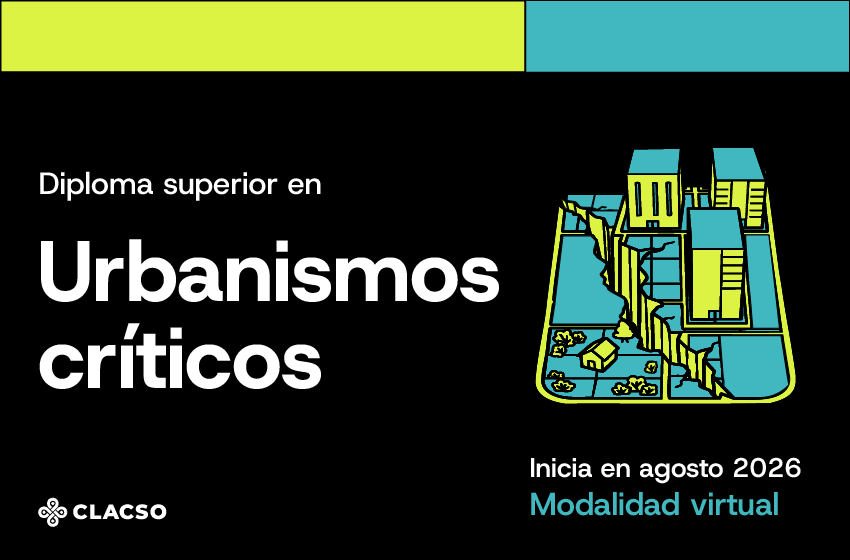
1th Cohort | Virtual Modality
ACADEMIC COORDINATION
María Gabriela Navas Perrone (Institut Català d'Antropologia / Universitat Oberta de Catalunya, Spain) | Manuel Bayón Jiménez (El Colegio de México)
PROFESSORS
María Gabriela Navas Perrone (Catalan Institute of Anthropology / Open University of Catalonia, Spain) | Manuel Bayón Jiménez (El Colegio de México) | Roberto-Luis Monte-Mor (Federal University of Minas Gerais, Brazil) | Eduardo Góes Neves (University of São Paulo, Brazil) | Monika Streule (Ibero-American University, Mexico) | Cristina Vega (FLACSO Ecuador) | Gustavo Durán (FLACSO Ecuador) | Raquel Rolnik (University of São Paulo, Brazil) | María Mercedes Di Virgilio (University of Buenos Aires, Argentina) | María Cristina Cravino (National University of Tierra del Fuego, Argentina) | Stefano Portelli (State Distance University, Spain) | Neiva Vieira da Cunha (State University of Rio de Janeiro, Brazil) | Jorge Sequera Fernández (National University of Distance Education, Spain)
Virtual format | August to November 2026
Start date : 19/08/2026 | Registration : 15/05/2026 to 18/08/2026
Critical urbanism has historically denounced the hidden mechanisms in urbanization processes, which have operated as rhetorical devices serving the commodification of space and colonial and imperialist agendas. This diploma program revisits this debate from the perspectives of Latin American ontologies and epistemologies, linking theoretical analysis with case studies on spatial and territorial reforms since the late 20th century. The program proposes a shift in focus toward power structures and their forms of spatial appropriation, as well as toward emerging forms of resistance, understood as social, collective, and everyday practices that question, overflow, or transform dominant urban logics. Through its various units, the program will analyze how current expressions of neoliberal urbanism, far from constituting a rupture, reproduce rationalities inherited from colonial, hygienist, security-focused, and utopian visions of the 19th century regarding how the city should function in service of capitalist exploitation. In this sense, the diploma program provides situated theoretical and methodological frameworks for analyzing the social, political, and economic fabric of Latin American urban production, seeking to rethink the disciplinary frameworks of urban planning practice. Finally, the program brings together academics and activists to build a situated research agenda with the aim of consolidating a working group on these topics.
The relevance of a Postgraduate Diploma in Critical Urbanism lies in the need to articulate regional debates in the face of the colonial expansion of global capitalism. This premise recognizes that, historically, urban planning has operated under a supposed technical neutrality; a mechanism that, in reality, has served imperialist interests by rendering invisible processes of accumulation by dispossession in favor of capital profitability. Given this scenario, the imperative arises to dismantle the power structures and colonial legacies that shape the cities of the region. From this perspective, Latin American urban space transcends its definition as a mere geographical category to become a field of situated knowledge production, capable of bringing together collective trajectories and responses to the threat of civilizational collapse.
To achieve this purpose, the program is structured into five modules that integrate theoretical frameworks, methodological tools, and case studies situated in various Latin American geographies.
GENERAL PURPOSE
To consolidate a space for training and situated thought that allows for critical debates on dominant urban logics from a Latin American perspective. The Advanced Diploma aims to strengthen collective capacities and provide theoretical and methodological frameworks oriented towards subverting traditional planning schemes that have perpetuated the hegemony of capital and colonial legacies in the region.
SPECIFIC OBJECTIVES
- Problematizing the technical neutrality of urban planning: Examining the genealogy of urbanism to highlight its strategic role as a rhetorical device serving the interests of colonial and imperialist agendas.
- Analyzing the commodification processes of Latin American cities: Investigating through case studies how the conversion of space into a commodity materializes from various promoting discourses that conceal the contradictions of urban morphology and infrastructure reforms.
- Investigating alternative epistemologies and ontologies: Systematizing theoretical and practical contributions from Latin America as a knowledge-producing center, integrating situated and alternative perspectives to the logics of urban planning practice in the Global North.
- Reclaiming emerging resistance practices from dwelling: Studying self-construction processes, everyday ways of inhabiting, and models of popular self-management as social and collective practices that constitute the raw material of an alternative urbanism.
- Incorporate critical methodologies from the lived experience of urban space: Incorporate ethnographic and feminist approaches as an analytical axis to make visible the networks of reproduction of life and their interaction with urban production.
- To promote the consolidation of a working group in Critical Urbanisms: To promote an interdisciplinary working network that allows the articulation of a situated research agenda, oriented to the study of Latin American urban transformations from a critical perspective.
The Higher Diploma in Critical Urbanism is aimed at undergraduate and postgraduate students; teachers at all levels; activists and members of trade unions, social movements and political parties; public officials; members and managers of non-governmental organizations and professionals interested in the subject.
The program consists of 5 modules of 3 weekly classes each, taught consecutively and linked together.
Total workload of 128 hours.
The modules that comprise the Higher Diploma are:
- Class 1: Hygiene and social control: Trajectories of exclusion in the Latin American city
Teacher: María Gabriela Navas Perrone
This session examines the persistence of hygiene as a medical-social mechanism in shaping the modern Latin American city. It problematizes how urban reforms have historically revived control mechanisms aimed at segregating and disciplining popular sectors under the rhetoric of order and public health. The objective is to demonstrate that the invisibility of the spatial practices of Indigenous populations and others linked to informality—in contrast to the Eurocentric civilizational ideal—is not a vestige of the past, but rather an operational logic underlying current urban transformations. This continuity manifests itself in policies of social cleansing of public space, where the discourse of hygiene and order is instrumentalized to eradicate the dynamics of the informal economy and displace those who do not conform to the standards of a perfectly planned city. - Class 2: Epistemologies and Ontologies of Latin America: Towards a Situated Urban Theory
Teacher: Manuel Bayón
This session will explore how the philosophies of Abya Yala cultures imply alternative ways of thinking about, planning, and inhabiting urban spaces. Drawing on an analysis of the ontological turn spearheaded by Latin American critical anthropology and the debates sparked by epistemologies from the Global South, the session will introduce the spatial knowledge and representations of diverse cultures. This will allow for a rethinking of how to understand cities from the perspective of the multiple ontologies that comprise them, within a South-North dialogue. In this way, urban-popular proposals such as the social production of habitat and multilocality can be understood from this perspective. Finally, the session will delve into the political proposals emerging from communities for alternative territorial planning. - Class 3: The plurinational city against colonial racism
Teacher: Eduardo Góes Neves
This class offers a critique of hegemonic Western urbanism based on the contributions of Amazonian archaeology and the territorial knowledge of Brazil's Indigenous peoples. It challenges the notion that the city, planning, and social complexity are exclusively products of Western modernity. Through the study of Amazonian anthropogenic landscapes—such as terra preta, networks of interconnected villages, and pre-colonial hydraulic infrastructures—the class analyzes forms of decentralized, relational, and ecologically integrated urbanism. These Indigenous experiences allow for a rethinking of key categories of contemporary urbanism, such as density, infrastructure, sustainability, and territorial governance. The session invites participants to decolonize urban thought, recognizing Indigenous historical agency and the enduring relevance of their knowledge in the face of the current environmental and urban crisis.
- Class 4: The city as a commodity: Dynamics of dispossession, touristification and securitization in Latin America
Teacher: Raquel Rolnik
This session examines the financialization and colonization of urban space in Latin America, addressing the issue of housing as a financial asset and the operation of capital markets on the territory. It analyzes how urban development deploys mechanisms of accumulation by dispossession that result in the displacement of vulnerable populations, the conversion of neighborhoods into tourist attractions, and the implementation of a wartime urbanism based on securitization and social control. Through this framework, the rhetoric of urban regeneration is demystified to reveal a territorial management strategy that prioritizes the profitability of transnational capital and the legal insecurity of residents, transforming the right to the city into a battleground for the reproduction of exchange value. - Class 5: Urban sociabilities from the kaleidoscope of mobility
Teacher: María Mercedes Di Virgilio
This course analyzes how residential and daily mobility shape urban inequality in Latin American cities. It examines the housing trajectories of middle and lower-income sectors, exploring how relocation decisions and daily commutes for work or education are conditioned by the land market, housing policies, and unequal access to urban resources. Through a mobility-focused approach, it becomes clear that far from being isolated processes, these territorial practices often reinforce patterns of socio-spatial segregation, making the study of movement a key tool for understanding the architecture of well-being in the city. - Class 6: Green Urbanism and Residual Urbanization
Teacher: Gustavo Durán
This class offers a critique of so-called “green urbanism” through an analysis of contemporary Amazonian urbanism, problematizing the relationship between extractivism and urbanization, where nature is a primary commodity and Amazonian cities a residual product. Drawing on Gustavo Durán's research in the Amazon, the class examines how discourses of sustainability, resilience, and nature-based solutions are incorporated into planning that, far from reversing environmental destruction, exacerbate it through the application of policies that legitimize urban growth divorced from Amazonian social relations. The class analyzes green infrastructure, road corridors, and territorial plans in the Amazon as technical and political devices that reorganize the territory according to extractive economic interests. In response, critical alternatives are discussed that incorporate situated territorial perspectives, political ecologies, and non-instrumental approaches to the relationship between urbanism, nature, and social life.
- Class 7: The informal city as resistance
Teacher: María Cristina Cravino
This session addresses the social production of habitat as a field of political struggle, analyzing self-construction not only as a response to exclusion, but also as an act of resistance that challenges the logic of private property and reclaims collective ways of living. Through a comparative and diachronic analysis of public policies in Latin America, the class examines the transition between land regularization and comprehensive urbanization, contrasting paradigms of state intervention with the actual trajectories of informal settlements. By integrating the dimensions of daily life and community organization, a critical understanding is proposed of how working-class communities produce urban life in contexts of structural inequality, neoliberal governance, and socio-spatial fragmentation. - Class 8: Technosustainability and platformization of urban sociability
Teacher: Jorge Sequera
This session critically examines the role of technological innovation and sustainability in the production of the contemporary neoliberal city. Devices such as artificial intelligence, digital modeling, and new construction solutions are presented today as inevitable responses to the exhaustion of traditional planning, under promises of efficiency, equity, and humanism. However, this rhetoric masks the reproduction of historical logics of control and dynamics of capital valorization. Far from a radical break, these approaches often deepen urban commodification under a façade of technical modernity. In the face of this hegemony, the session highlights emerging resistances: a set of social and collective practices that, from the everyday life of the territory, manage to overflow or rearticulate the imposed techno-sustainable frameworks. - Class 9: Extended Urbanization in Latin America
Teacher: Roberto Luis Monte-Mor
This class addresses the concept of extensive urbanization as key to understanding the contemporary transformation of peripheral territories in Latin America. Urbanization is analyzed not as a phenomenon limited to the compact city, but as a process that expands over rural, forestry, and extractive regions, functionally integrating them into the urban-industrial logic. The class focuses on the explosion-implosion dynamic described by Lefebvre: while certain urban spaces densify and concentrate capital, other territories are absorbed as supports for circulation, extraction, logistics, and social reproduction. From this perspective, infrastructures, expansion frontiers, and peripheral economies are examined as material expressions of extended/extensive/planetary urbanization. The session proposes a critical reading of regional planning and development, questioning urban-rural dichotomies and highlighting the socio-spatial conflicts and possibilities produced by the uneven expansion of the urban process.
- Class 10: Critical Cartographies and Conflict Visualization Instructor: Manuel Bayón Jiménez. To understand urban processes from different perspectives, it is necessary to think about and produce spatial representations using different frameworks. This session aims to show examples where the dynamics of urban sprawl can be depicted from different viewpoints and with different objectives. Based on this, it proposes a practical exercise to give graphic and spatial expression to the research and activism needs present in the classroom. Methodologies for managing alternative data and mapping what power renders invisible—popular economies, invisible borders, and territorial dispossession—will also be analyzed. To this end, some theoretical ideas will be presented, as well as the work that various collectives within critical and social geographies have carried out throughout Latin America and other regions.
- Class 11: Ethnographies of urban life Instructor: María Gabriela Navas Perrone. This session explores the dimension of inhabited space, with particular attention to informal logics and unforeseen uses that escape the traditional perspective of urban planning. An ethnographic approach to the study of the urban is presented, understood as the dimension closest to daily life and the radical expression of socialized space. Emphasis is placed on the subversive and poetic nature of spatial practices, presenting the methodological challenges involved in studying urban life in cities.
- Class 12: Mobile Ethnographies Instructor: Monika Streule. This methodological class introduces mobile ethnographies as an approach to the critical study of the contemporary city in Latin American urban contexts. The session proposes a shift from analyzing fixed places to following the trajectories, rhythms, displacements, and everyday practices that produce urban space. Through walks, journeys on public transport, informal tours, and accompanying urban actors, mobile ethnography allows us to capture how the city is experienced, negotiated, and fragmented in motion. The class discusses methodological tools—mobile field journals, situated cartographies, sensory records, and spatial narratives—as well as their ethical and political implications. This approach challenges static views of urbanism and opens possibilities for understanding inequalities, borders, and urban conflicts from the lived and situated experience of movement.
- Class 13: Self-management of conflicts and coexistence in urban peripheries Instructor: Stefano Portelli. This class proposes a detailed observation of daily life in urban peripheries, an understanding of micro-political conflicts, and the articulations and intersectionality between religious, social, and economic differences. This allows us to understand how inhabiting stigmatized or marginalized territories involves a series of established techniques, developed collectively, for managing conflict and coexistence. It examines how, similarly to colonial processes, the delegitimization of popular culture is used to favor extractive and commodification policies that prioritize capital over community life. Through ethnography and a close examination of everyday micro-dynamics, the aim is to decode the systems of self-regulation and unconventional forms of cohabitation that remain invisible beneath discourses of stigmatization and marginalization.
- Class 14: The right to the city from Latin America Instructor: Neiva Vieira da Cunha. This session analyzes the right to the city in Latin America as a tool for political insurgency and the social production of space, extending beyond the legal realm. Through ethnography in working-class neighborhoods, it examines how communities resist urban extractivism and forced displacement through collective action and the management of daily life. The focus is on activating the right through practice, where subaltern groups negotiate with the state and transform survival into radical forms of citizenship and territorial sovereignty in the face of violence and stigma.
- Class 15: Social Reproduction and the Feminist City Instructor: Cristina Vega. This class addresses social reproduction in urban space from a feminist and political economy perspective. The session analyzes how cities are sustained daily through care work, affection, and the reproduction of life, which remain largely invisible due to urban planning and public policies. It examines the spatial organization of care—housing, mobility, services, neighborhoods—and how this reproduces inequalities of gender, class, ethnicity, and immigration status. Drawing on empirical studies in Latin America, it explores how the care crisis is territorially inscribed in the city, generating differential burdens and unequal access to rights. Finally, it proposes rethinking urbanism and planning from the perspective of the sustainability of life, questioning productivist urban models and opening the debate toward urban policies centered on social reproduction and spatial justice.
- Maria Gabriela Navas Perrone (Institut Català d'Antropologia / Universitat Oberta de Catalunya, Spain)
- Manuel Bayón Jiménez (The College of Mexico)
- Roberto-Luis Monte-Mor (Federal University of Minas Gerais, Brazil)
- Eduardo Góes Neves (University of São Paulo, Brazil)
- Monika Streule (Ibero-American University, Mexico)
- Cristina Vega (FLACSO Ecuador)
- Gustavo Durán (FLACSO Ecuador)
- Raquel Rolnik (University of São Paulo, Brazil)
- María Mercedes Di Virgilio (University of Buenos Aires, Argentina)
- María Cristina Cravino (National University of Tierra del Fuego, Argentina)
- Stefano Portelli (State Distance University, Spain)
- Neiva Vieira da Cunha (State University of Rio de Janeiro, Brazil)
- Jorge Sequera Fernández (National University of Distance Education, Spain)
| Early registration (until 07/07) | General registration (May 6th to May 12st) | Registration without discount (13/08 to 19/08) | Payment in 3 installments | |
| Full or Associate Member Center | $190 | $260 | $340 | USD 420 (3 x USD 140) |
| No Link | $340 | USD 410 | $460 | USD 630 (3 x USD 210) |
* Residents of Argentina will pay the equivalent in Argentine pesos according to the official exchange rate of the Banco de la Nación Argentina (BNA) on the day of payment.
You must be registered in the CLACSO Single Registration System (SUIC) and enter your username and password. If you are not registered, click here . To access the registration form, click the "Register" button on the webpage of the Diploma program you are interested in.
Upon completion of the registration process, you will receive a confirmation in your email.
Classes will begin in August and will conclude in December 2026.
All registered participants will receive on the first day of activities the necessary instructions to access the classes, bibliography and discussion forums through the CLACSO Virtual Training Space.
Accessing and navigating the Virtual Learning Environment is very simple and user-friendly. In any case, a technical and academic support team will always be available. For inquiries, you can write to [email protected]
You must send an email with the request to [email protected] and we will send you the requested certificate as soon as possible.
Exceptional Criteria: In exceptional cases, and within the first 20 days of the start of the Advanced Diploma program, students may write to [email protected] requesting to withdraw and stating the reasons. After evaluation of the case, a response will be sent to the request. If approved, the student may resume the Advanced Diploma program if a new cohort is offered the following year. After this period has elapsed since the start of the course, no requests will be accepted.
Money paid will only be refunded in cases where the organizing institutions decide to cancel the activity.
Yes, the advanced diploma is certified by CLACSO. The diploma will be sent digitally and is completely free of charge.
Payment can be made in one installment, by credit card or bank transfer. We also offer the option of paying in 3 installments.
Yes. There will be discounts for students belonging to CLACSO Member Centers and CLACSO Associated Centers, for CLACSO Associate Researchers, and for all those who pay within the discount period.
You can check if you belong to a member center here:
The Advanced Diploma program integrates a dynamic of asynchronous and synchronous classes. Classes are primarily asynchronous. The schedule for synchronous sessions will be communicated by the Diploma coordinator at the beginning of the program, and participation in these sessions is not a prerequisite for passing the program.
Inquiries: WhatsApp: +54 9 11 3880 – 1388
Email: [email protected]

